RESEARCH WEEKLY: Transparency on the Front Lines – Part 1
(Feb. 23, 2016) We who are patients, caregivers and professionals live on the front lines of mental health progress - or lack of it. We are impacted daily by advances in diagnosis, treatment, services and all the other aspects of living or working with chronic psychiatric diseases. Yet we are more often than not the proverbial "last to know" about new studies and findings about these conditions.
 This gap between evidence and practice too often leaves us woefully underequipped for the life-and-death battles we fight. As a member of the Treatment Advocacy Center team, I am blessed with routine access to brain and behavior research. Nevertheless, I continue to come across information I'd never seen when I was supporting my own daughter's losing war with terminal mental illness. This gap between evidence and practice too often leaves us woefully underequipped for the life-and-death battles we fight. As a member of the Treatment Advocacy Center team, I am blessed with routine access to brain and behavior research. Nevertheless, I continue to come across information I'd never seen when I was supporting my own daughter's losing war with terminal mental illness.
Researchers are on the front lines, too. At the National Institute of Mental Health (NIMH), in laboratories and at regulatory agencies, researchers theoretically are positioned to be the first to know what reaches end users so many years - sometimes decades - later. Yet they, too, face hurdles to research access - and their challenges make the challenges on our front lines even greater.
Transparency on the Scientific Front Lines
The International Society for CNS Clinical Trials and Methodology (ISCTM) is made up of more than 300 members who focus on diseases of the central nervous system such as schizophrenia, bipolar and other mood disorders, Alzheimer's and Huntington's Disease. At their annual scientific meeting February 16-17 in Washington, D.C., the group devoted an afternoon to issues in data transparency on both their front lines and ours.
Mark Weiser, chair of the department of psychiatry at Tel Aviv University and associate director for treatment trials for the Stanley Medical Research Institute (SMRI), has been analyzing the publication rates for clinical trials conducted with funding from SMRI, the largest private funder of research into the causes and treatment of schizophrenia and bipolar disorder in the U.S.* Clinical trials test how proposed new treatments work in patients.
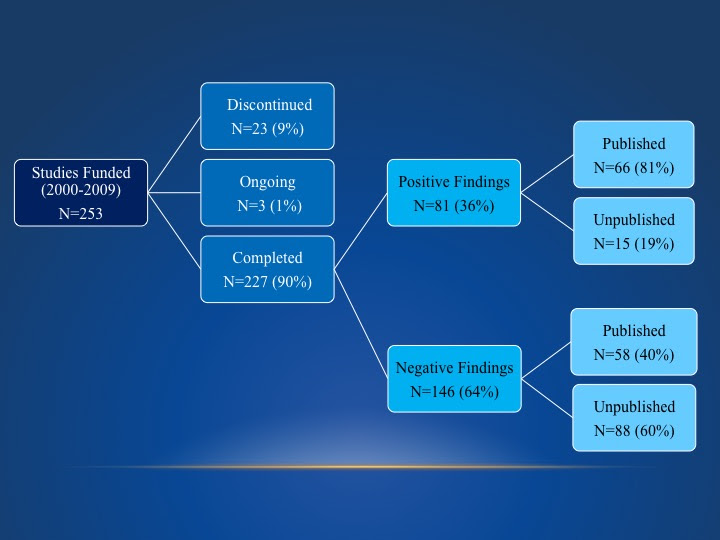
Of 253 clinical trials funded by SMRI from 2000 to 2009 and completed, Weiser found, publication rates barely topped 50% per year on average (54.6%). The greatest likelihood of publication was for "positive" studies - those that validated the theory under investigation. Yet most of the completed studies (64%) had "negative" results - meaning the findings did not support the theory being tested - and less than half of those (40%) found publishers (see chart).
"Bad for Everyone"
"This is bad for everyone," Weiser told the audience. "We get up in the morning scratching our heads about how we are going to help patients, and it's very bad if something already has been found not to work, but that information is not available." Unnecessary exposure of patients to study procedures or placebo and wasted funds that might be used for more effective treatments are among the results, he said. The fact that non-publication and positive-finding publication bias are issues in non-psychiatric specialties doesn't make them any less problematic, he said.
Moreover, the results of a majority of even the positive studies (53%) were not reproduced in a subsequent study, a critical benchmark for validity. The average time from the completion of a study to its publication was approximately two years, which meant that even if a treatment had positive findings and a journal accepted it for publication, other scientists - and the public - went on without the benefit of them for an extended time.
Some measures and market developments in recent years have improved access to both positive and negative data for scientists and the rest of us. Those will be the subjects of Transparency on the Public Front Lines - Part 2 on March 8.

Doris A. Fuller
Chief of Research and Public Affairs
* Stanley Medical Research Institute is a supporting organization of the Treatment Advocacy Center.
References:
- Weiser, M. "Improving transparency of clinical trial data." ISCTM 12th Annual Scientific Meeting. The Fairmont, Washington, DC. 16 February 2016. Conference presentation.
Next Week: February Roundup
Research Weekly is a summary published as a public service of the Treatment Advocacy Center and does not necessarily reflect the findings or positions of the organization or its staff. Full access to research summarized may require a fee or paid subscription to the publications.
To comment, visit our Facebook page.
Visit our blog archive to read all our recent posts.
Police Cleared in Fatal Shooting of Mentally Ill Man Agree he Needed Help
(Feb. 22, 2016) In another strike against mental illness, St. Paul police were justified in the fatal shooting of a man diagnosed with schizophrenia in the midst of a psychotic break last September, said a Ramsey County grand jury last week (“Grand jury clears St. Paul cops in fatal September shooting,” MPR, Feb. 18).
 The officer who shot Philip Quinn will not face criminal charges, Ramsey County Attorney John Choi announced at a news conference last Thursday, a day after the grand jury reached its conclusions. The officer who shot Philip Quinn will not face criminal charges, Ramsey County Attorney John Choi announced at a news conference last Thursday, a day after the grand jury reached its conclusions.
"This was a tragic event” for Quinn's family and for the officers involved,” said Police Chief Tom Smith. "There are times when we have to defend ourselves and others. [The] officer was put in a terrible situation. He did everything he was trained to do, and still had no other choice in this situation."
Smith said police had received several concerning calls throughout the day of September 24, 2015 from Quinn's family. Quinn's girlfriend had called 911 saying Quinn was acting "bizarre, psychotic," and Quinn’s mother said he had stabbed himself numerous times with a screwdriver and believed that he had died and come back to life.
Once police arrived on the scene, Quinn ran out of the garage directly at an officer in a "very aggressive manner" wielding a screwdriver.
In the dashcam video released last week, an officer can be heard shouting at Quinn to drop the object. But, police say Quinn ignored the officer’s commands and charged at him until he was forced to fire.
Quinn's family said they called 911 that day hoping police would come and help their loved one in crisis. They believe officers should have and could have taken a different approach because they knew Quinn was mentally ill.
Smith agreed with the Quinn family that he had clearly needed help with his mental illness.
"If Philip Quinn would have had the opportunity to have an open bed and to get some help, this tragedy probably would not have occurred," Smith said.
Tragedies like this are remarkably common. A recent report on the role of mental illness in fatal law enforcement encounters found that people with untreated mental illness are 16 times more likely to be killed during a police encounter than other civilians approached or stopped by law enforcement.
We must collectively recognize this as wholly unacceptable and restore the mental health system so that individuals with severe mental illness are not left to deteriorate until their actions provoke a police response.
To comment, visit our Facebook page.
Visit our blog archive to read all our recent posts.
Law Enforcement Face Increasing Burden of Failed Mental Health System
(Feb. 19, 2016) Two recent developments in California and Washington state highlight the impact that the policies of our failed mental health system have on the day-to-day work of law enforcement. By failing to help those most in need, our mental health system has effectively made police and sheriffs the front lines of mental health care in America.

In Washington state, a federal monitor reported being impressed with the Seattle Police Department’s (SPD) efforts to implement Crisis Intervention Teams and training throughout its ranks. Per the report, the influx of CIT-trained officers has led to low levels of use of force against individuals in crisis and strong efforts by SPD officers to guide people in crisis into the social service system, as opposed to arresting and jailing them. We are pleased to see Seattle embrace crisis intervention training as a means of deescalating crisis situations and diverting those in need away from the criminal justice system whenever possible.
While we are pleased to see the progress of Seattle’s law enforcement, one aspect of the report highlights a troubling reality – Seattle’s law enforcement is still being asked to deal with individuals in crisis far too often. Per the report, the SPD is on track for around 10,000 crisis contacts with individuals with a mental illness annually, or about 27 a day. For a police force of only about 1,300 total officers, that means that, for many officers, assisting those with a mental illness amounts to a full-time job.
In San Diego, the local chapter of the ACLU recently joined other organizations to call for the U.S. Department of Justice to open an investigation into alleged incidents of excessive force by the San Diego Police Department (SDPD) against people suffering a mental health crisis. In response to the letter, San Diego Police Chief Shelley Zimmerman said that “the number of mental health calls her department receives has skyrocketed” and that San Diego Police Officers “responded to over 18,000 mental health calls for service last year alone - a 100% increase in the last seven years.”
Theresa Bish, former chair of the San Diego County Mental Health Advisory Board, addressed the mental health system’s culpability, saying, "some of the liability rests with county Mental Health Services." She pointed out that the man whose death at the hands of SDPD occasioned the letter was known to the county, but a lack of services and legal tools for his family meant he went on-and-off treatment. San Diego’s newly passed Laura’s Law provisions might have prevented the incident and subsequent shooting, but weren’t in place at the time.
We applaud communities across the country for embracing important measures like CIT training to ensure law are as equipped as possible to deal with individuals in the throes of a mental health crisis. But even as we do, we must always recognize that the real solution is to hold mental health systems accountable and ensure those who need care receive it before they are in crisis and before law enforcement is needed.
To comment, visit our Facebook page.
Visit our blog archive to read all our recent posts.
“My Son is Trapped in an Indifferent System” — personally speaking
(Feb. 18, 2016) My son, Dwayne, was diagnosed with bipolar disorder twenty-four years ago. He is one of the most talented, creative, artistic, patient, and sincere people you would ever meet. He has a heart of gold and loves anyone that half-way loves him – unconditionally.
 Dwayne is currently in the Virginia mental health system and it has been a nightmare trying to get him the help that he needs to recover. Dwayne is currently in the Virginia mental health system and it has been a nightmare trying to get him the help that he needs to recover.
Our son was living with us along with his two children in late 2012 when he began having trouble sleeping and began talking irrationally. I called the local crisis intervention services office. They told me there was nothing they could do unless he was trying to hurt or kill himself or hurt someone else.
One night, his girlfriend told him that he had to leave. After leaving the house, he walked to a nearby house, opened the unlocked basement door, went inside and sat there with the lights on. We are not sure how long he was there before the family came home. The police were called. Dwayne was very confused and could not explain why he was there.
My son was arrested, taken to jail and charged with breaking and entering to commit a burglary. He spent two months in jail without medication. I told them he was a mentally disabled person and that he had been diagnosed with bipolar disorder. I tried to get him medication and treatment.
Despite my pleas, Dwayne’s health continued to deteriorate during the two months while he was waiting for a hearing. By this time, he had become incoherent and could not figure out what to do or why this was happening.
At the hearing, Dwayne was declared “not guilty by reason of insanity.”
In September 2015, Dwayne was granted a conditional release and sent to stay at a group home in Lebanon, VA. Soon after he settled in, we noticed during a visit that Dwayne did not seem as stable.
I called the group home to let the folks there know our concerns. The woman supervising the home told me she had been concerned ever since the psychiatrist had reduced his medicine. I was not aware that his medicine had been reduced. I told her that cutting his medicine in half was bound to trigger a mental breakdown, which is what seemed to be happening. We found out later that he had been pretending to take that lower dose.
Four days later, Dwayne went missing from the group home. I became frantic. My husband called to let me know the police were searching our house.
When Dwayne returned to the group home shortly after, I raced over to speak to him.
“God healed me, I do not need the medicine,” he said.
A few moments later, the police came and I watched them handcuff him, put him in the back seat of the police car, and take him back to jail.
Days turned into weeks and then a month went by. I was told that Dwayne would stay in jail until his next court hearing.
On January 27, 2016, my son was finally transferred back to the hospital from the jail.
I am so frustrated. My son is sick. He is not a criminal. Yet now he is trapped in a system that treats him with indifference and refuses to listen to those of us who love him.
DIANA STINSON
VIRGINIA
Read the entire story here.
To comment, visit our Facebook page.
Visit our blog archive to read all our recent posts.
“Tim’s Law” Aims to Stop the Revolving Door of Untreated Mental Illness in Kentucky
(Feb. 17, 2016) Tim Morton would enter a psychiatric hospital, stabilize and then get released. But because he didn’t believe he had schizophrenia – a condition known as anosognosia – he would inevitably stop taking his prescribed medication and spiral downwards until he became dangerous enough to require hospitalization again.
 In 2014, at 54 years old, he passed away from long-neglected health problems. In 2014, at 54 years old, he passed away from long-neglected health problems.
Before his passing, Tim Morton was involuntarily hospitalized for psychiatric treatment thirty-seven times over the course of his long battle with mental illness.
Kentucky has an assisted outpatient treatment (AOT) law, but advocates for people with severe mental illness have said the law is not usable as-is for most people who need treatment, ensuring that they will deteriorate until the point where they require inpatient hospitalization – bypassing the option of treatment in the community altogether.
Now, a proposed bill in Kentucky’s Legislature, House Bill 94 - named “Tim’s Law” - would modify the state’s assisted outpatient treatment (AOT) law so that it can help people like Tim before they hit rock bottom and require inpatient hospitalization (“Involuntary treatment weighed for mentally ill,” Courier Journal, Feb. 12).
HB 94 would finally bring Kentucky’s AOT law into line with how other states design their AOT programs – requiring a mental health case manager who would monitor the person’s progress. If the person fails to comply, the judge could order the person to be re-hospitalized.
Joann Strunk said such a measure could have helped her daughter, Sarah, 28, who has long battled schizophrenia. She was often not enough of a danger to herself or others to be involuntarily committed to a hospital, which left Strunk unable to intervene before problems exploded.
“If I had had a way of keeping her in treatment and taking her medication when she turned 18 – she might not have deteriorated in the years that followed," Strunk said.
The bill would also help people recently released from a psychiatric hospital. Kentucky law currently provides no real follow-up treatment ordered to keep someone on medication after discharge, perpetuating the cycle of hospital recidivism.
“If successful, House Bill 94 would help the most severely mentally ill out of the revolving door of jails and psychiatric hospitals,” said Sheila Schuster, executive director of the Kentucky Mental Health Coalition, which supports the bill.
Tim’s Law would make great improvements to the state’s mental health system and allow the most severely ill Kentuckians – those too sick to realize they need help – to access the treatment they so desperately need.
To comment, visit our Facebook page.
Visit our blog archive to read all our recent posts.
RESEARCH WEEKLY: Emergency in the ER
(Feb. 16, 2016) The findings of a recent survey of emergency room physicians will come as no surprise to anyone who has been or accompanied someone in psychiatric crisis to an emergency room.
More than 8 in 10 emergency room physicians surveyed by the American College of Emergency Physicians (ACEP) in 2015 said the mental health care system was not working for the patients in their region, leading to more psychiatric patients in hospital ERs waiting longer to see doctors.
90% of ERs are boarding patients
According to ACEP:
- "Nearly 9 in 10 emergency physicians reported psych patients were being 'held' in their emergency departments" - a practice known as "boarding."
- 91% of the responding doctors reported the practice led to "distracted staff, bed shortages or violent behavior by distressed psychiatric patients, all of which may harm patients or health care staff or both."
- Long waits in hospital ERs "do not help patients in psychiatric crisis and sometimes actually exacerbate the problem."
ACEP reports that 4% of all visits to emergency rooms each year are made by people in psychiatric crisis because of insufficient mental health resources in communities, particularly hospital beds. "Psychiatric patients may wait DAYS in an emergency department until a psych bed becomes available," ACEP said in a statement. In a 2014 review of the literature on psychiatric patient care in the ED, the organization reported "one study has demonstrated that 70% of institutions have to board psychiatric patients for more than 24 hours and 10% for a week or more."
More Psych Patients with Worse Symptoms
Arica C. Jesper et al. set out to quantify these impacts by examining the emergency department of an academic university hospital in Sacramento, California, when the county eliminated 50 of the 100 beds in a public inpatient facility and closed the facility's outpatient unit. The results starkly illustrate what the emergency physician survey responses.
Comparing ER use at the university hospital in the eight months before the beds and outpatient facilities were closed and the eight months following, the researchers found:
- The number of ER visits requiring psychiatric consultation tripled after the county cut its inpatient bed numbers in half.
- The average time psychiatric patients spent waiting to be seen by a psychiatric clinician increased from an average of 14 hours to nearly 22 hours.
- The average number of psychiatric patients held in the ER longer than 24 hours skyrocketed from 28 patients in the eight months before the county closures to 322 in the eight months afterward.
- The number of psychiatric consultations when the most serious symptoms of psychiatric crisis - assaultive or suicidal behavior - were the chief complaint ballooned from 58 to 283. The number of patients presenting with hallucinations shot from 18 to 79.
- A smaller percentage of the patients - who now included more severely ill patients - were ultimately transferred to hospital beds; more were discharged home instead.
- The number of hours per day that psychiatric patients occupied bed space in the ER rose from approximately 18 hours to 97 hours, substantially affecting the flow of other patients through the ER. Care for as many as 13-20 non-psychiatric patients may have been delayed or "displaced" as a result.
Toward Better Practices
"With the unique responsibility to care for every patient and serve as a safety net, the ED is particularly influenced by changes in community resources," the authors wrote. The paper noted that the Washington State Supreme Court already has found the boarding of psychiatric patients in the ED to be unconstitutional and projected that legal action elsewhere "will likely have an important influence on the care of psychiatric patients in the ED" going forward.
"Boarding is a significant problem in emergency medicine," the emergency physicians group summarized in its 2014 literature review. "For psychiatric patients, the problem is significantly worse, with psychiatric patients remaining in the ED far longer than medical patients. Research indicates that boarding negatively affects patient quality of care, hospital operations and the system's finances.
Labeling the situation a "national disconnect," Elizabeth M. La et al. from Duke University in December 2015 proposed an evidence-based computer model for calculating the supply of hospital beds needed to reduce ER stays in one region of North Carolina. ACEP advanced eight best practices for reducing the number of psychiatric patients presenting in emergency rooms, including the use of "psychiatry ED observation" units where patients in mental health crisis may be kept "in a quiet environment separate from the chaotic environment of the main ED." Any number of practices exist to reduce the emergency in America's emergency rooms. What is lacking is implementation.
Doris A. Fuller
Chief of Research and Public Affairs
References:
Next Week: Why Data Transparency Matters for Patients, Families and the Public
Research Weekly is a summary published as a public service of the Treatment Advocacy Center and does not necessarily reflect the findings or positions of the organization or its staff. Full access to research summarized may require a fee or paid subscription to the publications.
To comment, visit our Facebook page.
Visit our blog archive to read all our recent posts.
“My Dad Killed Himself When I was 13. He Hid His Depression. I Won’t Hide Mine” – guest commentary
(Feb. 11, 2016) When you walk into the laundry room and find your father hanging, you know that life is never going to be the same. That is a sight you can’t unsee and a pain you can’t unfeel.
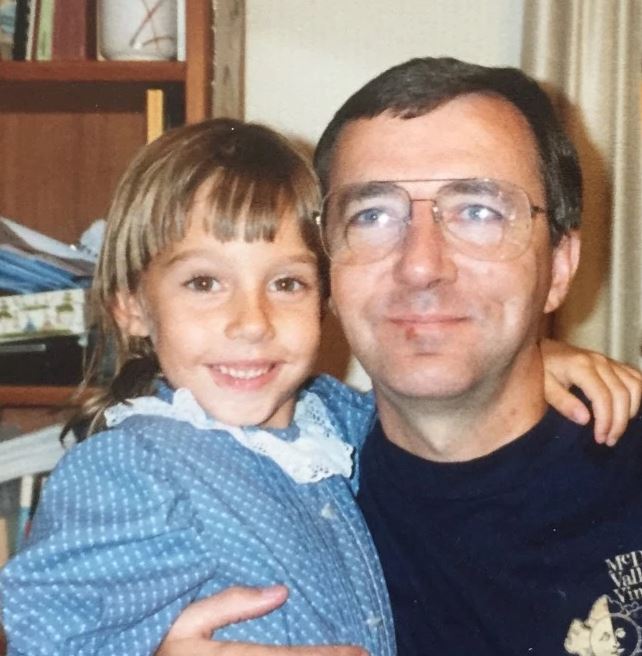 I was 13 years old and I didn’t know about depression, didn’t know that my dad had struggled silently with his mental health for years. I didn’t know the name for what started to change him. Why he became so tired, so withdrawn. Why he seemed weighed down with a heavy sadness. I was 13 years old and I didn’t know about depression, didn’t know that my dad had struggled silently with his mental health for years. I didn’t know the name for what started to change him. Why he became so tired, so withdrawn. Why he seemed weighed down with a heavy sadness.
Wrung with a fear that I couldn’t name I finally asked him, “Dad – what’s wrong?” His blue eyes clouded over as he said, softly, “I…don’t feel good.” Needing to know more, I asked, “When are you going to feel better?” He said nothing as his eyes filled with tears. I had never seen him cry before and it scared me. I raced out of the room and slammed the door like the teenage girl that I was. I expected him to follow, to explain.
He never did. Three days later, he was gone. My childhood ended and I became a survivor of suicide loss and a trauma victim.
From my 13-year-old perspective depression was to blame. I viewed it as an unstoppable evil, not a mental illness. As he had become increasingly and more obviously sick our family never discussed it.
Through my teens and twenties I carried that pain inside of me like a sleeping dragon – I knew it was in there and I tried my best not to wake it up.
Finally, at the age of 31, the sleeping dragon woke up. Under the advice of a doctor I tapered off my antidepressants in the hopes of getting pregnant.
After six months of struggling through withdrawal and becoming more and more depressed I bottomed out. I felt myself losing control – the sadness and anxiety and shame and trauma of the past 18 years seemed to hit me with the force of a tsunami.
That first panic attack was the beginning of a long and slow dive into a year-long mental health crisis. I often thought that I had descended into hell and I didn’t know how to come back. Unable to stabilize and feeling unsafe I checked myself into a psychiatric hospital. Twice. I spent nearly six months in a partial hospitalization program. Once again my whole life changed.
Getting so sick forced me to accept that depression and anxiety are real illnesses – not my flaws and not my fault. I found that treatment was helping me and that recovery was possible. I dug deep and finally accepted that I could live with depression. I could cope with anxiety. I came to see that depression didn’t have to end with suicide. And growing into these truths helped me to find compassion for my dad.
Hear me now: I’m not ashamed of his life or his mental illness or his suicide. The burden of silence ends with me.
AMY MARLOW
RESTON, VIRGINIA
The full version of this story was originally published in the Washington Post. Amy McDowell Marlow is a 20-year survivor of suicide loss and lives with depression and generalized anxiety disorder. She writes about her journey through mental illness at www.bluelightblue.com.
To comment, visit our Facebook page.
Visit our blog archive to read all our recent posts.
MOMENTUM IS BUILDING
If a year ago we had told you that there would be strong bipartisan proposals in the House and the Senate to help people with severe mental illness, you probably would have thought it impossible. But right now there are four reform bills gaining support in both chambers.
If a year ago we had told you that President Obama, Vice President Biden, Majority Leader McConnell, and Speaker Ryan would meet at the White House and discuss mental health reform, you likely wouldn't have believed me. But they did just that last week.
If a year ago we had told you the U.S. Senate Judiciary Committee would hold a hearing on the failures of the mental health system and highlight assisted outpatient treatment as part of the solution, you would have said we're being too optimistic. But they did just that this morning.
But here we are...
The time to win the fight for mental health reform is NOW. Make a donation today to support the Treatment Advocacy Center and together we will eliminate the barriers to treatment for people with severe mental illness.
New Bill Sends Mentally Ill to Jail, Even if They Haven’t Committed a Crime
(Feb. 10, 2016) An outrageous new bill would allow Maine’s Department of Health and Human Services to send people with mental illness to a prison unit instead of a psychiatric hospital (“Advocates: Bill punishes mentally ill found not guilty of crimes,” MPBN, Feb. 1).
 “This particular bill is focused on a very small percentage of forensic patients that exceeds the hospital’s ability to treat them,” said DHHS Commissioner Mary Mayhew, in defense of the proposal. “This particular bill is focused on a very small percentage of forensic patients that exceeds the hospital’s ability to treat them,” said DHHS Commissioner Mary Mayhew, in defense of the proposal.
Mayhew believes the more difficult patients would be better served at a 32-bed mental health unit within the Maine State Prison. Such patients often require an immense amount of resources to manage and treat, which comes at the expense of other patients, she said.
But advocates for people with mental illness are outraged by the proposal, arguing that it criminalizes mental illness and punishes people who have done nothing wrong.
The American Civil Liberties Union of Maine says the bill goes against everything the justice system stands for -- Maine is “treating” mental illness through incarceration.
We couldn’t agree more. This is an area of civil-rights we have gone completely backwards on.
What is the real solution?
We need to restore public psychiatric beds.
Maine maintains a shockingly insufficient number of public psychiatric beds. The state eliminated 17 percent of its psych beds between 2005 and 2010, according to a 2012 Treatment Advocacy Center report, leaving just 10.3 beds per 100,000 people – far below the 50-bed standard considered necessary to provide minimally adequate mental health treatment.
Maine’s mental health system is in trouble, but the answer is not to imprison our most severely ill. We would never consider doing this to someone suffering with cancer; why do it to someone suffering with a brain disease?
To comment, visit our Facebook page.
Visit our blog archive to read all our recent posts.
RESEARCH WEEKLY: Putting the News about Schizophrenia into Context
(Feb. 9, 2016) News that scientists have "moved closer to understanding schizophrenia's cause" had barely been published when social networks began trending with excitement that a cure for the disease might be on the horizon. Clinician phones at the same time began ringing with calls from eager patients and families.
The Thesis of Sekar et al.
The paper by Aswin Sekar et al. published in the journal Nature is an important study, and the authors are to be applauded for their elegant, creative and careful work. However, it is important to understand the underlying assumptions of this study, and the overall complexity of the findings, in order to put them in context.
The thesis of the paper is that the cerebral cortex of the brain becomes excessively thin in people with schizophrenia due to an abnormally active form of "synaptic pruning" that occurs in all individuals in late adolescence. "Synaptic pruning" is in part controlled by a protein called complement component 4 (C4), which is also used by white blood cells in the immune system to communicate with one another.

According to the study by Sekar et al., people with schizophrenia are more likely to have a genetic variant of C4 that allows for the overly rapid elimination of synapses. The study is important and unique in that it identifies a specific molecular target that is linked to a plausible neurobiological process and which may be amenable to new forms of treatment.
What We Know and Don't Know
First, there appears to be broad agreement in the scientific literature that there is loss of volume of the cerebral cortex in schizophrenia. Recent analyses of this finding have gone a long way towards showing that the thinning of the cortex occurs early in the course of the illness and that it cannot be fully explained by exposure to antipsychotic drugs.
However, the process of cortical thinning appears to vary considerably in its timing and in the parts of the brain that are most effected. Furthermore, while the degree of thinning is statistically different from that seen in unaffected persons, the distribution of cortical volumes overlaps significantly between people with schizophrenia and other individuals. This means it is quite unlikely that a "cortical volume" test could identify individuals who may be at risk for schizophrenia in a reliable way.
Second, the thinning of the cerebral cortex seen in schizophrenia may be due to excessive synaptic pruning as proposed in the current study, but it may also be due to other processes that we do not yet understand. The abnormal forms of the C4 gene that the authors identified were associated with a 1.1 to 1.3 greater chance of having schizophrenia. This means that if schizophrenia occurs randomly in 10 per 1,000 people, having a copy of the abnormal genes increases the risk to 11-13 per 1,000.
Earlier genetic studies of schizophrenia determined there may be a large number of other genes close to the C4 gene that also contribute to the risk for schizophrenia. Some of these genes may turn out to be more important than C4, or perhaps they work in concert with C4 to increase risk for disease.
Likewise, when C4 gene expression levels were measured in brain samples, patients with schizophrenia showed levels that were statistically higher, but only 1.4 times greater than that seen in samples from other patients. Thus, it is also hard to see that measurement of protein or gene expression levels as tests for schizophrenia risk would be accurate or reliable on their own.
The Future for Treatment
Finally, if the C4 protein were to be a viable target for drug development, several obstacles would need to be overcome.
We would need to identify drugs that inhibited the activity of C4 in the brain during the period of synaptic pruning but were not toxic to other parts of the body, particularly the immune system. In other branches of medicine, immune-related proteins are usually modified by giving antibodies, which are themselves proteins, directed towards the target molecules. It has been notoriously difficult to find antibodies that can cross the "blood-brain barrier" which is designed to keep proteins out. It may be possible to develop "small molecule" or non-protein chemicals that alter C4 activity, but the study of this problem will take significant time and investment of resources.
These drugs would also be likely to be more effective if they were given before illness onset. This means we will have to become much more accurate in our prediction of who is at risk for schizophrenia before these drugs can be given safely.
MICHAEL KNABLE, DO
Executive Director, Sylvan C. Herman Foundation
Board Member, Treatment Advocacy Center
MAREE J. WEBSTER, Ph.D.
Executive Director, Stanley Medical Research Institute, a supporting organization of the Treatment Advocacy Center
References:
Sekar, A., et al. Schizophrenia risk from complex variation of complement component 4. (27 January 2016). Nature.
Next Week: Emergency in the Emergency Room
Research Weekly is a summary published as a public service of the Treatment Advocacy Center and does not necessarily reflect the findings or positions of the organization or its staff. Full access to research summarized may require a fee or paid subscription to the publications.
|
|