When Mental Health Aid Turns Deadly, Diversion is Key
(June 6, 2016) A new investigative series from the Minneapolis Star Tribune examines the phenomenon of law enforcement being pushed to the front lines of a growing mental health crisis and the record number of fatal encounters that have occurred as a result (“When Aid Turns Deadly,” Minneapolis Star Tribune, June 5).
Today’s installment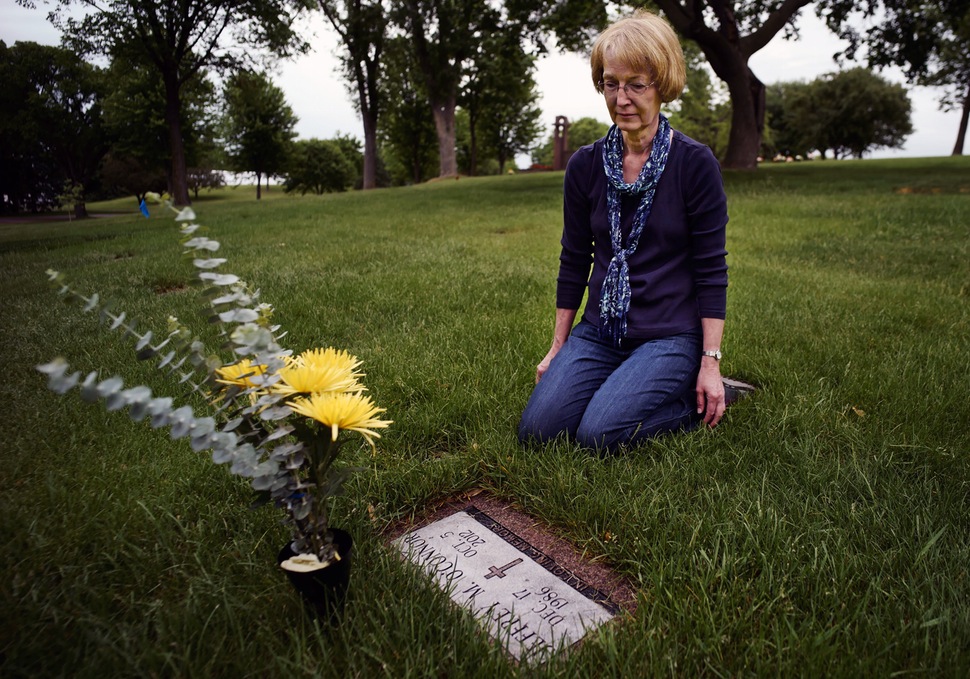 follows Minnesota mother Beckie O’Connor as she fights to change the way police are trained for mental health calls. follows Minnesota mother Beckie O’Connor as she fights to change the way police are trained for mental health calls.
“I’m Beckie, and my son was 25,” O’Connor tells a grief support group at her local church every week. “The police shot him.”
In the three years since she lost her son, Jeff, O’Connor has dedicated herself to trying to reform Minnesota police departments. Like most states, Minnesota doesn’t require police officers to undergo mental health crisis training.
O’Connor believes that better training—specifically, crisis intervention team (CIT) training—would have prevented Jeff’s death and could prevent future preventable tragedies.
“I don’t want this to happen to any other family,” O’Connor says.
Last year, nine of the 13 people who died during encounters with the police in Minnesota either had a history of mental illness or were experiencing an acute psychiatric crisis.
“We have completely failed as a mental health system,” said John Snook, executive director of the Treatment Advocacy Center. “You are taking a medical illness, especially a medical illness in crisis, and responding to it with law enforcement. If this was a heart attack or stroke and we sent in a SWAT team, people would be up in arms.”
People with severe mental illness are increasingly encountering law enforcement at alarming rates. There has been a surge in mental health-related calls to 911- no doubt in part because the state has only 7% of the beds necessary to meet the needs of its population with severe mental illness, according to a new Treatment Advocacy Center report.
CIT training is an invaluable tool in de-escalating a potentially deadly interaction between police and people in psychiatric crisis. Once the officer has de-escalated a situation, however, he or she needs somewhere to take the ill person. A public psychiatric hospital with open beds available is the natural needed place.
Read our 2016 report “Going, Going Gone: Trends and Consequences of Eliminating State Psychiatric Beds," and visit #aBedInstead to learn more about the national psychiatric bed shortage.
To comment, visit our Facebook page.
Visit our blog archive to read all our recent posts.
A Blessing of Brilliant Insights, a Curse of Mental Monsters – guest commentary
(June 3, 2016) On July 12, 2001, I stood outside the emergency room at Randolph Hospital sobbing in handcuffs and shackles, the blistering pavement burning through the ugly hospital socks on my feet. I felt humiliated.
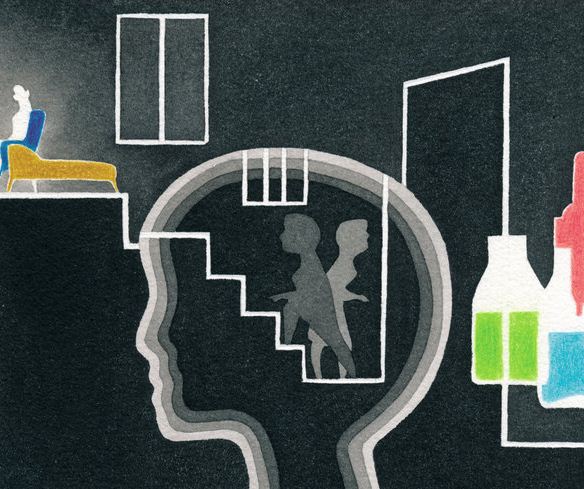 I had overdosed, almost died and was now waiting to be transported by the sheriff’s department to Dorothea Dix Hospital, which was one of our state’s mental hospitals. I had overdosed, almost died and was now waiting to be transported by the sheriff’s department to Dorothea Dix Hospital, which was one of our state’s mental hospitals.
I was in shackles and cuffs because when I was told I was being involuntarily committed to the state hospital I became very scared and angry and pretty much tore up the intensive care unit room I was in.
I have bipolar illness. I was diagnosed in 1998.
Doctors say mental illness is caused by a chemical imbalance in the brain, no different than diabetes is caused by a chemical imbalance in the pancreas. I use medications and lifestyle changes to manage my illness just like a diabetic. People can say, “I have diabetes,” and no one bats an eye. But say you have mental illness and most people get really uncomfortable.
I have experienced many episodes of mania (having lots of energy) and a couple really bad episodes of depression that lasted about a year. I have been hospitalized many times. In between times I feel mostly like other people.
I have had times feeling the world is the most beautiful place to live. But I have also had extremely manic episodes where I have behaved in ways I would not usually behave. I have hurt people. I have deep regrets. I have been so depressed I could hardly get out of bed for days.
I have not always taken medications because of side effects and sometimes because I felt better. Sometimes I have seemed to be going along fine, then spun into mania again, which is always followed by a depressed period. Because of the uncertainty of my moods, I have isolated myself over the years.
I have a family and a few close friends who are knowledgeable about mental illness and have always been very supportive, but there have been times when I was so sick it became too much for them to bear. My behavior was so bizarre they simply could not deal with me anymore for a period of time and did not know what to do to help me because I would not listen to anything anyone said.
Some days I live in fear knowing that no matter what I do, there is always the chance I might become sick again.
I hope that one day we will live in a world where mental illness is not something we fear, but something we recognize as an illness with no stigma attached. Where saying, “I have bipolar illness,” will cause no more alarm than saying, “I have diabetes.”
SHARON WOMACK
RAMSEUR, NORTH CAROLINA
Read the entire column here.
To comment, visit our Facebook page.
Visit our blog archive to read all our recent posts.
Mentally Ill Massachusetts Man with Violent Past Repeatedly Fell through Cracks
(June 2, 2016) A homeless Massachusetts man with a long history of violent episodes and hospitalizations resulting from untreated mental illness pled guilty this week to the 2011 murder of a homeless shelter employee (“Man pleads guilty in homeless shelter murder,” Boston Globe, May 31).
 Pericles Clergeau, 24, stood in court Tuesday and addressed the family of Jose Roldan, a 34-year-old employee of the homeless shelter where Chergeau once lived whom he fatally stabbed over five years ago. Pericles Clergeau, 24, stood in court Tuesday and addressed the family of Jose Roldan, a 34-year-old employee of the homeless shelter where Chergeau once lived whom he fatally stabbed over five years ago.
“I’m not very good with words,” Clergeau said. “I’m sorry for your loss. I’m sorry for taking that loss. I will try to be a better person.”
Diagnosed with schizophrenia, Clergeau has a record of psychotic episodes and hospitalizations beginning in childhood. Growing up in Massachusetts, Clergeau bounced from facility to facility. He assaulted fellow psychiatric patients, school staff and mental health workers and destroyed property.
But despite his violent past, Westborough State Hospital discharged Clergeau in 2010. Less than a year later, Clergeau was sitting in the common area of a local homeless shelter, unmedicated and delusional. He accused Roldan and another shelter employee of talking about him.
Roldan walked over to calm Clergeau down, but as he knelt in front of him, Clergeau pulled out a knife and stabbed him in the neck. Roldan lost consciousness and was rushed by helicopter to the hospital, where he died a few hours later.
On Tuesday, Clergeau’s attorney, Keith Halpern, delivered a scathing indictment of a mental health care system that knew for years that Clergeau posed a major risk and yet failed to properly treat him prior to Roldan’s death.
“It didn’t have to happen,” Halpern said. “It wasn’t a surprise that there was another violent episode.”
Over the past year, Halpern said, medication and treatment stabilized Clergeau, enabling the trial to go forward.
It’s incredibly tragic that it wasn’t until Clergeau had killed someone and was incarcerated that he was finally medicated and able to stabilize.
How was someone with a track record like Clergeau’s able to continue falling through the cracks? Surely during one of his stints in a psychiatric hospital someone recognized Clergeau’s obvious need for continuing care.
A new Treatment Advocacy Center study on the national psychiatric bed shortage provides some insight. The study reveals that Massachusetts has only 8.6 public psychiatric beds per 100,000 people, just 17.9% of the 50-bed standard considered minimally adequate.
Until Massachusetts addresses its psychiatric bed shortage—and adopts an assisted outpatient treatment (AOT) law, for that matter—preventable tragedies like this will inevitably continue.
Read “Going, Going Gone: Trends and Consequences of Eliminating State Psychiatric Beds” to learn more.
To comment, visit our Facebook page.
Visit our blog archive to read all our recent posts.
Psychiatric Hospital Bed Shortages "Beyond Disastrous" in 2016
(June 1, 2016) Nearly 20% of the hospital beds for the nation's most severely ill and dangerous psychiatric patients were eliminated in the last five years, at the same time demand for them skyrocketed, according to new Treatment Advocacy Center research released today.
Going, Going, Gone: Trends and Consequences of Eliminating State Psychiatric Beds, 2016 reports that the nation's psychiatric bed shortage has deteriorated to "beyond disastrous." The survey of the states found only 3.5% of the state hospital beds that existed in 1955 were still in operation by the first quarter of 2016.

Of the remaining beds, approximately half were occupied by patients charged or convicted of crimes, leaving about 6 state hospital beds per 100,000 people for civil patients, the study reported. By comparison, the average number of psychiatric beds in the 34-member Organization for Economic Cooperation and Development is 68 beds per 100,000 people, virtually all of them public.
"These beds represent the psychiatric equivalent of ICU patient beds," said John Snook, executive director. "Their loss has been disastrous for our nation and those most in need."
The study found a host of consequences from the bed shortage, including near-universal "boarding" of psychiatric patients in hospital emergency rooms, widespread waiting lists for hospital admission from jails and prisons, and pending or threatened civil rights lawsuits against states from coast to coast. States struggling to cope with surging demand for inpatient services for mentally ill criminal offenders increasingly resort to reducing access to last-resort hospital beds for non-offenders.
"A bed shell game with life-and-death implications has ensued" in which "one population benefits somewhat, at the expense of the other," the study said.
Going, Going, Gone is the Treatment Advocacy Center's fourth survey of psychiatric bed populations since 2008. Combining data collection in every state and the District of Columbia with statistics developed for the federal government, it represents the most complete and up-to-date source of state hospital bed data available, including the number of civil and forensic beds remaining in every state.
To see the Treatment Advocacy Center's recommendations for addressing the growing crises that denying access to last-resort hospital beds creates and to see where your own state ranks in the nation, read Going, Going, Gone: Trends and Consequences of Eliminating State Psychiatric Beds, 2016 now.
RESEARCH WEEKLY: Lionel Penrose, Psychiatric Beds and Mental Illness Behind Bars
(May 31, 2016) In 1939, a psychiatrist and mathematician named Lionel Penrose looked at the relationship between prison and mental health populations in 18 European nations. He arrived at a startling and controversial observation about "mental disease and crime": if mental hospital populations are reduced, prison populations grow.
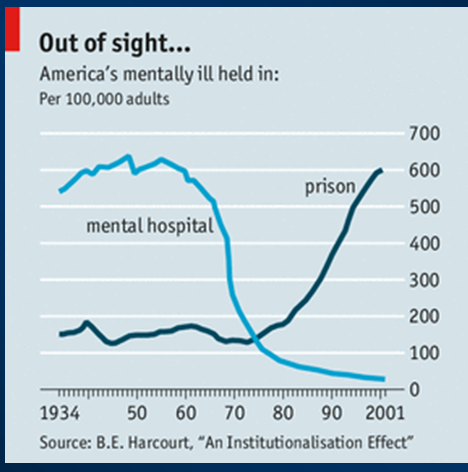 In 2016, we view the "Penrose hypothesis" across the 50-year social experiment known as "deinstitutionalization." Of the nearly 560,000 state hospital beds that existed at their peak in 1955, fewer than 40,000 remain today. At the same time, about 1.8 million jail bookings per year involve individuals with mental illness, and an estimated 350,000 adults with serious mental illness are currently living behind bars, at least 30,000 of them in solitary confinement. In 2016, we view the "Penrose hypothesis" across the 50-year social experiment known as "deinstitutionalization." Of the nearly 560,000 state hospital beds that existed at their peak in 1955, fewer than 40,000 remain today. At the same time, about 1.8 million jail bookings per year involve individuals with mental illness, and an estimated 350,000 adults with serious mental illness are currently living behind bars, at least 30,000 of them in solitary confinement.
The United States manages to incarcerate more mentally ill adults per 100,000 people than other high-income countries incarcerate, period. Presumably, Lionel Penrose would feel vindicated, albeit without any satisfaction.
A New Look at Trends and Consequences of Closing State Hospital Beds
The criminalization of mental illness is widely regarded as among the most widespread and devastating impacts of the half-century effort to eliminate state hospital beds, yet the Penrose hypothesis remains controversial and under study.
Into this crossfire, the Treatment Advocacy Center tomorrow releases its latest and arguably most dire report on the status of last-resort hospital beds in the United States. Combining original data collection with statistics developed for the federal government, the study will document, state by state, how America's state psychiatric hospitals are being repurposed as the clinical wings of the nation's jails and prisons, and the price this is exacting on the prisoners, corrections systems and communities.
The study, entitled Going, Going, Gone: Trends and Consequences of Closing State Hospital Beds, 2016, does not take up the debate over the Penrose hypothesis. Instead, it comes from the perspective that, for the men and women living with serious mental illness behind bars - typically without treatment - and for the family members and others who advocate on their behalves, the Penrose hypothesis is academic.
What matters in 2016 is that those in need are many, the beds for them are few and the consequences of trading hospital beds for jail beds can be deadly.
Visit our website tomorrow to read Going, Going, Gone.

Doris A. Fuller
Chief of Research and Public Affairs
References:
Next week: Behind Going, Going, Gone
Research Weekly is a summary published as a public service of the Treatment Advocacy Center and does not necessarily reflect the findings or positions of the organization or its staff. Full access to research summarized may require a fee or paid subscription to the publications.
To comment, visit our Facebook page.
Visit our blog archive to read all our recent posts.
Chairman Upton Works on Compromise Mental Health Reform Legislation
(May 26, 2016) Earlier this week, media reported that Representative Tim Murphy's Helping Families in Mental Health Crisis Act (HR 2646), will have a full Energy and Commerce Committee markup in June.
 "We're pleased that Chairman Upton and Chairman Murphy are making mental health reform a priority before the upcoming elections," said Treatment Advocacy Center Executive Director John Snook. "Too many people with the most severe mental illness and their families are suffering unnecessarily as a result of our outdated mental health laws." "We're pleased that Chairman Upton and Chairman Murphy are making mental health reform a priority before the upcoming elections," said Treatment Advocacy Center Executive Director John Snook. "Too many people with the most severe mental illness and their families are suffering unnecessarily as a result of our outdated mental health laws."
As negotiations continue, it is important that every member of Congress understands that real mental health reform demands a focus on the most severely mentally ill.
Write your Representatives and encourage them to support HR 2646 and mental health reform for the most severely mentally ill.
To comment, visit our Facebook page.
Visit our blog archive to read all our recent posts.
Unabomber Too Ill to Recognize Illness
(May 25, 2016) One of the country’s most notorious terrorists, ‘Unabomber’ Ted Kaczynski, is reportedly ready to speak out for the first time in years. But there’s a catch: He wants people to believe, as he does, that he isn’t mentally ill (“’Unabomber’ Ted Kaczynski tells journalist he is ready to be interviewed,” New York Daily News, May 24).
 Ted Kaczynski is currently serving eight life sentences for making and sending numerous homemade bombs that killed three and wounded more than twenty during an 18-year period. Ted Kaczynski is currently serving eight life sentences for making and sending numerous homemade bombs that killed three and wounded more than twenty during an 18-year period.
Kaczynski recently sent a letter to Lawrence Wright of the New Yorker saying he wants to talk. But the 74-year-old, who has been diagnosed with paranoid schizophrenia, wants the journalist and the world to know that he’s not crazy.
“I am ready to speak to someone from the media regarding my brother’s recent comments and to discuss how they are being used to torment me,” Kaczynski told Wright in his letter. “I am asking you to write me back affirming that you understand that I am NOT mentally ill, as my brother, Dave, would have you believe.”
Kaczynski’s belief in his own sanity goes all the way back to his 1996 trial when his lawyers attempted to enter an insanity defense, but he rejected the plea. At one point, Kaczynski requested that he be allowed to represent himself on the grounds that his lawyers thought he was mentally ill.
Although Kaczynski’s case is an extreme example, the reason behind his lack of insight into his illness is actually quite common amongst people with severe mental illness.
Approximately half of all people with schizophrenia and bipolar disorder do not realize they are sick - a condition called anosognosia.
Anosognosia, meaning “unawareness of illness,” is a syndrome resulting from anatomical damage to the brain and is the single largest reason behind why some individuals suffering with severe mental illness do not take their prescribed medications. Those affected believe there is nothing wrong with them, even though it is often obvious to those around them.
The brains of people who have and do not have anosognosia are different, which is why some people with schizophrenia or bipolar disorder are fully aware of their illness while other people with the conditions are not.
Read “Research Weekly: The Anatomical Basis of Anosognosia” to learn more about one of the most important, but difficult to understand, aspects of serious mental illness.
To comment, visit our Facebook page.
Visit our blog archive to read all our recent posts.
RESEARCH WEEKLY: The Anatomical Basis of Anosognosia
(May 24, 2016) One of the most important, but difficult to understand, aspects of serious mental illness is that approximately half of all people with schizophrenia and bipolar disorder do not realize they are sick - a condition called anosognosia. Individuals with this co-occurring disorder really believe that they are being followed by the CIA or that God is speaking to them through the voices they hear. They believe there is nothing wrong with them; therefore, they see no reason to take medication.
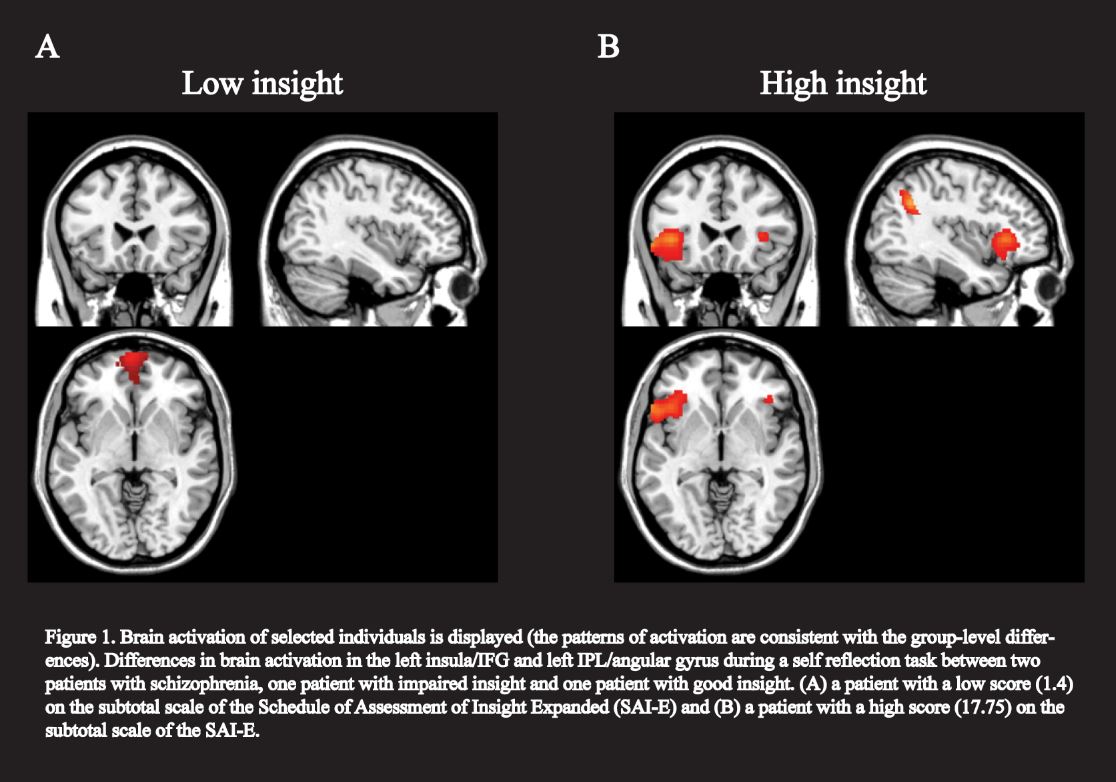 This lack of awareness of illness is seen in most cases of advanced Alzheimer's disease and Huntington's disease. Neurologists have known about it for more than 100 years, but psychiatrists just became aware of it about 25 years ago. Since then, the question has been: Why do some people with schizophrenia or bipolar disorder have anosognosia while other people with the conditions are fully aware of their illness? This lack of awareness of illness is seen in most cases of advanced Alzheimer's disease and Huntington's disease. Neurologists have known about it for more than 100 years, but psychiatrists just became aware of it about 25 years ago. Since then, the question has been: Why do some people with schizophrenia or bipolar disorder have anosognosia while other people with the conditions are fully aware of their illness?
Brain Differences
The answer to this question is now very clear: The brains of people who have and do not have anosognosia are different, and more than 30 studies support this conclusion.
The Stanley Medical Research Institute (SMRI), a supporting organization of the Treatment Advocacy Center, has been keenly interested in this research because of its important implications for medication adherence. For this reason, SMRI supported one of the early studies of the condition.
The most recent studies are using sophisticated techniques, with results that have become increasingly interesting.
Two of these studies come from Toronto and Moscow. A research group at the University of Toronto in 2014 published a study using the newer functional magnetic resonance imaging (fMRI) technique and reported that people with schizophrenia who have anosognosia show evidence of connectivity problems between specific brain areas. Another was carried out by researchers in Moscow using postmortem brains from the SMRI brain collection. These researchers found fewer glial cells - part of the white matter connectivity system of the brain - in people with anosognosia.
New techniques for studying the brain are yielding evidence-based findings for understanding the anatomical basis of anosognosia.
E. FULLER TORREY, MD
Associate Director of Research, Stanley Medical Research Institute
Founder and member of the board, Treatment Advocacy Center
Co-chair, Psychiatric Advisory Board to the Treatment Advocacy Center
Dr. Torrey serves as associate director of SMRI, where he oversees groundbreaking research on the causes and treatment of schizophrenia and bipolar disorder.
For More about Anosognosia
The Miyashiro family of Hawaii learned about anosognosia the way so many families do - when a family member, the mother in this case, became gravely ill and didn't believe anything wrong. After seven years in the revolving door of struggle and searching for hope and help, "Mom" is now in recovery. The family shares their story and offers encouragement and resources to others at the Anosognosia Caregiver Alliance.
Answers to "What is anosognosia?" can be found on the Treatment Advocacy Center website.
References:
Next week: Lionel Penrose, Psychiatric Beds and Mental Illness Behind Bars
Research Weekly is a summary published as a public service of the Treatment Advocacy Center and does not necessarily reflect the findings or positions of the organization or its staff. Full access to research summarized may require a fee or paid subscription to the publications.
To comment, visit our Facebook page.
Visit our blog archive to read all our recent posts.
New Hampshire’s Barbaric Practice of Jailing Psychiatric Patients Must Stop
(May 23, 2016) The Treatment Advocacy Center is leading the charge against the bizarre and inhumane practice of imprisoning civilly committed psychiatric patients who haven’t committed a crime in New Hampshire (“Lawsuit likely in NH’s imprisoning of non-criminal mentally ill patients,” InDepthNH, May 17).
 New Hampshire is sending some of its most vulnerable citizens – individuals with severe mental illness who have been court-ordered to receive treatment in a psychiatric hospital – to the Secure Psychiatric Unit (SPU) at the state prison for men. Yes, women, too. New Hampshire is sending some of its most vulnerable citizens – individuals with severe mental illness who have been court-ordered to receive treatment in a psychiatric hospital – to the Secure Psychiatric Unit (SPU) at the state prison for men. Yes, women, too.
It’s atrocious, but it’s legal.
New Hampshire law allows civilly committed patients who haven’t committed or been convicted of a crime, but are a danger to themselves or others, to be housed at the SPU, said Jeff Lyons, spokesman for the Department of Corrections, in an interview with InDepthNH.
“They are placed in the Secure Psychiatric Unit because they exhibit more violent tendencies than the other patients at the New Hampshire Hospital,” Lyons said. “Until such time as there is another option in New Hampshire, this is where they will be housed.”
But Frankie Berger, director of advocacy at the Treatment Advocacy Center, argues the practice violates patients’ civil rights and must stop immediately.
“We had no idea this type of thing was happening,” Berger told InDepthNH. “Honestly, it’s appalling and shocking what we’ve learned so far. We are going to do everything we can to stop this.”
The SPU population includes psychiatric patients who haven’t committed a crime, those who have been deemed incompetent to stand trial, those found not guilty by reason of insanity and mentally ill patients who have committed serious crimes such as murder and rape. The state’s most dangerous sex offenders are also housed there.
State Rep. Renny Cushing proposed legislation this year that would require alternative housing besides prison for mentally ill patients who are considered dangerous but who haven’t committed a crime.
“It’s long past time that the state of New Hampshire stop taking people who have never been charged with or convicted of a crime and sending them to prison. We should be sending them to hospitals, not prison,” Cushing said.
Civil rights lawsuits arising from the national psychiatric bed shortage have been filed across the country. But what’s going on in New Hampshire may be the most medieval example of the criminalization of mental illness of them all.
People with severe mental illness and their families – in New Hampshire and across the country – deserve better than this; they need #aBedInstead.
Visit #aBedInstead to learn more about the Treatment Advocacy Center’s campaign to end this injustice and ensure access to inpatient treatment for people with severe mental illness.
To comment, visit our Facebook page.
Visit our blog archive to read all our recent posts.
The Denver Post Calls for #aBedInstead
(May 19, 2016) "Hospitals, not jail, for the mentally ill," rail the editors of the Denver Post against recently proposed legislation that would place people with mental illness in jail for treatment even if they haven't committed a crime.
 "You know Colorado has a serious problem taking care of people experiencing a mental health emergency when the legislature passes a bill to extend the period they can be involuntarily warehoused in a jail," the editors write. "You know Colorado has a serious problem taking care of people experiencing a mental health emergency when the legislature passes a bill to extend the period they can be involuntarily warehoused in a jail," the editors write.
Senate Bill 169 would allow the state to detain a person suffering from an acute psychiatric crisis who has not committed a crime for 48 hours.
"Under ideal conditions, someone detained during a mental health crisis will be taken to a designated facility where appropriate evaluation and treatment can occur. The facility will respect patient rights, adhere to the proper standard of care and comply with relevant laws."
But the facilities to treat people who need it the most don't exist in Colorado - the editors say. The state has only 23 percent of the necessary beds to treat its population with serious mental illness. It has over 4 times more people with mental illness in jails and prisons than receiving treatment in a hospital.
Read the entire editorial.
Colorado isn't the only state that has proposed such abhorrent human rights violations as a solution to the lack of appropriate treatment facilities. Maine proposed similar legislation earlier this year. And several years ago, the New Hampshire legislature actually managed to pass legislation that does the same.
The practice of warehousing innocent people who are suffering from untreated mental illness in jails and prisons is unconscionable.
People with severe mental illness deserve #aBedInstead of jail.
VOICE the need for more beds with your followers and federal, state and local policymakers.
Share this blog on Facebook and Twitter to help us raise awareness about the devastating consequences our psych bed shortage and broken system has on people in need. Use the hashtag #aBedInstead.
For more information on our psychiatric bed campaign, visit #aBedInstead.
To comment, visit our Facebook page.
Visit our blog archive to read all our recent posts.
|
|