Our Spring 2016 Catalyst is in the Mail and Online Now
(Apr. 28, 2016) Our latest Catalyst newsletter is in the mail and online now.
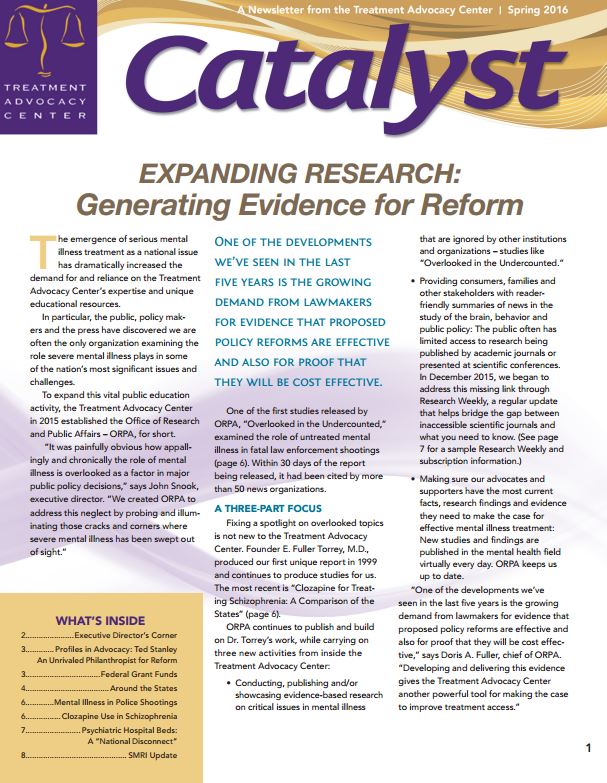 In this issue, we discuss the earth-shattering changes happening at both the state and federal levels. Read about how legislatures are embracing the Treatment Advocacy Center’s recommendations to restore needed inpatient hospital beds and commonsense solutions like assisted outpatient treatment (AOT). In this issue, we discuss the earth-shattering changes happening at both the state and federal levels. Read about how legislatures are embracing the Treatment Advocacy Center’s recommendations to restore needed inpatient hospital beds and commonsense solutions like assisted outpatient treatment (AOT).
We share the results from our latest study, “Overlooked in the Undercounted: The Role of Mental Illness in Fatal Law Enforcement Encounters,” which found that people with severe mental illness are 16 times more likely to be killed during an encounter with law enforcement than other civilians.
We discuss details about a new federal grant program to support local assisted outpatient treatment programs nationwide – a longtime goal of the Treatment Advocacy Center – that will provide $15 million in annual funding to assist state and local mental health systems establish new AOT programs.
And much more!
Read our spring Catalyst.
If we have your address, your Catalyst is in the mail.
As one of our supporters you will notice something has changed. We have moved Memorials and Tributes to our website. Visit our website to view all Memorials and Tributes this year.
To comment, visit our Facebook page.
Visit our blog archive to read all our recent posts.
Fix Pennsylvania’s Commitment Law – guest commentary
(Apr. 27, 2016) My mother died while eating breakfast three years ago. In my shock and grief, I vowed to change the circumstances that led to her death.
 You see, my son had killed her, because he lived in a delusional, imaginary world in which it was a heroic act. You see, my son had killed her, because he lived in a delusional, imaginary world in which it was a heroic act.
What could have stopped him? The answer is simple: Pennsylvania must allow families to get mental health treatment for loved ones before it’s too late.
Pennsylvania’s psychiatric hospitalization law requires someone to be an imminent danger to themselves or others before they can be committed. This means that most people get treatment only when they are dangerous at the time of evaluation, which is long past the point when someone needs psychiatric care.
To get psychiatric treatment in a hospital, my son Levi would have had to demonstrate he was a clear and present danger. Evidence of a clear and present danger includes assault, use of weapons, repeated threats to kill or harm, and harm to oneself. The law presupposes that anyone who later kills will first go through one of these stages.
But Levi’s illness didn’t make him angry or threatening. He was quiet and calm, though distant. Until he killed my mother while she ate breakfast, he had not raised a hand against anyone. We had no early warning signs of violence.
On the other hand, we had plenty of other early warnings. He believed that aliens had given him a bionic heart and that angels were his best friends. At times, he moved in a strange, slow way and could not understand what we said to him, and once he sat for hours in the snow until he had hypothermia and fell down a flight of stairs, fracturing his back and face. He also had a delusional memory that my mother had attempted to stab him while he slept. He believed she was poisoning our food. He told me that her spirit had left her body and she was not really his grandmother any more.
By the time danger was both clear and present, my son had killed my mother and was suddenly incarcerated. We lost my mother and he lost his adult life.
If Pennsylvania had better treatment laws for people with severe mental illness, my mother might be alive today and my son might not be sitting in jail. But in Pennsylvania, we had to wait for my son to become dangerous.
Pennsylvania must alter its commitment standards. I’m looking for state legislators who want to champion this necessary change. Let’s not let another tragic anniversary go by nor wait for more unnecessary deaths.
If Pennsylvania legislators refuse to act on behalf of those with severe mental illness, we need all of our representatives in Congress to support the Helping Families in Mental Health Crisis Act. Sponsored by Rep. Tim Murphy, R-Upper St. Clair, this bill would set a minimal “need for treatment” national standard. This means Levi would have gotten treatment when he displayed early warning signs, before my mother was killed.
If nothing is done, the tragedies like mine will continue to make headlines.
Visit #aBedInstead to learn about the Treatment Advocacy Center's new campaign to address the national psychiatric bed shortage.
RUTH A. JOHNSTON
GIBSONIA, PENNSYLVANIA
Read the entire column here.
To comment, visit our Facebook page.
Visit our blog archive to read all our recent posts.
RESEARCH WEEKLY: How Race and Ethnicity Affect Psychiatric Outcomes
(Apr. 26, 2016) Race and ethnicity significantly influence the likelihood of being diagnosed and treated for psychiatric disease, but the reasons why remain to be determined.
Karen J. Coleman and colleagues searched for patterns by analyzing rates of diagnoses, medication prescription and psychotherapy sessions for 7.5 million adult patients enrolled in private, not-for-profit health care organizations in 11 states. The analysis is the first to examine racial-ethnic differences based on service utilization instead of patient self-reports, which are not considered entirely accurate. The Coleman analysis used de-identified medical and pharmacy record data instead.
Differences in Diagnoses
Of the 7.5 million health system patients in the analysis, 15.6% were diagnosed with one or more of nine psychiatric conditions: bipolar disorder, schizophrenia, other psychoses, depression, anxiety, substance use disorders, attention-deficit disorders, autism spectrum disorders and dementia.
Among the findings:
- Native American/Alaskan Native patients had the highest rates for all diagnoses (20.6%), followed closely by non-Hispanic whites (19.8%).
- Persons from all the other racial-ethnic minorities - Hispanic, Asian, non-Hispanic black, Native Hawaiian/other Pacific Islander - had lower rates of overall diagnosed psychiatric conditions with one clear exception:
- Non-Hispanic blacks were nearly twice as likely as non-Hispanic whites to be diagnosed with schizophrenia.
- At 7.5%, Asians were significantly less likely to be diagnosed with any diagnosis than any other race or ethnic group. They were two-thirds less likely than non-Hispanic white patients to be diagnosed with depression and also less likely to receive medication if diagnosed.
Treatment Differences
In the study population, 73% of the patients received a psychotropic medication in the study year; 34% received formal psychotherapy.
Just as they were more likely to be diagnosed, non-Hispanic whites and Native American/Alaskan Natives were more likely to receive psychotropic medications than other groups, with the exception of schizophrenia and other psychosis. Even though they were twice as likely to be diagnosed with the disease, non-Hispanic blacks were less likely to receive medication for schizophrenia or other psychosis than non-Hispanic whites. Asian patients also were less likely than whites to receive medication for other psychoses.
Overall and unlike diagnoses and treatment, no clear differences in psychotherapy treatment were found across racial and ethnic groups. When diagnoses were analyzed separately, however, patients from any racial-ethnic minority were found more likely than non-Hispanic whites to receive psychotherapy for depression. Non-Hispanic blacks were as likely as whites to receive psychotherapy though less likely to receive a medication prescription.
The Meaning in the Differences
"Our study does not provide answers to why racial-ethnic differences in the diagnosis and treatment of psychiatric conditions persist, especially for non-Hispanic black patients," the authors concluded. "There are many patient- and provider-level factors that could contribute...."
The authors cited evidence that some cultures prefer complementary and alternative medicine (such as herbal remedies) to pharmaceuticals for some conditions. They noted that factors such as immigration status, language preference, socioeconomic status and subsidized insurance coverage are all known to relate to diagnosis and medication.
Provider-level factors also are known to account for some differences, they wrote. The same mental health symptoms are more likely to result in non-Hispanic blacks being diagnosed with bipolar or schizophrenia and non-Hispanic whites being diagnosed with major depression.
"Further research is necessary to understand how patient preferences and provider practices determine the differences we have reported," the authors closed.

Doris A. Fuller
Chief of Research and Public Affairs
References:
Next week: The Disturbing New Suicide Statistics
Research Weekly is a summary published as a public service of the Treatment Advocacy Center and does not necessarily reflect the findings or positions of the organization or its staff. Full access to research summarized may require a fee or paid subscription to the publications.
To comment, visit our Facebook page.
Visit our blog archive to read all our recent posts.
"We Don't Have Any Beds For Your Son" – personally speaking
(Apr. 25, 2016) My 18-year-old son, Peter, had his first psychotic break in 2006. His sister called me the evening before and said "Peter needs some help, something really weird is going on with him." I told her I would be there the next day to pick him and his dog up and would see how things were then.
 The next morning, Peter showed up at my job. He had hitchhiked from his father's house and killed his beloved dog. I called the Crisis and Counseling Center and they said to bring him in. He was admitted, spent six days in the psych ward of the hospital and was released with an $800 prescription and a pamphlet. So began our journey through the broken mental health system. The next morning, Peter showed up at my job. He had hitchhiked from his father's house and killed his beloved dog. I called the Crisis and Counseling Center and they said to bring him in. He was admitted, spent six days in the psych ward of the hospital and was released with an $800 prescription and a pamphlet. So began our journey through the broken mental health system.
Peter is now 27 years old, diagnosed with paranoid schizophrenia and has been hospitalized more than 10 times in Maine and New Hampshire. New Hampshire was horrible. There was never a bed available and the overworked case management just seemed to want my son gone. Recently, Peter was released after being transferred from jail for an evaluation. After three days, they falsely determined he had no mental illness, just an attitude problem.
For every time Peter was successfully admitted to a psychiatric hospital, there were five times he was turned away. One time, he was convinced his friend's 7-year-old was trying to stab him and, after some persuading, agreed to go to the ER. We waited 14 hours before a crisis team showed up to evaluate him. They were willing to admit him, but there were no available beds.
Once, after he was denied treatment in a hospital, Peter assaulted his father with a bat during a psychotic episode. Because of his aggression while unmedicated, I cannot have my son live with me. I have spent literally thousands of dollars this year alone to keep him alive. He is now fully symptomatic, delusional, angry, hungry, seeing danger everywhere and homeless on the streets in Maine.
As a parent, this is heartbreaking. Peter will be arrested for stealing food because he is hungry, or he will harm himself or someone else. Inpatient beds need to be available for people like my son. We are but
one example of the thousands of families who cannot get help for their loved one. Something has to change.
The Treatment Advocacy Center has launched a campaign to end this injustice and ensure access to inpatient treatment for people with severe mental illness. Called "#aBedInstead," the campaign draws attention to how the nation's state psychiatric bed shortage has left the most severely mentally ill locked out of psychiatric treatment. The goal is to increase the number of available beds by reforming state and federal policies that created and perpetuate this crisis for people like my son. Visit #aBedInstead for more information.
DARLENE PATRICK - Mother to a son with severe mental illness
To comment, visit our Facebook page.
Visit our blog archive to read all our recent posts.
Psychiatric Bed Registry a Step in the Right Direction
(Apr. 22, 2016) Pam Lipp discovered how difficult it is to find an available inpatient psychiatric bed in the state of California when her 18-year-old daughter, Amanda, suffered a psychotic episode in 2010.
Amanda had been admitted to a psychiatric crisis center but she could only stay there for 72 hours. Lipp asked the crisis center for help finding her daughter a bed in a facility that could provide longer-term care, but was told she was on her own – a problem many families in California and across the country face due to a scarcity of beds and inconsistent reporting of openings (“A dearth of hospital beds for patients in psychiatric crisis,” Kaiser Health News, Apr. 12).
Lipp called one hospital after the next only to find that they were all full. After eight hours, she finally found her daughter an open bed in Fair Oaks, California. She was lucky: many psychiatric patients spend days deteriorating in hospital emergency departments while they wait for a bed.
And it’s no wonder: California is facing a serious shortage of psychiatric beds, said Randall Hagar, director of government affairs for the California Psychiatric Association. The state eliminated 16 percent of its beds between 2005 and 2010, according to a 2012 Treatment Advocacy Center report, leaving just 14.2 public psychiatric beds per 100,000 people – far below the 50-bed standard considered necessary to provide minimally adequate mental health treatment. In 25 counties in the state, there were no psychiatric beds at all.
“We have to use the beds we do have and we have to know where they are. It can be a hit or miss process. It needs to be more reliable,” said Hagar. “We’ve heard instances where people were told there were no beds when in fact it turns out later that there were. An online registry would fix that issue.”
AB2743, an Assembly bill backed by the California Psychiatric Association, seeks to address this problem by establishing an online registry to collect and display information that would help find psychiatric beds. Facilities with psychiatric beds would be required to update the registry as the beds became available, and emergency medical providers would be able to use it to search for openings.
But the California Hospital Association is firmly opposed, saying that finding the right placement for a patient is much more complex than identifying an empty bed.
Part of the problem is the national shortage of psychiatric beds, in part due to the IMD exclusion. One necessary fix is the IMD exclusion. Eliminating the IMD exclusion would increase the availability of psychiatric beds, increase access and decrease psychiatric boarding issues for people with severe mental illness.
Pam Lipp said an online bed registry is an “absolutely phenomenal” idea.
“If I hadn’t done what I did, our daughter would most likely have been discharged, back on the street with nowhere to go, and we would have just repeated the cycle again,” said Lipp. “Maybe she wouldn’t have survived.”
Visit #aBedInstead to learn about the Treatment Advocacy Center's new campaign to address the national psychiatric bed shortage.
To comment, visit our Facebook page.
Visit our blog archive to read all our recent posts.
The Game Changer: Federal Grant Funds Now Available to Launch New AOT Programs!
(Apr. 21, 2016) They said it couldn’t happen! As a result of our dedicated advocacy and your support, the federal government has – for the first time ever – allocated $15 million for assisted outpatient treatment (AOT).
 SAMHSA posted a grant announcement earlier this week inviting state and local authorities to apply for up to four years of federal support of NEW AOT PROGRAMS. SAMHSA posted a grant announcement earlier this week inviting state and local authorities to apply for up to four years of federal support of NEW AOT PROGRAMS.
Applications are due July 16, 2016.
The Treatment Advocacy Center is the nation’s leading expert on AOT – and we want to help your local mental health officials implement the life-saving program.
We will help your local officials:
- Design an AOT program
- Identify target populations
- Develop a program budget
- Educate community stakeholders
- Draft an application for AOT
Our staff will travel anywhere in the continental US to help you prepare an application and implement a great AOT program.
You can also join a live informational webinar SAMHSA Tuesday, April 26, from 3:00 to 4:30 pm EST.
Visit our implementation page for more details and who may apply OR
This e-mail address is being protected from spambots. You need JavaScript enabled to view it
ASAP.
This grant is the fruit of years of diligent advocacy by the Treatment Advocacy Center and our allies, and the leadership of Congressman Tim Murphy (who continues to fight for many more essential mental health reforms).
We hope someday to look back on this moment as a watershed in making AOT a routine tool of public mental health systems, everywhere in America.
Visit our website for more details on who may apply OR
This e-mail address is being protected from spambots. You need JavaScript enabled to view it
ASAP.
To comment, visit our Facebook page.
Visit our blog archive to read all our recent posts.
Tell Your Senator: End Discrimination for People with Severe Mental Illness
(Apr. 20, 2016) If you experience a brain aneurysm, a stroke, or any other acute medical emergency that requires hospitalization, federal Medicaid funds will help cover the cost of your inpatient care.
But if you are an adult in crisis who requires acute psychiatric hospitalization, Medicaid will not pay for your inpatient treatment.
This discrimination means most private psychiatric beds are off-limits to the country's most vulnerable patients -- Medicaid enrollees. Due to an antiquated federal rule called the "IMD Exclusion," this is one of the most significant barriers to treatment for people with severe mental illness. To get people the care they need, this rule must be reformed.
Tell your Senator to repeal the discriminatory IMD exclusion and stop limiting payments for psychiatric hospitalizations for people on Medicaid.
Share this link with your friends on social media, ask them to write their Senators. Use the hashtag #aBedInstead and the Treatment Advocacy Center will retweet you!
For more information on our psychiatric bed campaign, visit #aBedInstead
To comment, visit our Facebook page.
Visit our blog archive to read all our recent posts.
RESEARCH WEEKLY: How Many Psychiatric Beds Does America Need?
(Apr. 19, 2016) With patients in psychiatric crisis waiting days and even weeks in emergency rooms before being admitted to hospitals, it has never been more urgent to quantify how many mental health beds America needs in order to provide people experiencing acute psychiatric symptoms with the same level of intensive care that people in cardiac or other medical emergencies receive.
In a new Treatment Advocacy Center backgrounder, E. Fuller Torrey, MD, founder of the Treatment Advocacy Center, reviews previous bed surveys and new bed supply projections and finds concurrence around a target of 40 to 60 public psychiatric beds per 100,000 population as the "minimum standard currently needed for reasonable psychiatric care in the US." More effective outpatient services in a community would relieve some need for psychiatric hospital beds, according to "How Many Psychiatric Beds Does America Need?" but "the ultimate safety net of the state psychiatric hospital" will continue to be required for some severely ill patients.
"It is important that we recognize that fact and establish a minimum standard for how many psychiatric beds are needed," according to the paper, originally published in Psychiatric Times. Specifically, "what percentage of the 40 to 60 beds per 100,000 population should be in state psychiatric hospitals"? No standard exists at this time.
'No Room at the Inn'
The Treatment Advocacy Center's 2012 bed survey, "No Room at the Inn," reported that 14.1 state hospital beds per 100,000 people remained by the end 2010, essentially the same level that existed in 1850. A Duke University team used a computer simulation program in 2015 to model how many psychiatric beds would be needed in one region of North Carolina to reduce emergency room waits to less than one day. The answer was 39 beds, exclusive of those beds for children and inmates with mental illness who have been court-ordered into hospital care.
"The gap between the supply and demand for psychiatric beds grows larger by the day," said John Snook, executive director of the Treatment Advocacy Center. "Until Congress and the states address the gap by reforming the IMD Exclusion and taking other actions to increase inpatient treatment access, severe psychiatric disease will continue to extract an exorbitant and unnecessary toll from the people who suffer from these conditions and their communities."
Read the backgrounder now.
Doris A. Fuller
Chief of Research and Public Affairs
References:
Next week: How Race and Ethnicity Affect Psychiatric Outcomes
Research Weekly is a summary published as a public service of the Treatment Advocacy Center and does not necessarily reflect the findings or positions of the organization or its staff. Full access to research summarized may require a fee or paid subscription to the publications.
To comment, visit our Facebook page.
Visit our blog archive to read all our recent posts.
#aBedInstead: OUR PROMISE TO ADDRESS THE NATIONAL PSYCHIATRIC BED SHORTAGE
 People with severe mental illness deserve access to psychiatric treatment in an inpatient setting. People with severe mental illness deserve access to psychiatric treatment in an inpatient setting.
But decades of cuts and neglect have left our system facing a critical shortage of needed psychiatric beds. This scarcity often leaves the most severely ill with nowhere to go, abandoning hundreds of thousands to jails and prisons, the streets, or worse.
The Treatment Advocacy Center has launched a campaign to end this injustice.
Together, we will:
- BRING ATTENTION to the causes and devastating consequences of our national psychiatric bed shortage;
- REFORM POLICIES at the state and federal levels that created and perpetuate this crisis;
- INCREASE the AVAILABLE NUMBER of psychiatric beds for people with severe mental illness; and
- ENSURE ACCESS for people to have #aBedInstead.
Visit #aBedInstead for more information.
“There is a Light at the End of the Tunnel” – personally speaking
(Apr. 15, 2016) For the past 14 years I have been dealing with mental illness. I have been in and out of the hospital over 50 times. I have been on a journey of highs and lows. I have been abused physically and mentally. Yet through it all I am here to share my story.
 Today I am proud to say I have been out of the hospital for 17 months and I'm in a program called Connections. Since becoming a part of this program I have been out of the hospital. I am now taking meds to treat paranoid schizophrenia and, along with journaling and therapy, I have been able to live a high functioning life. Today I am proud to say I have been out of the hospital for 17 months and I'm in a program called Connections. Since becoming a part of this program I have been out of the hospital. I am now taking meds to treat paranoid schizophrenia and, along with journaling and therapy, I have been able to live a high functioning life.
The Connections team is a support system with doctors, nurses, social workers, employment specialists, housing specialists and aides. They make house visits and they also take us shopping and to appointments. With this support system in place it helps us to manage our lives better.
I believe as a consumer it is imperative that I educate myself on the meds and their pros and cons. While it has taken me 13 years to find the right combination of drugs, it doesn’t necessarily have to take that long. It’s all about finding the right meds for you. We need to work together to make life easier for those of us affected by this illness.
The meds they have me on are in very low doses. My mind is not racing anymore, I am coherent and alert with no depression or anxiety. I have hope that one day I will be able to function without meds. There are a few side effects, but I keep my doctors informed so they will know how to treat me.
I know the challenge for many of us is taking meds, but I am a witness that it can help you function better. You just have to be proactive and assertive in your recovery. Ask questions, research, research and research again.
To those who share my struggle of battling not only the illness but also the stigma attached to it: Keep your head up and know there is a light at the end of the tunnel.
CALVIN DAVIS JR.
WILMINGTON, DELAWARE
To comment, visit our Facebook page.
Visit our blog archive to read all our recent posts.
|
|