15 Years of Advocacy
(April 12, 2013) Fifteen years ago, the Treatment Advocacy Center was founded with one goal in mind: to eliminate barriers to treatment for people with severe mental illness.
Fifteen years later, our founder, Dr. E Fuller Torrey, has this to say: “We have fundamentally changed the public dialogue on severe mental illness and dozens of state laws on these treatment issues. Our goal was and remains promoting recovery for anyone with severe psychiatric disease by assuring that reasonable treatment laws are on the books in each state and that they are used.”
We have accomplished more than we ever dreamed was possible on behalf of those too ill to advocate for themselves.
But there is still much to do. The coming months will see the release of valuable additional resources for families and their communities and new interactive programs that will bring our experts on severe mental illness into homes and offices everywhere. New grassroots advocacy efforts will help our supporters spread the word about the importance of restoring reason to the treatment of mental illness. All of this with the goal in mind to make treatment possible for more of those too ill to seek treatment themselves.
Says Dr. Torrey, “We will know when we have succeeded. The number of people with serious mental illnesses who are homeless, victimized or incarcerated will be markedly fewer. Suicides and homicides by individuals with untreated mental illness will decrease in incidence.”
To kick the observance off, a special, redesigned 15th anniversary Catalyst newsletter is going into the the mail shortly. If we don't have your mailing address, sign up now to receive an issue you will not want to miss. Or watch for the electronic version via email in coming weeks.
Doris A. Fuller Speaks at Brown University about Violence and Mental Illness
(April 9, 2013) Following the massacre at Sandy Hook, Brown University is tonight hosting a public health policy discussion centering on mental health. Doris A. Fuller, executive director of the Treatment Advocacy Center presented about access to mental health treatment, and how society treats and manages people with severe mental illness in order to prevent future tragedies.
 “There is an association between violence and the most severe mental illnesses when they are not treated,” Doris Fuller said. “I’m talking about the ones in which factors such as paranoia or command hallucinations are present. Chiefly diseases with psychotic features because those are the symptoms that alter reality and make irrational acts seem perfectly logical.” “There is an association between violence and the most severe mental illnesses when they are not treated,” Doris Fuller said. “I’m talking about the ones in which factors such as paranoia or command hallucinations are present. Chiefly diseases with psychotic features because those are the symptoms that alter reality and make irrational acts seem perfectly logical.”
The executive addressed the stigma associated with severe mental illness, and to discuss laws that enable treatment. “The solution to both the violence and the stigma that we promote at the Treatment Advocacy Center is advocating for laws that eliminate barriers to treatment,” she continued. “Mandated treatment in the community, or assisted outpatient treatment, reduces violence, suicide, homelessness, arrest, incarceration and quite a few other consequences of non-treatment.”
She was joined by Dr. Richard Alan Friedman, director of the Psychopharmacology Clinic at Weill Cornell Medical College and Jeffrey Swanson a professor of psychiatry at Duke University.
Read more about the discussion.
To comment, visit our Facebook page.
Visit our blog archive to read all our recent posts.
After Tragedy, People Ask, "What Could Have Been Done?"
Knowing Emergency Hospitalization Standards Can Help
 (April 8, 2013) Newly updated, state-by-state information about emergency hospitalization standards is now available on our website. (April 8, 2013) Newly updated, state-by-state information about emergency hospitalization standards is now available on our website.
“Emergency Hospitalization for Evaluation: Assisted Psychiatric Treatment Standards by State” provides essential information about criteria for short-term hospitalization for a psychiatric evaluation, also known as a “72-hour hold,” “pick-up,” “detention” and other terms.
“We research, update and publish these resources because knowing one’s own state law is critical to timely and effective intervention in a mental illness crisis,” said Doris A. Fuller, Treatment Advocacy Center executive director.
Also recently updated was "Initiating Court-Ordered Assisted Treatment: Inpatient, Outpatient and Emergency Hospitalization Standards by State," state-specific information about who may initiate proceedings leading to court-ordered treatment for an individual with symptoms of severe mental illness
For additional information about responding to a psychiatric emergency, visit the Get Help section of our website and our Civil Commitment Laws and Standards page.
.
The Day My Life Turned Upside–Down – personally speaking
(April 5, 2013) Six weeks ago, my life was turned upside-down in five minutes when my schizophrenic adult son killed my mother as she was eating breakfast.
 Levi had never raised a hand in violence against me or against his grandparents, but for many months he had believed a hallucination that his grandmother had tried to kill him. He could not stop believing that she was evil, no matter what we said. His schizophrenic disease had been developing for many years, but we could not persuade him to accept medicine to treat it. Instead, he believed that he was an angel with alien cyborg parts. Without clear, imminent signs of violence, we could not force treatment. Levi had never raised a hand in violence against me or against his grandparents, but for many months he had believed a hallucination that his grandmother had tried to kill him. He could not stop believing that she was evil, no matter what we said. His schizophrenic disease had been developing for many years, but we could not persuade him to accept medicine to treat it. Instead, he believed that he was an angel with alien cyborg parts. Without clear, imminent signs of violence, we could not force treatment.
What a contrast with my past experience raising a bipolar child. "Devin," my child with bipolar, is now 23 and although he still has many challenges, he is a responsible member of society who accepts his illness as just part of life to manage. His personal form of bipolar disorder is very depressive, not manic; there is no doubt in my mind that, untreated, he would have died by suicide in his teens. The odds were always against his making it to age 25, and we're nearly there. The credit for every step of the way goes to advice I received in our support groups. He was put on the wrong medicines more than once, and I only knew they were wrong because other parents told me so.
We all hate spending money, but it's a blessing when money can actually buy a solution. With "Devin," it could. At several points, I made high-stakes decisions to spend obscene sums of money getting him to experts outside our local area. I'm sure I threw at least $2,500 at the problem in just one year. We paid $1,700 for just one high-profile evaluation at Harvard, as the only way to get him off a wrong medicine that was killing him by inches. Then we took a train (every six weeks, all year) to NYC to see a pediatrician who specialized in bipolar children, and he didn't accept any insurance. We paid "out of pocket"---to put it mildly. Mental illness is a mugger. It sneaks up on you and says "Give me all your money or someone will die."
When my older son Levi began showing signs of schizophrenia, he was only 13. There was still time to throw money at the problem and save ourselves. But nobody recognized the signs of illness; it developed under the cover of Asperger Syndrome so he was expected to be “weird.”
There wasn’t a specialty organization for early schizophrenia, so I didn't have parents pointing out the bits that didn't fit, telling me "that's exactly what my kid did," or "that is not Asperger’s syndrome that looks like psychosis, please get help now." As he lost the ability to concentrate, withdrew from human contact, stopped smiling and was chronically offended, we could have put him on an antipsychotic medication. But we didn’t know. We tried to find places where he could succeed, not knowing that he was slowly losing his ability to understand the real world. He had three semesters of college credits completed when the disease finally blew the whistle on education. By then, Levi was over 18 and we had no legal way to make him get treatment. He talked about demons and scribbled on the walls, and we pleaded with him to get help; but diagnosis didn't come until the disease finally broke out into really public view, not long before he listened to a voice one last time and killed my mother.
None of the help I had for "Devin" was available for Levi.He turned 18 and we lost legal control; he was diagnosed with schizophrenia at 25 and nobody could make him get treatment. Money can't help us now; my mother is gone forever, and Levi will spend his life in the hospital. I cry every day because I miss them both so much. It should not have come to this.
RUTH JOHNSTON
Author and mother of two children with severe mental illnesses
To comment, visit our Facebook page.
Visit our blog archive to read all our recent posts.
RESEARCH – First Mania Episode Does Not Significantly Reduce Quality of Life
(April 3, 2013) Quality of life remains relatively good in patients with bipolar disorder after a first episode of mania, according to a new study. Instead, severe depressive symptoms are the main predictor of reduced life quality.
 "’Our findings offer a message of hope, both for clinicians and for people newly diagnosed with BD [bipolar disorder],’ say Lakshmi Yatham (University of British Columbia, Vancouver, Canada) and colleagues” (“Quality of life largely unaffected by first mania episode,” March 21). "’Our findings offer a message of hope, both for clinicians and for people newly diagnosed with BD [bipolar disorder],’ say Lakshmi Yatham (University of British Columbia, Vancouver, Canada) and colleagues” (“Quality of life largely unaffected by first mania episode,” March 21).
The researchers suggested that sustained quality of life after an initial manic episode may result because "in the early stage of the illness patients likely remain hopeful that initial treatments will be effective." They said their findings support the importance of aggressively treating depression in bipolar.
"Our results add to a formidable body of research demonstrating that we must drive home the message that aggressive treatment of residual symptoms of depression is essential to attain optimal outcomes," Yatham et al conclude.
Recognition that early intervention in psychotic disorders improves the prognosis for conditions such as schizophrenia and schizoaffective disorder already has led to hundreds of early intervention programs worldwide, the RAISE (Recovery After an Initial Schizophrenia Episode) project at the National Institute of Mental Health among them. Similar findings for bipolar would be helpful, especially for the adolescents and young adults most at risk for an initial episode.
To comment, visit our Facebook page.
Visit our blog archive to read all our recent posts.
Remembering Janice DeLoof
(April 2, 2013) Janice DeLoof of Fullerton, California, a recipient of our 2007 Torrey Advocacy Commendation, has passed away.
 As the mother of a son who lost his life after not receiving effective treatment for bipolar disorder, DeLoof fought for years to bring about laws that would bring assisted outpatient treatment (AOT) to Orange County and throughout California. As the mother of a son who lost his life after not receiving effective treatment for bipolar disorder, DeLoof fought for years to bring about laws that would bring assisted outpatient treatment (AOT) to Orange County and throughout California.
Her efforts contributed to the passage of the bill that became “Laura’s Law.” She also worked tirelessly to reduce the stigma of mental illness by creating and exhibiting artwork and facilitating art workshops that dealt with mental health issues. The painting seen on this page was called “Welcome Hope.”
In nominating DeLoof for our commendation for advocacy, Treatment Advocacy Center board member Carla Jacobs said, “Through her tenacity she kept moving forward. Someday Laura’s Law will be implemented in Orange County and, when that happens, it will be in large part due to Janice’s years of advocacy.”
Janice DeLoof fought to ensure that others would not have to face the same barriers to treatment her son encountered. She will be greatly missed.
Our thoughts are with Janice’s family and friends in this time of loss.
To comment, visit our Facebook page.
Visit our blog archive to read all our recent posts.
Hope At Last – personally speaking
(Mar. 29, 2013)This is a short story about a long five and a half years. My son Bill graduated from high school in 2003 and started working, saving, dating and other typical activities.
 It was in the later part of 2007, at the age of 22, when we started noticing changes in Bill. He was becoming paranoid about his co-workers and was making narcissistic comments. Some of Bill’s mannerisms were becoming unusual and he was showing signs of withdrawal. We did not think much of this other then it seemed odd. We had no knowledge about mental illness. It was in the later part of 2007, at the age of 22, when we started noticing changes in Bill. He was becoming paranoid about his co-workers and was making narcissistic comments. Some of Bill’s mannerisms were becoming unusual and he was showing signs of withdrawal. We did not think much of this other then it seemed odd. We had no knowledge about mental illness.
In 2008, Bill was fired from his job. Shortly after that, at the age of 23, Bill had his first of many psychotic episodes. He called me from his home and said there were people in is house with guns trying to hunt him down and kill him. I responded as any father would by calling 911 and rapidly responding to his home. We found Bill delusional and hallucinating. Bill was left in my temporary custody to obtain him psychiatric help. Bill refused any help.
Over the next four and half years he became more delusional. Numerous times, we had to get him committed involuntarily for emergency evaluation by petitioning the local magistrate court to obtain a court order. Unfortunately, Georgia law only allows 72-hour retention unless the patient is determined by medical professionals to be in imminent danger to self or others.
Bill was hospitalized five times over the next four years for short durations and diagnosed with paranoid schizophrenia. Sadly, Bill has anosognosia, blindness to his own illness. After each time he was stabilized, he would eventually quit taking his medication and crash into another psychotic episode. I cannot tell you how painful this has been for everyone and the impact to our family.
In 2012, Bill obtained a pistol. I was able to get the pistol from him and get him involuntarily committed again for emergency evaluation. He was treated at the West Central State Mental Health Hospital for 90 days. Then - with me working with the state hospital doctors, case managers and with a local case expeditor from the state - we were able to present Bill’s medical history in a local court and obtain a court order for a mandatory outpatient program.
This program, although not specifically called “assisted outpatient treatment” or AOT, provides Bill medication management, peer counseling and supervised visits at his apartment. Recently, Bill completed a Georgia Department of Labor vocational rehabilitation training program and received a certificate of completion. The department is now looking for some part-time employment for Bill.
There is hope now. Bill has been stable and improving for almost a year now. We hope that his stability and progress continues. None of this would have been possible without the current laws in Georgia that allowed me to get Bill treated.
In closing, I am a pastor. When this mental illness hit my son, I was angry, upset, confused, in denial, felt guilty, isolated and was scared. I kept asking God “why me, why Bill?” Faith in God helped me stay focused during very difficult times and get my son the help he needed, thanks to current Georgia laws on treatment of the mentally ill.
Lastly, from all this, I have developed a new ministry called “There is Hope” for families of people with mental illness. You can read about this new ministry at our website.
It is true that God works all things for His good.
GARY TABER
Pastor
There is Hope Ministries
After Silence – Voices for Change
(Mar. 28, 2013) In the 15 years the Treatment Advocacy Center has worked to make treatment possible for more people with the most severe mental illnesses, 24 states have improved their civil commitment laws and standards.
 Connecticut and Maryland have not been pioneers in this regard, nor were they among the states whose laws already were reasonably progressive when we began. Together, they are two of only six states without court-ordered outpatient treatment (AOT) laws. At the beginning of the year, Maryland hadn’t improved its civil commitment standards in nearly a decade, Connecticut in even longer. Connecticut and Maryland have not been pioneers in this regard, nor were they among the states whose laws already were reasonably progressive when we began. Together, they are two of only six states without court-ordered outpatient treatment (AOT) laws. At the beginning of the year, Maryland hadn’t improved its civil commitment standards in nearly a decade, Connecticut in even longer.
Now, both states are among many who are actively considering reform. This is good news for the people of Maryland and Connecticut and a hopeful sign for all of us that perhaps, at last, the half-century tide of public policy that has washed millions of people with untreated mental illness into the streets, jails and prisons and to their own untimely deaths has turned.
“It has been 50 years since the last sea change in mental health policy began the trend of withholding timely and effective treatment from individuals in psychiatric crisis or with chronic mental illness,” said Executive Director Doris A. Fuller. “Now, in just three months, 26 states have taken a new look at the laws that establish access to treatment for those too ill to seek help for themselves.”
Whether or not the 2013 legislative season ends with Connecticut and Maryland - or any of the other states - passing the bills they are deliberating, the legislation itself indicates a new recognition and resolve to address issues that have been too long ignored or dismissed – and an opportunity for advocates to raise their own voices for change.
In Maryland, the Senate this week unanimously passed a bill that would broaden the commitment standard for court-ordered hospitalization in psychiatric crisis. SB 1040 now goes to the Maryland House of Representatives. If you live in Maryland, find your state delegate here and write or call to share your personal story and urge support for SB 1040.
In Connecticut, authorization for court-ordered outpatient treatment was the subject of four bills that have thus far failed to make it past the first round of legislative consideration this session. A legislative task force and commission formed by the governor are both still considering the issue. The Harford Courant weighed in forcefully this week on the side of embracing AOT. If you live in Connecticut, applaud the Courant editorial in a letter to the editor or online comment and forward it to your state senator and assembly member expressing your support for AOT.
To comment, visit our Facebook page.
Visit our blog archive to read all our recent posts.
Let Them Be Homeless?
(Mar. 27, 2013) “Let them be homeless” sums up how the opposition framed their testimony last week at a Senate hearing in Maryland to expand access to treatment for severe mental illness. We could hardly believe our ears.
 “There are a lot of folks that are homeless that are served by some of our programs, who are quite happy individuals, actually,” said Elaine Carroll of On Our Own of Maryland, which describes itself as a “mental health consumer education and advocacy group.“ “There are a lot of folks that are homeless that are served by some of our programs, who are quite happy individuals, actually,” said Elaine Carroll of On Our Own of Maryland, which describes itself as a “mental health consumer education and advocacy group.“
“They choose to be homeless because that is their choice at the moment. They may not get the best nutrition, and they may not have slept in a few days and may not look as though they know what is good for them. But they do! And we know this because we’re with them every day. So to actually think that they might fall into a category where they would be forced out of their environment is very upsetting to a lot of the members of our community.”
We find it appalling that anyone would suggest people with severe mental illness, many of whom cannot even recognize their illness, prefer to stay homeless. The quality of life for these individuals is abysmal. Many are victimized regularly. One study found that 28% of homeless people with previous psychiatric hospitalizations obtained some food from garbage cans, and 8% used garbage cans as a primary food source. (Read our backgrounder on homelessness and mental illness).
The Maryland bill, SB 1040, would broaden the language in Maryland's civil commitment standard and make treatment possible for people with severe mental illness who cannot meet their basic human survival needs without assistance, and expand the focus of a dangerousness evaluation to allow doctors and judges to consider not just the person’s condition at the moment of evaluation but also how he or she can reasonably be expected to fare in the community if not hospitalized. The bill is particularly important for people with anosognosia — unawareness of one’s own illness — because they often do not adhere to treatment, which can lead to homelessness, hospitalization, victimization and jail.
We are delighted to report that yesterday the bill passed the Maryland Senate unanimously. It now goes to the House of Delegates, where Delegate Peter Hammen (D-Baltimore), Chair of the House Health and Government Operations Committee, must decide whether to bring the bill to a committee vote.
How can you help?
CALL OR EMAIL your own delegate if you live in Maryland. (Find your delegate here.) This is particularly important if your delegate is a member of the House Health and Government Operations committee. Urge your delegate to ask Chairman Peter Hammen to bring SB 1040 to a committee vote. Share how your personal story speaks to the need for this change in the law.
WRITE a letter to the editor of the Baltimore Sun and say you support passage of SB 1040 to make treatment more available. If you have a personal story that is relevant, please share it in the letter so the editor knows what SB 1040 means to you.
To comment, visit our Facebook page.
Visit our blog archive to read all our recent posts.
Navigating the Law to Seek Treatment For Severe Mental Illness
Who Can Initiate Treatment – Updated and Centrally Located
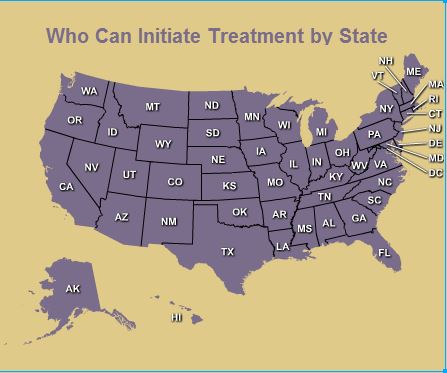 (March 26, 2013) Voluntary treatment is the ideal path to treatment for a severe mental illness, but when individuals are in acute psychiatric crisis and too sick to recognize they are ill or are incapable of making a self-interested medical decision, involuntary treatment is sometimes warranted. (March 26, 2013) Voluntary treatment is the ideal path to treatment for a severe mental illness, but when individuals are in acute psychiatric crisis and too sick to recognize they are ill or are incapable of making a self-interested medical decision, involuntary treatment is sometimes warranted.
Court-ordered treatment options exist in every state to provide court-ordered intervention for individuals who meet strict legal criteria. But who can petition the court for assisted treatment varies from state to state, sometimes dramatically. In some states, such as Washington, only a mental-health professional can petition a court. In others, like Colorado, virtually anyone can ask the court to consider whether someone needs emergency care.
To provide families, professionals and the public with essential information about who may begin proceedings leading to court-ordered treatment, the Treatment Advocacy Center has updated “Initiating Court-Ordered Assisted Treatment: Inpatient, Outpatient and Emergency Hospitalizations States by State,” a centralized state-by-state resource.
The guide is published in the Civil Commitment Laws and Standards section of our website, where a print-friendly version is also available.
In a mental health crisis, the first priority is always to protect loved ones and others from dangerous behaviors that may result from untreated or uncontrolled mental illness. To do that, it is essential for family members to know the standards and criteria that are used to determine when intervention may be ordered.
Providing public education about court-ordered treatment options is one of the ways the Treatment Advocacy Center reduces barriers to treatment and promotes recovery from psychiatric crisis.
|
|