A Call for Compassion – personally speaking
(Sept. 9, 2013) A good object lesson can be learned from the recent hostage situation at the Ronald E. McNair Discovery Learning Academy outside of Atlanta, a situation that could easily have ended in a disaster.
 The set-up was much the same as the others in that an individual with severe mental illness, who was off his psychiatric medication and not receiving adequate treatment, gave in to his suicidal and homicidal impulses. What was different, and most certainly a miracle, was the resolution. No one was harmed, crisis was averted, lessons were learned and it all ended on a note of affirmation. The set-up was much the same as the others in that an individual with severe mental illness, who was off his psychiatric medication and not receiving adequate treatment, gave in to his suicidal and homicidal impulses. What was different, and most certainly a miracle, was the resolution. No one was harmed, crisis was averted, lessons were learned and it all ended on a note of affirmation.
There is a particular corollary to this episode for this writer. When I was much younger and a patient in a psychiatric hospital, I became enraged by the behavior of another patient. It ended with me kicking the wall in frustration. I was immediately manhandled and carried to the seclusion wing where I was put in restraints on a bed in a bare room; sobbing the whole time.
If only someone had sat me down and talked to me in a soothing manner and proffered some comfort, a great deal of trouble and fuss would have been saved. I would not have been traumatized and the nurses would have not had to make the extra physical effort.
Young Michael Hill, who has a diagnosis of bipolar disorder, was not taking his medications and had literally plunged into the abyss, wanted to die and wanted to do it in the most spectacular way. He came to a school filled with about 600 children, armed with an A-K 47, and 500 rounds of ammunition. The scene was set for absolute horror. Yet, by the grace of God, he was intercepted by Antoinette Tuff, who was not even supposed to be in that particular chair in that particular room at that time.
What followed was a textbook example of how to talk to a mentally ill person who has lost all hope and is threatening to harm himself or others. The only tools she had were reassurance and love, something she was steeped in through her strong Christian faith. She was coached by a dispatcher, a nervous yet heroic Kendra McCray, but the bulk of what she said came from the heart and was wholly her own. In about the space of an hour, she gained Michael Hill’s trust, disarmed him, and helped him surrender to the police without incident. There was no bloodshed; merely relief and no little joy.
What heralded this resolution? It was certainly Ms. Tuff’s skills as a negotiator. But, it was more in her approach. She never lost sight of Michael Hill’s humanity and never let him lose sight of it also. She treated him with dignity and respect. She understood him and did not condemn him. She treated him courteously and not condescendingly. She addressed him as “Sir,” person to person, friend to friend. She displayed a rare compassion and she gave him a piece of herself, divulging her own struggles so that he would not feel so alone, that someone had been there and understood.
And in the end, it was her reassurance that brought the situation to a positive close, as she told Michael Hill, “It’s going to be all right, sweetie. I just want you to know I love you, though, OK? And I’m proud of you. That’s a good thing you’re just giving up and don’t worry about it. We all go through something in life.”
These comforting words have the simplicity of scripture and in their own humble way could compare to Paul’s 13th chapter on love in First Corinthians. Tuff transformed a negative into a positive and opened a window into the respective souls of each of us.
What can we draw from this episode? The way to defuse a situation like this one is to talk softly and reason with the agitated individual. Do not slight him or patronize him. Most certainly, don’t railroad him coming out with guns blazing as the police are wont to do. His symptoms and the agony he is in are the most real and immediate things in his world. Talk to him and strive to discern his level. Show him love and care.
By following these simple rules, many a crisis can be averted. No one wants senseless violence, not least the suffering individual, but there is often a disconnect that makes it inevitable. Yet, by sensitive and kind words, discerning understanding, a calm approach, and a little help from above, many a desperate situation can have a safe and positive outcome. You just have to keep an open mind and a receptive heart.
BRANDON W. FITCH
Program Annotator, Cleveland Philharmonic
To comment, visit our Facebook page.
Visit our blog archive to read all our recent posts.
The Forensic Bed Wrinkle
(Sept. 6, 2013) As if the shortage of psychiatric beds across the country were not dire enough already, a growing proportion of the state hospital beds that do exist are being filled by forensic patients – people who have committed crimes, often as a result of untreated mental illness.

Typical of the trend is North Dakota State Hospital in Jamestown. The number of forensic evaluations conducted at the hospital has more than doubled since 2007, going from 38 annual evaluations to 80 per year, according to the hospital’s clinical director (“State Hospital staff dealing with more forensic evaluations,” Aug. 28).
Dr. Rosalie Etherington, clinical director for adult inpatient psychiatric and chemical dependency services, said most of the recent evaluations were competency evaluations for people suffering from untreated mental illness who were charged with serious crimes.
"When you couple somebody's willingness to commit crimes with a mental illness, that's not a good combination," she said.
North Dakota’s mental health treatment law is a decent one. It allows individuals suffering from mental illness an opportunity to receive treatment, either in the community or a hospital, before they are dangerous.
The state should be focusing its efforts on using its law and getting treatment to people before a crisis – and before they end up occupying one of the state’s scarce psychiatric beds.
For more information about public hospital bed shortages, see our 2012 study, "No Room at the Inn: Trends and Consequences of Closing Public Psychiatric Beds."
To comment, visit our Facebook page.
Visit our blog archive to read all our recent posts.
RESEARCH: Medications Not to Blame For High Mental Illness Mortality Rates
(Sept. 5, 2013) “Contrary to expectations,” a new study published by the Journal of the American Medical Association reports that the early death associated with severe mental illness is not related to short- and medium-term use of psychotropic medications, such as antipsychotics and antidepressants.
 In fact, overall mortality was found to be lower among patients with schizophrenia who were treated with antipsychotic medications than among those given placebo (“Comparative mortality risk in adult patients with schizophrenia, depression, bipolar disorder, anxiety disorders, and attention-deficit/hyperactivity disorder participating in psychopharmacology clinical trials,” Aug. 28; full content available only to subscribers or by purchase). In fact, overall mortality was found to be lower among patients with schizophrenia who were treated with antipsychotic medications than among those given placebo (“Comparative mortality risk in adult patients with schizophrenia, depression, bipolar disorder, anxiety disorders, and attention-deficit/hyperactivity disorder participating in psychopharmacology clinical trials,” Aug. 28; full content available only to subscribers or by purchase).
“The increased mortality risk observed among patients with severe psychiatric illness, including schizophrenia, does not seem to be attributable to use of psychopharmacologic therapy,” according to a summary of the study published by Medwire (“Increased mortality in schizophrenia ‘not attributable to drug therapy,’”Sept. 4).
A research team from the Duke University School of Medicine used the Freedom of Information Act “to obtain data from the US Food and Drug Administration on the safety and efficacy of 43 psychopharmacologic agents approved between 1990 and 2011.” Data for 92,542 patients who participated in placebo-controlled trials were surveyed.
Risk of death was strongly associated with diagnoses of schizophrenia, depression and bipolar disorder but not with anxiety disorders or ADHD. Mortality risk was 3.8 times higher among patients diagnosed with schizophrenia, 3.2 times higher in those with depression and 3.0 times higher for patients with bipolar disorder.
Suicides accounted for 41.1% of the deaths that occurred in the study group, according to the study.
Opponents of court-ordered treatment for acute or chronic psychiatric disease often argue that the medications typically included in assisted outpatient treatment (AOT) orders place participants in the programs at risk for early mortality and other poor outcomes. As JAMA says in its abstract of the study, “There is concern that increased mortality risk among patients with psychiatric illness may be worsened by psychopharmacological agents.”
This study of nearly 100,000 patients will not be the final word on mortality risk – as the authors write, “further research is needed to support firm conclusions” – but it provides credible affirmation drug therapy for individuals with the most severe mental illnesses does not lead to early death and, for some, reduces risk.
It’s Not Recovery (Recovery) Month for Everyone
(Sept. 4, 2013) It’s official: September is “Recovery Month.”
 “National Recovery Month (Recovery Month)” is SAMHSA’s 24th annual salute to … something related to recovery. Originally (1989), the celebration was called “TreatmentWorks!” and saluted “treatment and recovery professionals.” Nine years later (1998), the observance morphed into National Alcohol and Drug Addition Recovery Month after being “expanded” from workers to include people actually trying to recover … from substance abuse. “National Recovery Month (Recovery Month)” is SAMHSA’s 24th annual salute to … something related to recovery. Originally (1989), the celebration was called “TreatmentWorks!” and saluted “treatment and recovery professionals.” Nine years later (1998), the observance morphed into National Alcohol and Drug Addition Recovery Month after being “expanded” from workers to include people actually trying to recover … from substance abuse.
It took an additional 13 years for recovery from mental health issues to make the cut for some celebration. In 2011, the annual observance was re-christened “National Recovery Month (Recovery Month)” (yes, “Recovery Month” appears twice in the title) to include “all aspects of behavioral health” as well as the “prevention, treatment and recovery service providers who make recovery possible.”
The stated purpose of “Recovery Month (Recovery Month)” is “to laud the gains made by those in recovery” and to “spread the positive message that behavioral health is essential to overall health, prevention works, treatment is effective, and people can and do recover.”
We are all for lauding the gains of individuals in recovery. In fact, we solicit, publish, share and promote personal stories of recovery 12 months of the year. And while “prevention” has never been shown to “work” for severe mental illness, we wholeheartedly agree that treatment can be effective, people can and do function better with it, and mental health is indeed an essential component of overall health.
But please excuse us for not getting excited about the recovery rah-rah on the snazzy website. SAMHSA has repeatedly and abundantly made clear that its focus is on “recovery” for people who are well enough to choose it, not for those so ill they can’t. Typical is the agency’s year-long quest for a “working definition of recovery,” which declares unequivocally that “Self-determination and self-direction are the foundations for recovery….” How self-determination and self-direction of treatment work for someone who believes his medical providers are intergalactic aliens trying to poison him is left unaddressed, just as the people suffering such delusions are.
At the Treatment Advocacy Center, we believe anyone who needs treatment in order to be stable and self-aware enough to direct his or her own recovery deserves to get that treatment, with court-ordered assistance, if necessary. For us, it’s recovery month (recovery month) every month.
Evicting the Homeless is Not a Solution
(Sept. 3, 2013) Homeless people are no longer welcome on the downtown streets of Columbia, South Carolina. Earlier this week city officials unanimously approved a plan that will give homeless residents three options: go to a shelter, get out of town or go to jail. (“ South Carolina city takes steps to evict homeless from downtown,” the New York Times, Aug. 25).
 The decision was prompted by concerns from business owners who believe homeless people are a threat to their bottom lines. The thriving city has plans to develop a 181-acre campus, which ironically used to house the state’s psychiatric hospital. The decision was prompted by concerns from business owners who believe homeless people are a threat to their bottom lines. The thriving city has plans to develop a 181-acre campus, which ironically used to house the state’s psychiatric hospital.
But these types of “not in my backyard” policies don’t actually address the reasons why so many people are chronically homeless.
At any given time, there are many more people with untreated severe mental illness living on America’s streets than are receiving care in hospitals. People with untreated severe mental illness constitute roughly one-third of this country’s homeless population. The quality of life for these individuals is abysmal. Many are victimized regularly. One study found that 28% of homeless people with previous psychiatric hospitalizations obtained some food from garbage cans, and 8% used garbage cans as a primary food source.
Simply evicting the homeless population from Columbia will not solve the problems that many homeless people face. If the city really wants to help its bottom line and improve the lives of residents, it should focus more on providing treatment to those suffering in the streets.
“You’ve got to get to the root of the problem: why we’re homeless,” said Jaja Akair, a homeless man who spoke during a City Council session on the plan.
We agree.
To comment, visit our Facebook page.
Visit our blog archive to read all our recent posts.
My Voices Are Not Nice – personally speaking
(Aug. 30, 2013) When it comes to involuntary treatment, I have mixed feelings.
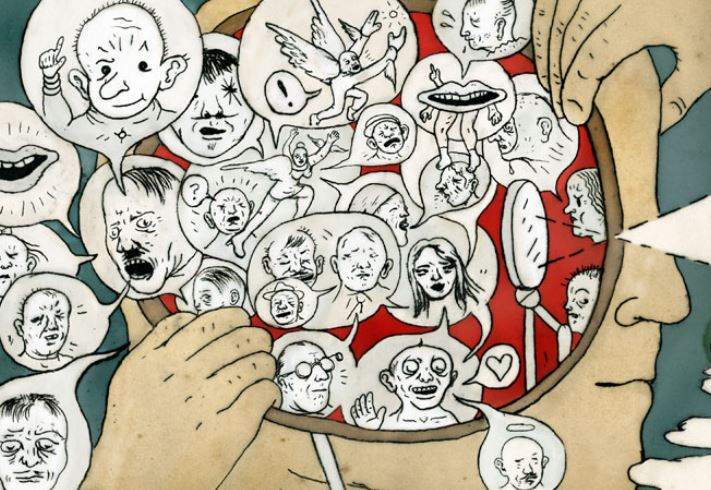 A part of me believes that people living with mental illness should be free to live their lives just as normal people do. The problem is, when some people with mental illness try to get by without treatment, they can’t live their lives just as normal people do. It would be great if everyone with a mental illness could hold jobs, pay rent, feed themselves and stay out of trouble. There would be no need for involuntary treatment if this was the case. But it’s not. A part of me believes that people living with mental illness should be free to live their lives just as normal people do. The problem is, when some people with mental illness try to get by without treatment, they can’t live their lives just as normal people do. It would be great if everyone with a mental illness could hold jobs, pay rent, feed themselves and stay out of trouble. There would be no need for involuntary treatment if this was the case. But it’s not.
Without treatment, many people with mental illness will either end up homeless, in jail or – like Joel Reuter, who was shot and killed in a confrontation with Seattle police last month – dead (“Joel Reuter’s family pushes for change in mental illness laws,” Capitol Hill Seattle Blog, Aug. 11).
I live with bipolar, and Joel Reuter was like me in many respects. We are fine if we’re on our meds. We both graduated college, can hold a job and live successful lives . . . on our meds. I have been hospitalized three times, and I agree with Joels’ father Doug Reuter when he said, “[For] most people with mental illness, it takes two or three hospitalizations before it clicks.”
For me, it took me a third hospitalization (after going off my meds) and two near-death experiences to figure out that when I am not on my meds, I hear voices. These voices are not nice. These voices want me dead and are convincing enough to make me want to die. If I want to live, I have to take the meds that keep them away.
For Reuter, his paranoia and delusions made him a danger to others, but the problem to me seems that he was smart enough to get released without being ready. If he hadn’t been, he may still be alive today.
As a person living with bipolar, I am thankful for involuntary treatment. It was very hard at times, especially when I thought there was nothing wrong with me and everyone else was crazy, not me. But I know without involuntary treatment, I would be dead, too. Civil commitment laws save lives. They provide people with a way to get medication that allows them to live normal, successful lives, like how Reuter’s was before he went off his medication.
If people with mental illness didn’t need help sometimes to get and stay in treatment, these laws wouldn’t exist. I know that the meds can be crummy at times, but they are better than the alternative . . . homelessness, jail or death.
NATALIE
A former psychiatric hospital patient thankful that treatment works
To comment, visit our Facebook page.
Visit our blog archive to read all our recent posts.
No More Excuses In California
(Aug. 28, 2013) The California Legislature helped put an end to the argument there’s no funding for Laura’s Law in California this week when it passed SB 585. The measure clarifies that the state’s Mental Health Services Act funds may be used to pay for assisted outpatient treatment (AOT) programs.
Cost concerns are among the top reasons states and counties give for not implementing AOT, but they are crumbling not only in California but elsewhere.
Just last month, a comprehensive new study of AOT in New York reported net cost savings of 50-62% for qualifying individuals living in the community under an assisted outpatient treatment order. Now, California lawmakers have swept aside the excuse that the state’s MHSA pool of mental health money cannot be tapped for AOT.
"Unfortunately, compassion for those suffering from the consequences of untreated mental illness has not been enough to motivate some communities to put their AOT laws to work," said Doris A. Fuller. “Like the Duke University study of AOT costs, the California legislature’s explicit authorization for counties to use MHSA funds for Laura’s Law provides a fiscal motivation."
Research has found that court-ordered outpatient treatment reduces psychiatric hospitalization and lengths of stay, arrests, incarceration, homelessness, victimization, violence and other consequences of not treating people with mental illness who don’t recognize they are ill or who otherwise struggle to adhere to treatment while living in the community.
The State Assembly approved the bill on a 68-4 bipartisan vote. The bill now heads to Gov. Jerry Brown’s desk for consideration.
Please contact Gov. Brown and ask him to sign this. Click here to send him an email.
Keeping Up the Drumbeat for Change
(Aug. 28, 2013) “Love him or hate him, Dr. E. Fuller Torrey continues to be a prolific and powerful voice in mental health,” author Pete Earley recently wrote about the Treatment Advocacy Center’s founder.
 And how. And how.
Dr. Torrey’s latest salvo came in a National Review online feature taking aim at the Substance Abuse and Mental Health Services Administration – SAMHSA, for short. Co-authored with former Treatment Advocacy Center board member D.J. Jaffe (now the brain trust behind MentalIllnessPolicy.org), the article continues Dr. Torrey’s attack on SAMHSA for its failure to pay attention to the those with severe mental illness who have the most desperate need for treatment.
“After Newtown: The existing federal mental-health agency actually opposes efforts to treat mental illness” continues Dr. Torrey’s longstanding effort to goad the $3.1 billion agency to address the needs of those suffering the most severe mental illnesses and stop funding programs that undermine court-ordered treatment options for those too ill to seek treatment. Among other topics, the article explores the criteria SAMHSA uses for underwriting mental health programs and its expenditures on planning for mental health services for Iraq and Afghanistan.
The article also raises questions about the current White House chatter about reforming the mental health system, deconstructing recommendations from the Biden task force on gun violence, which President Obama established following the Sandy Hook massacre and the White House’s National Conference on Mental Health.
“What happens next remains to be seen,” the authors write as they conclude. “Members of Congress looking for places to cut the budget should look closely at SAMHSA’s low-hanging fruit.”
Read the complete article at National Review Online.
To comment, visit our Facebook page.
Visit our blog archive to read all our recent posts.
Michigan Can Do Better
(Aug. 27, 2013) “Offenders in Michigan’s new mental health courts are far less likely to re-offend compared to those in the traditional criminal justice system,” was the finding of a new study by the Michigan State Court Administrative Office (“Michigan says mental health courts making a difference,” AP, Aug. 26).
 The report is further evidence that treatment of severe mental illness works to reduce criminalization, but Michigan shouldn’t start celebrating just yet. Our new survey of states that use basic tools for diverting people with serious mental illness out of jail awarded Michigan a D overall. The report is further evidence that treatment of severe mental illness works to reduce criminalization, but Michigan shouldn’t start celebrating just yet. Our new survey of states that use basic tools for diverting people with serious mental illness out of jail awarded Michigan a D overall.
First, getting people into treatment before they commit a crime would be more humane, more economical, and less burdensome to law enforcement. Mental health courts are also only available to less than half the state’s population, and crisis intervention teams serve only Kalamazoo County (representing less than 2.6% of the state’s almost 9.9 million people.)
Michigan has a good assisted outpatient treatment (AOT) law, Kevin’s Law, but it won’t work if it isn’t used. Comprehensive state-wide implementation of AOT may help intercept people who need treatment before end up in a mental health court or a jail or worse.
The effectiveness of the mental health courts that exist in Michigan is certainly a step in the right direction, but come on, Michigan, there’s some more work to be done.
To comment, visit our Facebook page.
A Police Officer Who Did the Right Thing: Helped My Son When I Couldn’t – personally speaking
(Aug. 23, 2013) My 22-year-old son, Zac, has schizophrenia, the paranoid type. Since February, he has phoned emergency services five times to ask for help for problems that he’s imagining. Sometimes it’s a heart attack, sometimes his throat is closing, and yesterday, it was to report a gunshot wound to his head.
 He was certain he had been shot because earlier in the day, he’d heard a leader in his psychiatric rehab program say, “Who wants directions to Zac’s house?” That comment upset him and by night time, it had translated into him thinking that he’d been shot in the head. He was certain he had been shot because earlier in the day, he’d heard a leader in his psychiatric rehab program say, “Who wants directions to Zac’s house?” That comment upset him and by night time, it had translated into him thinking that he’d been shot in the head.
He phoned 911 to report it.
I was worried when I found out what he’d done. The police have weapons and there is no shortage of news articles about tragic encounters when police are called to intervene during a psychiatric crisis.
Calling the police should not be the route that severely mentally ill individuals have to take to get to decent care, but it seems to be much more common. The new mental health page posted on the White House website advises you to call 911 if you have a mental illness and need help. That is its official recommendation — as bizarre and sickening as that seems.
We waited together for the police to arrive although my son asked me to let him do the talking. He didn’t want them to know he had a mental illness.
A female officer arrived. Her name-tag identified her as Officer Kim. My son met her outside on the sidewalk. She asked his name, shook his hand politely and asked him what was wrong. He told her he wanted to report being shot in the head.
“Where were you shot,” she asked. “Can you show me?”
He pointed to both temples. There was nothing there, of course.
She said, “I see what you mean. I do see a little spot right there.”
He told her that he was worried about losing brain cells. She asked him if he’d seen the weapon. He thought it was a pistol but he wasn’t sure. She asked when he’d been wounded; he wasn’t sure. He just wanted to report his gunshot wound.
She said, “Do you mind if I check your pockets? Do you have anything sharp on you that could hurt me?”
He gave her permission so she gently patted his pockets and then thanked him for letting her check.
She took a few steps toward me and I whispered: “My son has schizophrenia.”
Another officer arrived as backup. Before he could approach my son, Officer Kim called him over and whispered something. The officer approached me and softly asked, “Is your son taking medicine?”
I said, “Yes, faithfully.”
This second officer handed me a note with a hotline number to call in case of crisis. I asked him to introduce himself to my son since I feel it is important for us to know the police in our area (unfortunately). They shook hands and the officer introduced himself before leaving on another call.
What Officer Kim did next was miraculous.
Zac told her that a group leader at the hospital had given out his address. He was sure that he heard the leader say: “ Hey, who wants Zac’s address?”
Officer Langford said, “I’m going to go to the car now, and I’m going to check all our databases and see what it says. You wait right here while I find out who’s responsible, ok? I will check for you to see how this happened.”
My son agreed to wait.
When she looked at me, I said quietly, “There’s nothing wrong. What are you doing?”
She said, “I know, I’m just going to pretend to check…Ok?”
When she returned from her squad car, she told him: “I checked all the databases. We have a lot of them. I checked every single one, and I didn’t find anything at all. No one can get your address. Nobody can get your address, not your friends or people at the school, nobody. OK? You are safe now.”
When he told her that he was certain people were giving out his address, Officer Langford said, “You know sometimes people at school or your friends–they just like playing with you. They just tease or say things to cause trouble. I have kids at home, and I know how kids can be, they just like to say things and cause a little trouble. But you don’t have to worry about that. I just checked the databases for you, all of them, and nobody can get your address except us, and we are the police. Now you can laugh if that happens again. You can laugh because you know, they’re playing you. The police told you nobody can get your information. It can’t happen ok?”
He smiled and nodded.
Officer Kim then asked if there was anything else she could do to make my son feel better.
After a moment, he said, “Well, no. But should I get my head wound checked out?”
She looked at him carefully and said, “I don’t think so. I’ve seen gunshot wounds lots of times.” Reaching up, she rubbed the spot on his temple where he said the bullet had entered.
“Yep, I’ve seen that before, it should clear up by itself in a couple days. You will be fine, Ok?” she said.
He nodded but it was obvious that he was still worried so she repeated it a few more times: “I’ve seen that before, it should be ok, it’ll be fine in 4 or 5 days at the most.”
She told him that she had another call but she was absolutely certain that he would be fully recovered in a couple days.
I had braced myself for the worst when I learned that he had called the police. What I had just witnessed was the best. I’m not certain if Officer Kim had received Crisis Intervention Team Training but she was undoubtedly the most compassionate police officer who I’ve ever met and very skilled in handling psychiatric patients.
She was professional, she validated his concerns, she had an immediate solution for calming him, she asked how she could make him feel better, she addressed every worry he presented and she did that without once asking if he were sick and if he was taking his medicine. She did not ridicule him or make fun of his delusion or get angry because he was wasting her time.
This morning, I took great pleasure in phoning the Towson, Maryland precinct and asking that someone tell her sergeant, or captain, or whoever supervised her, to thank her. I have friends whose children with psychiatric illnesses have been tasered, beaten, even shot at… Officer Langford treated my son with respect, with incredible skill, with patience and compassion.
She made a fearful young man feel better, something I often cannot do.
My son came in the house after that experience, drank some juice, and got ready for bed. He knocked on my bedroom door. He had his pills in his hand and a glass of water. He took them in front of me, said good night, then lay down to sleep.
There are myriad ways the police visit could have gone wrong. But it didn’t because a police officer was willing to do whatever she had to, to make a scared and worried young man feel better, and she did.
She did it right!
Laura Pogliano
Maryland
Laura’s letter previously appeared in author Pete Earley’s blog
To comment, visit our Facebook page.
Visit our blog archive to read all our recent posts.
|
|