“It Has Been Five Years” – guest blog
(April 30, 2013) It has been five years, at many times long and painful, since a sudden delusional episode on a Massachusetts highway took the lives of my only children, Kaleigh and Shane, and their aunt Marci. Kaleigh was a beautiful and happy girl almost 6 years old, and Shane was just 4 - but everything a dad would want in a son.
 Their aunt Marci, although she had suffered for several months with a misunderstood mental illness, was a loving mother, wife, sister and friend. My wife Danielle and I thought, as did others in our family, that Marci had fully recovered from her psychotic episode a few months earlier, but clearly that was not the case as she led herself and my children onto Route 495. Not a day goes by that I do not think about them, wishing that circumstances had come out differently. Their aunt Marci, although she had suffered for several months with a misunderstood mental illness, was a loving mother, wife, sister and friend. My wife Danielle and I thought, as did others in our family, that Marci had fully recovered from her psychotic episode a few months earlier, but clearly that was not the case as she led herself and my children onto Route 495. Not a day goes by that I do not think about them, wishing that circumstances had come out differently.
It is based on that notion and quest that Danielle and I started a 501c3 charitable nonprofit called "Keep Sound Minds." Each and every goal of this organization directly relates to the consequences of ignoring mental illness, which led to the early and tragic deaths of our loved ones. With that in mind, we are proud to say we have achieved much in the last five years, including:
Produced a well-received police training DVD dealing with interacting with mental illness. This DVD has been sent to every police department in three states and is still in high demand.
Conducted two public forums on how to deal with mental illness and navigate the current mental health system, medically and legally.
Awarded several college scholarships to high school students who took an interest in mental health and suicide prevention.
Educated members of the New Hampshire and Massachusetts state legislatures about key bills that would have helped our family survive mental illness. One of these involved working with the Treatment Advocacy Center in Boston.
Through it all, the Treatment Advocacy Center has been a strong ally. We believe strongly in assisted outpatient treatment and the benefits it brings to the most vulnerable people.
This May 18, Keep Sound Minds will host an educational fundraiser, “An Evening to Support Mental Health Awareness,” in Woburn, Massachusetts. The agenda includes highly regarded speakers Dr. Jim Sabin from the Harvard Medical School and David Wellstone, son of the late U.S. senator, Paul Wellstone, who will discuss their own experiences with mental health issues and need for better access to mental health care.
If you feel strongly about our mission, we ask you to consider attending the event. More info is available here.
We know that we are not the only family to experience the tragic results of untreated mental illness, but we want to stop these tragedies from happening and we are asking for your help.
Thank you,
Ken Lambert
President, Keep Sound Minds
To comment, visit our Facebook page.
Visit our blog archive to read all our recent posts.
Mother Jones On The Grim Facts of Deinstitutionalization
(April 26, 2013) “It’s insanity to kill your father with a kitchen knife. It’s also insanity to close hospitals, fire therapists and leave families to face mental illness on their own.
“’None of us are suggesting that we need to go back to 1930, when I as a psychiatrist could say, ‘I don’t like the sound of your voice, so I’m going to keep you in my facility that I also happen to own for three weeks.’ You have to have a system of checks and balances.’
“But the pendulum has swung far past patients’ rights and well into the territory of wild neglect. The dismantling of the mental-health system has left those willing to undergo treatment with no options, and rendered the laws to protect against dangerous scenarios ineffective. ‘Danger to self or others is defined too limitedly,’ (Dr. E. Fuller) Torrey says. ‘(Y)ou either have to be trying to kill your psychiatrist or trying to kill yourself in front of your psychiatrist.’ Some states have less-strict provisions, but even there, no open beds plus the expense of keeping someone in the beds equals admission standards that are too high and discharge standards that are too low.
“Regardless of what you think about commitment rules, the bottom line is you have to have facilities. If there had been a facility—not ‘a psych ward in a general hospital which is set up to see people with eating disorders and depression,’ Torrey says, but a clinic staffed with the appropriate kinds of professionals and with an open bed and antipsychotics that have proven to be extremely effective if properly administered— if my Uncle Mark could have taken Houston someplace like that—maybe crimes like Houston’s could be not just predictable, but preventable.”
Mac McLelland’s searing personal account of the consequences of deinstitutionalization was last week’s Mother Jones cover story.
Read the full story here.
HIPAA: What’s Smoke, What’s Fire? – personally speaking
(April 26, 2013) A curious thing happened at today’s House subcommittee hearing on whether HIPAA helps or hinders patient care and public safety.
Essentially everyone who testified – from a federal civil rights official to heartbroken family members – agreed that HIPAA is getting in the way of treatment of those with the most severe mental illnesses and other psychiatric conditions, including dementia in the elderly.
And they all agreed on one of the reasons why: The privacy rule that medical providers wield like a missile defense shield to keep family members and caregivers in the dark about loved ones in psychiatric care is being widely “misinterpreted and overinterpreted,” in the words of Rep. Tim Murphy, chair of the House Subcommittee on Oversight and Investigations.
The witnesses all agreed that medical providers typically want to talk to family members but don’t because they feel their lips are sealed by Health Insurance Portability and Accountability Act (HIPAA) Privacy Rule and fear punishment.
Experts on the law testified the law doesn’t require this. To correct the commonplace misunderstanding, the federal Office of Civil Rights published a “message to our nation’s health care providers” on January 15 as a heads up that it’s okay to “disclose necessary information about a patient to law enforcement, family members of the patient, or other persons, when you believe the patient presents a serious danger to himself or other people.”
Universally correcting this misconception would be a start, but those of us who live with persistent and severe mental illness know disclosure in the face of dangerousness doesn’t go far enough – and so did several of the committee members.
“The federal government is totally divorced from the reality of an emergency room physician at 3 o’clock in the morning,” declared an openly skeptical Rep. Bill Cassidy (LA), who is a physician.
Rep. Murphy wanted to know whether anosognosia (lack of insight into illness) in deciding when disclosure is in a patient’s best interest.
Cassidy was more blunt. “What if a patient is not lucid?” he asked. “They think there are black helicopters circulating and their mother is the pilot of one of them?”
Family members like Ed Kelly and Gregg Wolfe – fathers who have battled unsuccessfully to help their mentally ill sons get and stay in treatment – who testified know “what if.” They are shut out, their loved ones don’t get the treatment they need, and everyone suffers.
In his summation, Rep. Murphy told the audience, “Not since John F. Kennedy have we had such a focus on mental health in this country.”
The hearing was over, but examination of whether HIPAA is interfering with patient care is not. Members of the Oversight and Investigations subcommittee whose purview HIPAA comes under are listed here. Let them know how HIPAA has affected the care and recovery of your loved one. I will be.
DORIS A. FULLER
Executive director
To comment, visit our Facebook page.
Visit our blog archive to read all our recent posts.
Tell Your Representative That HIPAA Hurts People with Severe Mental Illness
(April 25, 2013) A House subcommittee will take testimony Friday on whether the HIPAA privacy rule prevents people with severe mental illness from getting timely and effective treatment and puts the public at risk when they don’t receive it.
 “This hearing will explore how HIPAA may interfere with patient care and public safety, either through misunderstanding, or proper application, of the law,” according to public notice of the meeting. “This hearing will explore how HIPAA may interfere with patient care and public safety, either through misunderstanding, or proper application, of the law,” according to public notice of the meeting.
We agree that privacy deserves to be respected and preserved but not when doing so hurts treatment by preventing families from advocating on behalf of loved ones who are in psychiatric crisis or chronically ill. This is especially relevant for people with anosognosia, who cannot recognize their illness and seek help for themselves.
Please, write your representative and members of the subcommittee to share your story about how HIPAA laws have prevented your loved one from getting timely and effective treatment.
- WHO: Members, Subcommittee on Oversight and Investigations
- WHAT: “Does HIPAA Help or Hinder Patient Care and Public Safety?”
- WHERE: Room 2132 of the Rayburn Office Building
- WHEN: April 26, 9 am
For more about the privacy rule, see “Understanding and Navigating HIPAA Privacy Restrictions” on our website.
Please forward this message to your friends and relatives and ask them to share their stories, too!
To comment, visit our Facebook page.
Visit our blog archive to read all our recent posts.
“I Don’t Know Why It Has to Be So Hard”
(April 24, 2013) A bill currently making its way through the Pennsylvania state legislature would make it easier to keep people in desperate need of psychiatric care hospitalized - people like Michael McDaniel.
 Illustrating the need for SB 796, McDaniel's mother recently told their family's wrenching story to the Reading Eagle (“Mental health system fails families,” April 21). Illustrating the need for SB 796, McDaniel's mother recently told their family's wrenching story to the Reading Eagle (“Mental health system fails families,” April 21).
Nina McDaniel said her son had made repeated threats against members of his family while suffering delusions from paranoid schizophrenia and refusing treatment. After he attempted to buy a pistol online and threatened his parents “I’ll blow your brains out,” she thought she had enough evidence to have him hospitalized. But under current Pennsylvania law, such threats and others do not warrant involuntary commitment. Michael was released hours after being held for a psychiatric evaluation.
Three weeks later, he walked into his grandmother’s bedroom and attacked her with a cane.
His grandmother survived the assault, but McDaniel remains hospitalized at Wernersville State Hospital - still another individual who had to commit a crime to get treatment. Nina McDaniel says “medications keep his head clear and that he wouldn’t have attacked his grandmother had he been taking them.”
People like Michael McDaniel deserve treatment before their symptoms drive them to criminal acts. In Pennsylvania, SB 796 could improve the chances they get it.
To comment, visit our Facebook page.
Visit our blog archive to read all our recent posts.
A Letter from Prison: "There Is Hope" – personally speaking
(April 19, 2013) Dear E. Fuller Torrey, A friend of mine recently wrote to me to say that she read your book, The Insanity Offense: How America’s failure to treat the seriously mentally ill endangers its citizens. She also informed me that my name and offense were in your book. This came as quite a surprise to me because I’m a clerk in the prison library (for nearly seven years) and did not know this, even though this book is in the place at which I work. So, I thought I should read the book before I wrote you, at the suggestion of my supervisor to share my thoughts about the heart breaking issues in your book (mine included).
 In retrospect, I agree with you. My own journey and struggle with mental illness has brought me to this point. However, it wasn’t always so. In retrospect, I agree with you. My own journey and struggle with mental illness has brought me to this point. However, it wasn’t always so.
For years I denied I had an illness and refused to take medication because I believed it was poison and people were trying to kill me. I even believed my own family was part of this imagined conspiracy. I know full well this deadly disease and how untreated lead to my son’s death.
Even after my arrest and subsequent conviction, I was still in denial. In my mind, it was all a grand scheme to assassinate my character. I know was not the case and here is why.
In your book, The Insanity Offense, you advocate the need for forced treatment for those individuals who pose the greatest threat to themselves and others, people like myself. During my incarceration, my sanity (or lack thereof) slipped from me, forcing the institution to transfer me to the state hospital for treatment. It was there that I received the proper care in the form of medication, psychotherapy and something else that your book did not mention, education about my illness.
I was taught in groups that I have a clinical illness, the same as if I had diabetes and needed insulin to survive. I now have acceptance of my illness because I’ve been educated about it. However, I know that this great epiphany could not have occurred had I not been stabilized on medication.
The conscious choice to take meds comes from knowing about the illness and finally acceptance that I have this disease. Now, I wouldn’t stop taking meds for any reason. I understand now.
I guess the reason I’m writing you is to let you know that there is hope. Some of us with mental illness get it. We can move forward to live full and healthy lives while maintaining the safety of those around us.
I feel that once an individual (such as myself) has education about their illness and understands what they are dealing with, this ultimately leads to acceptance. I feel this is how the mentally ill can become medication compliant even if at first they are forced.
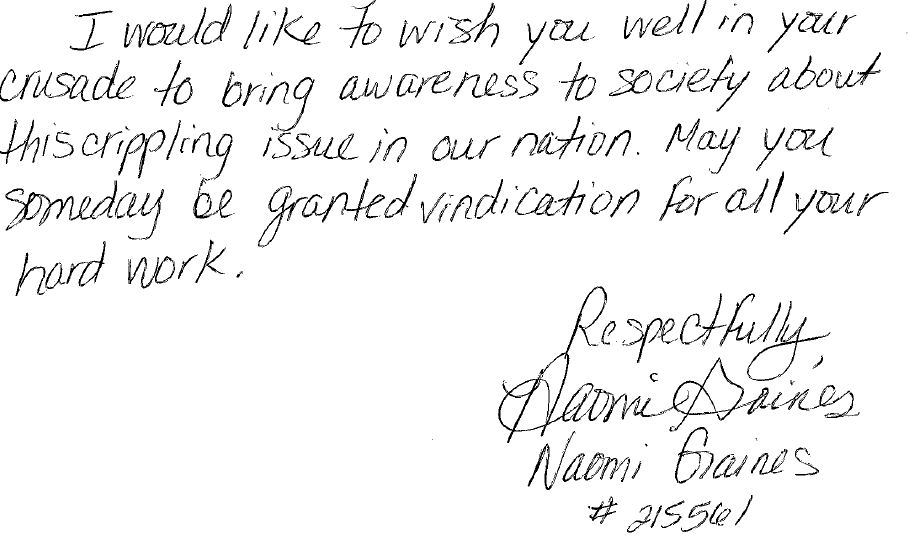
I would like to wish you well in your crusade to bring awareness to society about this crippling issue in our nation. May you someday be granted vindication for all your hard work.
Respectfully,
Naomi Gaines
Naomi Gaines is an inmate in Minnesota.
To comment, visit our Facebook page.
Visit our blog archive to read all our recent posts.
An Open Letter to Congress After Defeat of Gun Legislation
(April 18, 2013) Dear Honorable Members of Congress:
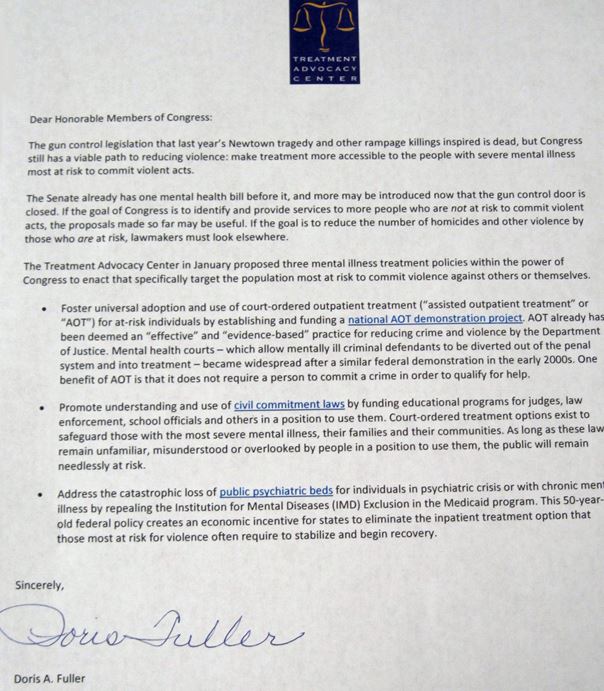 The gun control legislation that last year’s Newtown tragedy and other rampage killings inspired is dead, but Congress still has a viable path to reducing violence: make treatment more accessible to the people with severe mental illness most at risk to commit violent acts. The gun control legislation that last year’s Newtown tragedy and other rampage killings inspired is dead, but Congress still has a viable path to reducing violence: make treatment more accessible to the people with severe mental illness most at risk to commit violent acts.
The vast majority of individuals with mental illness are no more violent than the general public. But when an individual with a serious mental illness is untreated, the risk of violence rises. An estimated 10% of homicides and 50% of rampage killings are committed by a small subset of people with untreated mental illnesses, particularly those that include paranoia or command hallucinations. People with schizophrenia or bipolar disorder are also much more likely to die from suicide than others.
The Senate already has one mental health bill before it, and more may be introduced now that the gun control door is closed. If the goal of Congress is to identify and provide services to more people who are not at risk to commit violent acts, the proposals made so far may be useful. If the goal is to reduce the number of homicides and other violence by those who are at risk, lawmakers must look elsewhere.
The Treatment Advocacy Center in January proposed three mental illness treatment policies within the power of Congress to enact that specifically target the population most at risk to commit violence against others or themselves.
- Foster universal adoption and use of court-ordered outpatient treatment (“assisted outpatient treatment” or “AOT”) for at-risk individuals by establishing and funding a national AOT demonstration project. AOT already has been deemed an “effective” and “evidence-based” practice for reducing crime and violence by the Department of Justice. Mental health courts – which allow mentally ill criminal defendants to be diverted out of the penal system and into treatment – became widespread after a similar federal demonstration in the early 2000s. One benefit of AOT is that it does not require a person to commit a crime in order to qualify for help.
- Promote understanding and use of civil commitment laws by funding educational programs for judges, law enforcement, school officials and others in a position to use them. Court-ordered treatment options exist to safeguard those with the most severe mental illness, their families and their communities. As long as these laws remain unfamiliar, misunderstood or overlooked by people in a position to use them, the public will remain needlessly at risk.
- Address the catastrophic loss of public psychiatric beds for individuals in psychiatric crisis or with chronic mental illness by repealing the Institution for Mental Diseases (IMD) Exclusion in the Medicaid program. This 50-year-old federal policy creates an economic incentive for states to eliminate the inpatient treatment option that those most at risk for violence often require to stabilize and begin recovery.
President Obama, Vice President Biden’s task force and the Senate to date have focused the bulk of their response to the rampage killings of 2012 on gun control. That pathway to reducing violence is closed.
If our leaders are serious about reducing violence, they must focus now on the role of untreated serious mental illness. To change the math in which less than 1% of the U.S. population commits half the rampage killings, 10% of the homicides and countless other violent acts, including suicide, we have to add treatment to the equation.
To comment, visit our Facebook page.
Visit our blog archive to read all our recent posts.
AOT: Better Than a One–Way Bus Ticket and Far More Effective
(April 17, 2013) We already knew Nevada’s mental health system was one of the most threadbare in the country before last weekend’s Sacramento Bee report about the state discharging patients from the state’s primary psychiatric hospital to buses bound for other states.
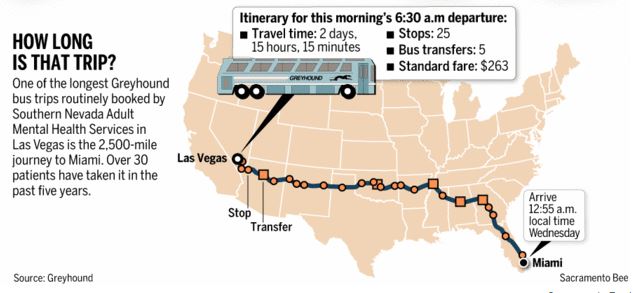 “Since July 2008, Rawson-Neal Psychiatric Hospital in Las Vegas has transported more than 1,500 patients to other cities via Greyhound bus, sending at least one person to every state in the continental United States,” according to “Nevada buses hundreds of mentally ill patients to cities around country” by Cynthia Hubert (April 14). “Since July 2008, Rawson-Neal Psychiatric Hospital in Las Vegas has transported more than 1,500 patients to other cities via Greyhound bus, sending at least one person to every state in the continental United States,” according to “Nevada buses hundreds of mentally ill patients to cities around country” by Cynthia Hubert (April 14).
The patients are shipped at a pace of more than one a day. Last year, nearly 400 were sent to 176 cities in 45 states. About a third were dispatched to California, including Sacramento, where a suicidal and confused former patient was sent in February even though he had never been to the city and knew nobody there.
Nevada also jails far more of its citizens and visitors in psychiatric crisis than any other state, according to our 2010 study, “More Mentally Ill Persons are in Jails and Prisons Than Hospitals.” An individual with mental illness was nearly 10 times more likely to land behind bars in Nevada than in a psychiatric hospital bed.
However, there is a glimmer of hope in all this darkness.
A bill sponsored by Assemblyman Lynn Stewart would remove Nevada from the short list of states that do not have laws authorizing assisted outpatient treatment (AOT). This would provide a means for qualifying patients at risk for relapse, arrest, incarceration, homelessness, violence including suicide can live safely in the community.
Treatment Advocacy Center Director of Advocacy Kristina Ragosta recently provided testimony in favor of AB 287, which would add AOT to the state’s civil commitment code.
“Nevada currently has one of the most restrictive civil commitment laws in the country. The state forces individuals to deteriorate to the point of dangerousness before help can be provided,” she told the Assembly Health and Human Services Committee.
“If Nevada were to pass a law allowing for assisted outpatient treatment and use it effectively, the state could begin to address some of the problems created by untreated mental illness.”
The bill passed out of committee and has been referred to Ways and Means. Click here to learn more about the bill and the current law in Nevada.
Authorizing AOT will not fill holes the size of Hoover Dam in Nevada’s mental health system, but it will provide a humane alternative to letting people deteriorate to dangerousness, end up in jail or discharged to a Greyhound bus.
Read more here.
Read Kristina Ragosta's testimony at the Nevada hearing on AB 287 here.
To comment, visit our Facebook page.
Visit our blog archive to read all our recent posts.
A Call for Justice, Not Vengeance
(April 16, 2013) Mental illness does not excuse murder, but killings "spawned in psychosis should be adjudicated differently from those for profit, jealousy or revenge," wrote author Pete Earley in a Washington Post op-ed published last week.
 Earley, author of Crazy: A Father's Search Through America's Mental Health Madness, wrote the opinion in response to Colorado prosecutor George Brauchler's declaration that "justice is death" for James Holmes, the accused gunman in last summer's theater massacre in Aurora. Holmes's attorneys had sought a life sentence without possibility of parole in exchange for a guilty plea. Earley, author of Crazy: A Father's Search Through America's Mental Health Madness, wrote the opinion in response to Colorado prosecutor George Brauchler's declaration that "justice is death" for James Holmes, the accused gunman in last summer's theater massacre in Aurora. Holmes's attorneys had sought a life sentence without possibility of parole in exchange for a guilty plea.
In the op-ed, Earley says the legal system "does a poor job of dealing with mentally ill defendants" ("The mentally ill require a different calculation for the death penalty").
"The standard legal test is whether the defendant knew at the time of the crime the difference between right and wrong and whether he understood the consequences of his actions," writes Earley. "But that's often a fool's reasoning when applied to an ill person's mind."
Individuals who kill while in the grip of psychotic symptoms are regularly executed in the United States, essentially creating a triple tragedy. First, the perpetrator doesn't get the treatment for severe mental illness he or she needs to function safely in society. Second, others die as a consequence of the non-treatment. Third, the individual who killed is killed for acts that resulted from an untreated disease. Fourth, as Earley writes, "victims (of the tragedy) face a protracted public trial, decades of legal appeals and appellate hearings in which they will be required to rehash their nightmares."
Preventable tragedies are deplorable. Systematic neglect of their cause and solution is inexcusable.
To comment, visit our Facebook page.
Visit our blog archive to read all our recent posts.
Equal–Opportunity Mental Illness – personally speaking
(April 12, 2013) Mega-church pastor Rick Warren’s loss of his 27-year-old son Matthew to suicide is reported to be troubling some people of who can’t square the image of one of America’s a prominent religious leader losing a loved one to mental illness.
 Their confusion won’t extend to people of faith or anyone else who has struggled to help a loved one in the grip of profound psychiatric disease. We know only too well that severe mental illness is an equal-opportunity disease. Intelligence, honors, intelligence, beauty, riches, religious conviction – none provide immunity. Their confusion won’t extend to people of faith or anyone else who has struggled to help a loved one in the grip of profound psychiatric disease. We know only too well that severe mental illness is an equal-opportunity disease. Intelligence, honors, intelligence, beauty, riches, religious conviction – none provide immunity.
I remember when my brilliant, high-achieving, beautiful daughter was first diagnosed with bipolar disorder. People I knew actually said to me, “But I thought only poor, uneducated people got that!”
No, everyone gets these illnesses, and even the beloved children of celebrity ministers and their families suffer and die from them.
Warren and his wife Kay are openly acknowledging the role of the illness. Like so many of us, they are trying to turn their grief into help for others: They have established a fund in Matthew’s memory to raise money to “help others impacted by mental illness” (“Rick Warren sets up mental illness fund after son’s suicide as the best selling author bemoans ‘haters celebrating his pain,’” Daily Mail, April 9).
Many diseases have stopped being unmentionable when well-known people have experienced them and talked about it. First lady Betty Ford and breast cancer. Magic Johnson or Rock Hudson and HIV. Patty Duke, Patrick Kennedy, Carrie Fisher and bipolar disorder.
Nothing the Warrens do will ever fill the void left by their son’s death. But by being frank about its cause, they may continue nudging the most severe mental illnesses out of the shadows for the benefit of countless others who dwell there.
We applaud them and wish them both solace and success.
DORIS A. FULLER
Executive director
To comment, visit our Facebook page.
Visit our blog archive to read all our recent posts.
|
|