We Can’t Rely on Heroes
(Aug. 22, 2013) A 20-year-old gunman who allegedly entered a Georgia elementary school with hundreds of rounds of ammunition this week was reportedly “not on his medications” for his bipolar disorder (“Antoinette Tuff hailed as ‘real hero’ for handling Georgia school gunman,” CNN, Aug. 22).
 Because school employee Antoinette Tuff was able to talk Michael Hill into surrendering, this school drama ended far differently than the one in Newtown last year. Nobody was hurt, accused gunman Michael Hill has been arrested and charged with multiple felonies, and members of the county court’s mental health division are now handling his case. Because school employee Antoinette Tuff was able to talk Michael Hill into surrendering, this school drama ended far differently than the one in Newtown last year. Nobody was hurt, accused gunman Michael Hill has been arrested and charged with multiple felonies, and members of the county court’s mental health division are now handling his case.
None of us can count on heroes like Ms. Tuff to be nearby every time a person with serious mental illness presents a risk for violence. But Georgia has another option for preventing tragedies caused by the small subset of people with severe mental illness who are not in treatment and are at risk to commit violent acts.
Georgia is one of 45 states with an assisted outpatient treatment (AOT) law authorizing court-ordered treatment in the community for individuals with severe mental illness who meet strict state criteria. From news accounts that Hill lived quietly and safely in the community while on his medications, it appears he might have been a candidate for AOT.
We know that AOT saves lives but a law only works when it is used. This averted tragedy should be a wake-up call to Georgia and the other 44 states with AOT laws: Laws only work when they are implemented. Our communities should not have to rely on the timely appearance of heroes like Tuff to save lives.
To comment, visit our Facebook page.
Visit our blog archive to read all our recent posts.
This Is Why Jails Are Not Psych Hospitals
(Aug. 21, 2013) An inmate in a California jail died after consuming a “significant amount of water,” according to the Sacramento Bee. This tragic story is yet another example of why jails should not be the primary providers of treatment for mental illness (“Autopsy says Yolo inmate drank a fatal amount of water,” Aug. 10).
 The inmate’s death left the coroner and jail officials wondering why he would drink so much water. They ruled out foul play. They ruled out trauma and drugs. They even investigated suicide, auditory hallucinations and attention seeking behavior. The inmate’s death left the coroner and jail officials wondering why he would drink so much water. They ruled out foul play. They ruled out trauma and drugs. They even investigated suicide, auditory hallucinations and attention seeking behavior.
But mental health professionals would have recognized his behavior as indicative of psychogenic polydipsia. The condition, although rare in the general population, is not rare among those with severe mental illness and it results in the excessive consumption of liquid – often leading to intoxication and death.
“[S}chizophrenics are among those battling mental illness who are prone to drink water compulsively,” said UC Davis biochemistry professor George A. Kaysen.
In an appropriate inpatient setting, a simple plan executed by nurses and doctors trained to recognize the disorder common among people with serious mental illness may have saved this man’s life.
This heartbreaking story is just one more reason why jails and prisons are not fit to be the largest providers of mental health care in the country.
To comment, visit our Facebook page.
Visit our blog archive to read all our recent posts.
Balancing Involuntary Treatment and Autonomy – How Others Do It
(Aug. 20, 2013) One of the American Psychiatric Association journals recently published a provocative examination of how France – famously the home of “liberty, equality, fraternity” – squares its national motto with its civil commitment practices for people with severe mental illness.
 “In the United States 19th century criteria for civil commitment based on patients’ need for treatment and physician-controlled procedures gave way in the 1970s to dangerousness criteria, extensive procedural protections, and judicial review,” according to the introduction to “The evolution of laws regulating psychiatric commitment in France ” (July 2013). “In the United States 19th century criteria for civil commitment based on patients’ need for treatment and physician-controlled procedures gave way in the 1970s to dangerousness criteria, extensive procedural protections, and judicial review,” according to the introduction to “The evolution of laws regulating psychiatric commitment in France ” (July 2013).
“Although most countries have moved in the direction of greater procedural formality and oversight, many nations have struck a balance different from the U.S. balance between the interests of people with severe mental illness in receiving treatment and their liberty and autonomy interests. This description of commitment law in France offers an illustrative example.”
Indeed, it does.
According to the article in the “Law & Psychiatry” column of the magazine:
- France’s primary concern is for the patient’s need for treatment rather than his/her dangerousness to self or others, as is widely required in the US;
- Medication over objection is incorporated with the commitment order rather than requiring separate proceedings as is commonly the case in the United States;
The story also says that “compulsory community treatment” following hospital discharge has become a trend throughout Europe with Belgium, Luxembourg, Sweden and the United Kingdom embracing it in recent years and some Spanish cities currently experimenting with it.
“Knowing that France has chosen a somewhat different course (as has England, where criteria oriented toward need for treatment remain a basis for commitment) should stimulate us to consider the appropriateness of the balance we have struck,” the column suggests.
We couldn’t agree more. In too many states and counties, the US civil commitment system leaves patients who are gravely disabled and suffering from untreated mental illness to completely disintegrate before intervening to spare them, their families and their communities the consequences of non-treatment. The land of “liberté, égalité, fraternité” has struck a more humane balance. We should, too.
Read the journal article here.
To comment, visit our Facebook page.
Visit our blog archive to read all our recent posts.
Michigan Passed a Good Law – Has Anything Really Changed?
(Aug. 16, 2013) Tomorrow marks thirteen years since the tragic death of Kevin Heisinger, a 24-year-old University of Michigan graduate student who was killed in a Kalamazoo bus station by Brian Williams, a man with untreated mental illness.
 Prior to the tragedy, Williams’ paranoid schizophrenia caused him to cycle in and out of institutions and the criminal justice system for years. He was functional when in treatment, but his condition consistently deteriorated when he stopped taking medication. Williams said voices made him beat Heisinger to death. Prior to the tragedy, Williams’ paranoid schizophrenia caused him to cycle in and out of institutions and the criminal justice system for years. He was functional when in treatment, but his condition consistently deteriorated when he stopped taking medication. Williams said voices made him beat Heisinger to death.
Following the tragedy, Heisinger’s family worked tirelessly to advance assisted outpatient treatment (AOT) in Michigan. Effective in 2005, Kevin’s Law authorizes court-ordered outpatient treatment for people with mental illness, like Williams, who are unable to help themselves or are likely to present a risk to others.
“Kevin’s Law will make our communities safer and at the same time provide compassionate, earlier care for people who seriously need it. Until today, families had to wait until their loved ones made a threat or actually hurt someone before they could get help….If the treatment is successful, the person never needs to reach a crisis point and hospitalization may be altogether averted,” said Senator Tom George, a co-sponsor of the milestone law, at the time of Kevin’s Law’s passing.
Heisinger’s death has left both an irreparable loss and a significant legacy. In taking a moment to remember Kevin Heisinger, we are reminded of the importance of providing treatment before tragedy.
Now Michigan must make better use of the law that this tragedy inspired.
To comment, visit our Facebook page.
Visit our blog archive to read all our recent posts.
Stopping the Gag Lines Won’t End the Stigma
(Aug. 15, 2013) After a string of offensive tweets mocking schizophrenia, the chairman of Amnesty International UK, Ciarnan Helferty, resigned yesterday amidst heavy criticism for his remarks (“Amnesty International UK chairman resigns after outcry over jokes mocking mental illness on Twitter,” the Independent, Aug. 14).
 Helferty isn’t the only prominent figure making headlines lately for offensive characterizations of serious mental illness. Dr. Phil rightly received criticism for saying that people with mental illness “suck on rocks and bark at the moon.” NBC Anchor Brian Williams said that Ariel Castro, the Cleveland kidnapper and rapist, was “arguably the face of mental illness.” Helferty isn’t the only prominent figure making headlines lately for offensive characterizations of serious mental illness. Dr. Phil rightly received criticism for saying that people with mental illness “suck on rocks and bark at the moon.” NBC Anchor Brian Williams said that Ariel Castro, the Cleveland kidnapper and rapist, was “arguably the face of mental illness.”
These statements have drawn heavy and legitimate flak from mental health advocacy groups concerned that they feed stigma against individuals living with psychiatric diseases. The Associated Press even recently introduced language guidelines for talking about mental illness in media coverage. President Obama has said “We’ve got to get rid of that stigma.”
But would stigma be eliminated if mental health advocates were granted the final review on every news article, blog, television show and radio broadcast? Hardly. Opinions also are heavily influenced by personal experience and observation.
People who are successfully managing a chronic illness don’t wear labels indicating, “I take insulin” or “successfully treating my schizophrenia” so outsiders don’t know they have a diagnosis – and they don’t make headlines. It is those who are untreated and behaving in ways that attract attention.
An encounter with someone in the midst of a psychotic episode can shape another individual’s opinion about mental illness forever – and unfavorably. Media guidelines and the removal of derogatory terminology will not prevent these encounters or the news they generate.
Only successful treatment can.
To comment, visit our Facebook page.
Visit our blog archive to read all our recent posts.
One-Third of US States Score Ds Or Fs For Jail Diversion
(Aug. 13, 2013) Fewer than half the U.S. population lives in communities where the most basic methods of diverting people with severe mental illness from the criminal justice system are being used, according to a new study by the Treatment Advocacy Center.
 A full one-third of the nation’s states get a D or F grade for using mental health courts and crisis intervention teams (CIT) – diversion programs proven to reduce the criminalization of mental illness, the study found. A full one-third of the nation’s states get a D or F grade for using mental health courts and crisis intervention teams (CIT) – diversion programs proven to reduce the criminalization of mental illness, the study found.
“People with untreated psychiatric disease should be getting the treatment they need before law enforcement shows up at their door because of behaviors caused by their illness,” said Doris A. Fuller, executive director.
“Assisted outpatient treatment (AOT) is a proven best practice to keep high-risk individuals from encountering police in the first place. Until more jurisdictions start actively using AOT to reduce criminal justice involvement, mental health courts and CIT are the best available options to reduce the criminalization of mental illness. The failure to use these basic tactics is a disservice to both the individuals who would benefit and to their communities.”
Mental health courts divert qualifying non-violent criminal defendants from jail into community-based mental health treatment. Crisis intervention teams consist of specially trained officers who respond to service calls involving mental illness. Both programs have consistently been found to reduce the arrest and incarceration of individuals with severe mental illness.
Nationwide, less than 40% of the U.S. population lives in jurisdictions with mental health courts, and only 49% lives where police departments are using CIT, according to “Prevalence of Mental Health Diversion Practices: A Survey of the States.”
At the top of the class, Utah and Arizona were the only states serving at least 75% of their populations with both mental health courts and CIT. At the bottom, receiving Fs, were 10 states where less than 20% of the population has access to these diversionary practices.
SEE WHERE YOUR STATE RANKS: Read “Prevalence of Mental Health Diversion Practices: A Survey of States” on our website.
Justice Served? Florida Executes a Man with Paranoid Schizophrenia
(Aug. 8, 2013) “I just want everyone to know, I am the 'Prince of God' and I will rise again." These were the last words of John Ferguson, a man with paranoid schizophrenia who was executed by lethal injection earlier this week (“Florida executes mass murderer who claimed mental illness,” The Huffington Post, Aug. 5).
 "Mr. Ferguson is insane and incompetent for execution by any measure," his attorney said in a statement after the U.S. Supreme Court denied a stay of execution request. Ferguson believes “he will rise up after his execution to fight alongside Jesus and save America from a communist plot. He has no rational understanding of the reason for his execution or the effect the death penalty will have upon him,” his lawyer continued. "Mr. Ferguson is insane and incompetent for execution by any measure," his attorney said in a statement after the U.S. Supreme Court denied a stay of execution request. Ferguson believes “he will rise up after his execution to fight alongside Jesus and save America from a communist plot. He has no rational understanding of the reason for his execution or the effect the death penalty will have upon him,” his lawyer continued.
Ferguson had a long history of mental illness that involved several stays in a state psychiatric hospital. During his hospitalizations, doctors warned the patient was “a danger to himself and to society” and should not be released. Another doctor stated that Ferguson did not understand the consequences of his actions.
But he was ultimately released from the hospital, after which he killed six people during a robbery – the crime he was executed for.
Individuals with serious mental illness are much more likely to be victims of violent crime. However, a small number of individuals with serious mental illnesses commit acts of violence, including 5 to 10 percent of all homicides. Almost all these acts of violence are committed by individuals who are not being treated and many such individuals are also abusing alcohol or drugs.
Ferguson is not the first, and likely not the last person with severe mental illness to commit a violent act that carries the death penalty.
Yet when individuals with severe mental illness receive appropriate and effective treatment their risk of committing violent acts is no greater than that of the general population. Ensuring access to effective treatments would reduce the number of homicide victims and - by extension - the capital cases that result from them.
To comment, visit our Facebook page.
Visit our blog archive to read all our recent posts.
Crimes Against Humanity
(Aug. 7, 2013) The largest mental health providers in the United States are jails. The impact of what deinstitutionalization started and disappearing funding for mental health programs has exacerbated – the criminalization of the mentally ill – is examined in this week’s Economist (“Locked in: The costly criminalization of the mentally ill,” Aug. 3).
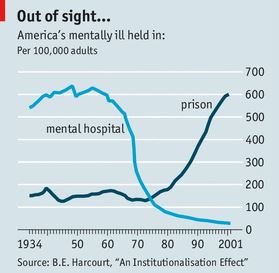 With nowhere to go and no treatment, “if someone decides he wants to walk around naked, or cannot give his name to a police officer, the likelihood is that he will end up in jail.” With nowhere to go and no treatment, “if someone decides he wants to walk around naked, or cannot give his name to a police officer, the likelihood is that he will end up in jail.”
The article highlights the story of Tracey Aldridge. Aldridge has been arrested 100 times and jailed 27 times since 1994. Her arrests were for relatively minor crimes including trespassing, prostitution, drugs, disorderly conduct, petty theft and drinking in public. “At only 42, Ms. Aldridge has already cost taxpayers $719, 436 for her arrests and incarcerations.”
However, the cost to taxpayers is only one consideration. Clearly, the cost to Aldridge’s mental health is much more severe. The system’s failure to give Aldridge timely and appropriate care has led to a crippling illness that often necessitates special arm sleeves to prevent her from biting her own flesh and “[ripping] her veins out with her teeth.” Recently, she ate the special sleeves used to protect her.
When prisons and jails are the primary sources of mental health treatment for someone like Aldridge, our society is failing people who sometimes cannot help themselves. Sheriff Tom Dart, who runs the Cook County jail in which Aldridge is a frequent resident, describes the situation as “an abomination.”
The article goes on to say that “these days it is very rare for people to be put in a mental health institution unless they are a danger to themselves or others.” Utilizing Illinois’ assisted outpatient treatment (AOT) law would not only be more cost effective but also a more humane way to provide treatment for people before they end up in the criminal justice system.
To comment, visit our Facebook page.
Visit our blog archive to read all our recent posts.
“I Thought I Was a Prophet”
(Aug. 6, 2013) “It isn’t easy to be crazy. But seven years on this path has taught me that people with mental illness are some of the most resilient and courageous people there are.”
 Michael Hedrick has been battling schizophrenia for the last seven years. His firsthand account of his psychotic break and subsequent delusions takes the reader inside the logic of his “cracked mind.” (“I thought I was a prophet,” Salon.com, August 2). Michael Hedrick has been battling schizophrenia for the last seven years. His firsthand account of his psychotic break and subsequent delusions takes the reader inside the logic of his “cracked mind.” (“I thought I was a prophet,” Salon.com, August 2).
Michael describes how his first delusions brought him across the county to carry out “God’s will” as a prophet tasked with saving the world. After a period of hospitalization in a psychiatric ward in Boulder, Colorado, Michael struggled to return to a normal life and combat his paranoid thoughts.
“To be unsure of your own mind is a prison, one that can break some of us. It simply becomes easier to slip into homelessness or drug abuse, but I fought against that,” Michael relates. Today, he consistently takes his medication (while working to counter the side effects), has health care, a career and a close family that checks in on him.
Michael also writes about societal preconceptions that people with serious mental illness are violent “monsters” and shares his efforts to “change minds” and fight stigma of mental illness.
Ultimately, Michael realized that despite the side effects of his medication, his treatment plan made him feel “okay” and that was much better than the alternative.
To comment, visit our Facebook page.
Visit our blog archive to read all our recent posts.
Is Anosognosia Real? First Microscopic Study of the Brain Says Yes
(Aug. 5, 2013) There are now 20 studies of the brains of individuals with schizophrenia using neuroimaging techniques to determine whether the brains of individuals with anosognosia (poor insight) are different from the brains of individuals who do not have anosognosia (good insight).
 Of the 20 studies, 18 reported clear differences and two did not. Two of the positive studies were done on individuals who had never been treated with antipsychotic drugs, so the observed differences clearly were not a drug effect. Thus, using neuroimaging techniques, it is apparent that the brains of individuals with anosognosia are different from the brains of individuals who do not have anosognosia. Of the 20 studies, 18 reported clear differences and two did not. Two of the positive studies were done on individuals who had never been treated with antipsychotic drugs, so the observed differences clearly were not a drug effect. Thus, using neuroimaging techniques, it is apparent that the brains of individuals with anosognosia are different from the brains of individuals who do not have anosognosia.
Neuroimaging techniques, such as magnetic resonance imaging (MRI) are rather gross measures of the brain. Such studies are done on people who are alive and are like the pictures from an airliner at 20,000 feet; you can see the contours and major features of the land but not the small details.
We now have some of those details. For the first time, a report was recently published on postmortem research on the brains of people with schizophrenia – some of whom had had anosognosia and some did not – looking at their brain cells under a microscope. The research was carried out by a highly experienced Russian group that does neuropathological research under the leadership of Dr. Natalya Uranova at the Mental Health Research Center in Moscow .*
In this research, anosognosia was assessed after death by examining the person’s medical records. Indication of anosognosia included the person’s explicit denial of illness, refusal to take medication, failure to follow treatment plans, and multiple re-admissions. The brains of 24 individuals with schizophrenia were assessed. Nine of them did not have anosognosia (they had good insight and awareness of illness), and 15 exhibited symptoms of anosognosia (fair or poor insight and awareness of illness). The brain areas examined were two parts of the inferior parietal lobule, a brain area known to be involved in insight.
The results of the study showed a 21% reduction in glial cells (specifically obligodendroglia) in the brains of the individuals with anosognosia (fair or poor insight). Those with anosognosia differed statistically from the normal control brains (p=0.04) and at the borderline statistically from those without anosognosia (p=0.055). The brains of the individuals without anosognosia (good insight) did not differ from the normal controls.
Summary: This is the first study that has assessed microscopically the brains of people who have died with schizophrenia, some of whom had anosognosia and some of whom did not. Those with anosognosia had fewer glial (obligodendroglial) cells. Such research is continuing.
For more information about lack of awareness into illness, see our Frequently Asked Questions about Anosognosia page and watch our four-minute video that includes dramatic footage of an accused killer with symptoms of anosognosia being interviewed.
* Vostrikov et al, Reduced obligodenroglial density in the inferior parietal lobule and lack of insight in schizophrenia. European Journal of Psychiatry 27:111-121, 2013.
To comment, visit our Facebook page.
Visit our blog archive to read all our recent posts.
|
|