Caring for the Caregiver on Mother's Day
(May 10, 2013) Mother’s Day has a special meaning to us here at the Treatment Advocacy Center.
 Mothers so often are the primary caregivers fighting to ensure their loved ones get the treatment they need. They are also part of the reason so many laws have improved over the past 15 years. Half the people we have honored with our Torrey Advocacy Commendation have been mothers as they and countless others fought to change treatment laws. Mothers so often are the primary caregivers fighting to ensure their loved ones get the treatment they need. They are also part of the reason so many laws have improved over the past 15 years. Half the people we have honored with our Torrey Advocacy Commendation have been mothers as they and countless others fought to change treatment laws.
Mothers – and other family members – benefit when the fight to make treatment possible succeeds. A study published in 2004 examined the impact of assisted outpatient treatment (AOT) on those who serve as primary caregivers for people with severe mental illness (typically, family members). When stress on caregivers of individuals who received AOT for at least six months was compared with stress on caregivers of those who received brief AOT or no AOT, extended participation in a court-ordered outpatient treatment was found to significantly reduce caregiver stress.
Not surprisingly, improved treatment adherence also reduced caregiver stress, but the study found that just having a loved one in AOT – regardless of treatment adherence – was a stress-buster. AOT, the authors concluded, “contributes significantly to reduced caregiver strain, over and above its effect on treatment adherence” (Groff et al. 2004).
As Mother’s Day approaches, the Treatment Advocacy Center salutes all the mothers and caregivers among us and wishes for every one the benefits of timely and effective treatment of their loved ones.
To comment, visit our Facebook page.
Visit our blog archive to read all our recent posts.
Two Bills Expanding Access to Treatment Signed Into Law
(May 9, 2013) Bills that will make treatment possible for more people with severe mental illness in two states were signed by their governors in April.
 Montana Gov. Steve Bullock signed HB 16. The new law, which takes effect in October, will make it easier for people with severe mental illness to get treatment by allowing an officer to initiate an emergency evaluation for a person with mental illness who appears unable to meet his or her own basic needs of clothing, shelter, food, health or safety. Currently, the law requires imminent danger of death or bodily harm before an officer can initiate an emergency evaluation. The bill was supported by a number of Montana advocates who worked tirelessly for its passage. Montana Gov. Steve Bullock signed HB 16. The new law, which takes effect in October, will make it easier for people with severe mental illness to get treatment by allowing an officer to initiate an emergency evaluation for a person with mental illness who appears unable to meet his or her own basic needs of clothing, shelter, food, health or safety. Currently, the law requires imminent danger of death or bodily harm before an officer can initiate an emergency evaluation. The bill was supported by a number of Montana advocates who worked tirelessly for its passage.
Meanwhile, Indiana Gov. Mike Pence signed HB 1130 into law. The bill will further empower police officers to detain and transport people with severe mental illness who appear to be gravely disabled for psychiatric evaluation. This new law will ultimately make it much easier to secure treatment for people in the midst of a crisis.
Both bills illustrate how strong the tide of reform is this year. However they are achieved, treatment law reforms save lives and family and are cause for celebration. We are celebrating these and applauding the policy makers and advocates who made them happen.
To comment, visit our Facebook page.
Visit our blog archive to read all our recent posts.
NEW! Tools for Responding to Myths About AOT
(May 8, 2013) One of the ways the Treatment Advocacy Center fights barriers to treatment of severe mental illness is by giving supporters tools they can use to combat misinformation and misunderstanding whenever they encounter it.
 We’ve just added a new resource to our website: an analysis of the “OTCET” study of compulsory treatment in England, which has been erroneously interpreted as a study addressing assisted outpatient treatment (AOT). It doesn’t. Here is a one-page summary of our analysis. We’ve just added a new resource to our website: an analysis of the “OTCET” study of compulsory treatment in England, which has been erroneously interpreted as a study addressing assisted outpatient treatment (AOT). It doesn’t. Here is a one-page summary of our analysis.
Other useful tools we provide to help combat common myths about severe mental illness and assisted outpatient treatment include:
If these resources help you, they’ll help others. Please be sure to share them widely!
To comment, visit our Facebook page.
If You Live or Work With Someone With Severe Mental Illness, This Tool Is For Your
(May 7, 2013) It’s the Treatment Advocacy Center’s new mobile “Psychiatric Crisis Resources Kit,” a smartphone app that puts critical information into the hands of families dealing with acute psychiatric crises – whenever and wherever the emergency strikes.
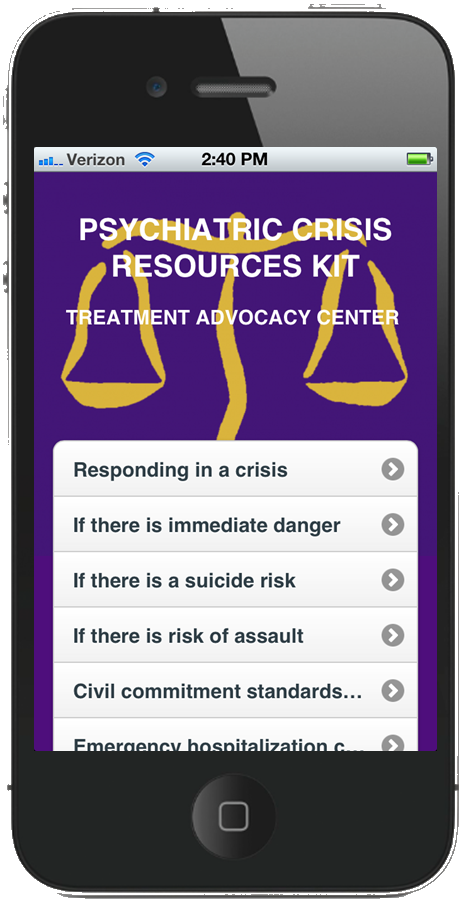 In the application: state-specific standards for emergency hospitalization and for who can initiate treatment; inpatient and outpatient commitment criteria by state; tips on navigating the Health Insurance Portability and Accountability Act (HIPAA); and information on responding to specific kinds of psychiatric emergencies such as suicide or assault danger. In the application: state-specific standards for emergency hospitalization and for who can initiate treatment; inpatient and outpatient commitment criteria by state; tips on navigating the Health Insurance Portability and Accountability Act (HIPAA); and information on responding to specific kinds of psychiatric emergencies such as suicide or assault danger.
"We believe this mobile application will help address the need for immediate, practical information that families, friends and others experience when someone with a severe mental illness is in crisis," said Doris A. Fuller, executive director of the Treatment Advocacy Center.
Open this link on your smartphone to download the app. Scroll to “How to use this app” for instructions or hit "Share this app" to pass it along right now. If you have a blog, website or newsletter or you use Facebook or Twitter, share it there, too!
A printable flyer you can distribute in your community can be downloaded. The flyer features a QR code for the app as well as a URL. Don’t know how to use a QR code? Go to the app store on your smartphone and download a QR reader.
If you work in an emergency room or doctor’s office, with a law enforcement agency or mental health professional or anywhere that public information is posted, download this flyer with the QR code so people can download it anywhere and start using it today.
The DSM: A “Dictionary,” Not a “Bible”
(May 7, 2013) NIMH Director Thomas Insel set the mental health world abuzz last week when he blogged that the National Institute of Mental Health will be “re-orienting its research away from DSM categories.” A new edition of the Diagnostic and Statistical Manual for Mental Disorders (DSM-5) is due to be released later this month.
 “While DSM has been described as a ‘Bible’ for the field, it is, at best, a dictionary, creating a set of labels and defining each (psychopathology),” said Insel in “Transforming diagnosis” (Director’s Blog, April 29). He said that people “with mental disorders deserve better” than a menu of diagnoses that ensures clinicians use the same terms in the same ways but lacks scientific basis. “While DSM has been described as a ‘Bible’ for the field, it is, at best, a dictionary, creating a set of labels and defining each (psychopathology),” said Insel in “Transforming diagnosis” (Director’s Blog, April 29). He said that people “with mental disorders deserve better” than a menu of diagnoses that ensures clinicians use the same terms in the same ways but lacks scientific basis.
“(Y)ou know what?” he told the New York Times. “Biology never read that book” (“Psychiatry’s guide is out of touch with science,” May 6).
Insel said psychiatric diseases need to be defined by their biology, genetics and neuroscience – their causes – not by their symptoms.
“Unlike our definitions of ischemic heart disease, lymphoma, or AIDS, the DSM diagnoses are based on a consensus about clusters of clinical symptoms, not any objective laboratory measure,” he blogged. “In the rest of medicine, this would be equivalent to creating diagnostic systems based on the nature of chest pain or the quality of fever.”
Insel said an 18-month-old NIMH project is underway “to transform diagnosis by incorporating genetics, imaging, cognitive science, and other levels of information to lay the foundation for a new classification system.“
As supporters and partners in scientific study of severe mental illness, the Treatment Advocacy Center applauds the NIMH’s direction. As long as psychiatric disease is described in behavioral terms, it will be treated as a behavior, not a disease.
To comment, visit our Facebook page.
Visit our blog archive to read all our recent posts.
The OCTET Study of English Compulsory Treatment – A Summary
(May 7, 2013) The Oxford Community Treatment Order Evaluation Trial (OCTET), published in the April 2013 issue of the British medical journal The Lancet, compared hospital re-admission rates between two randomized groups of psychiatric outpatients. Both groups received intensive mandated community supervision upon hospital discharge but under different legal mechanisms.
The study, “Community treatment orders for patients with psychosis (OCTET): a randomised controlled trial” (March 26, 2013), found no difference in subsequent hospital re-admissions between the two groups, despite significantly longer periods spent under mandated treatment by one group.
Some have suggested that the OCTET findings raise questions about court-ordered “assisted outpatient treatment” (AOT), a U.S. treatment option that has no British equivalent and has been reported in multiple studies to produce vastly improved treatment outcomes.
While the OCTET study may have value as a source of information about two English mandatory treatment programs, it adds nothing to the body of knowledge on AOT in North America, much less to the question of whether AOT offers benefits over voluntary treatment.
In summary, the OCTET study:
- Sheds no light on the North American AOT model because neither form of mandatory treatment that was studied is equivalent to AOT.
- Compares two similar forms of mandatory treatment to one another, not the outcomes of mandatory treatment to outcomes for voluntary treatment.
- Is based on a randomized sample that is suspect (e.g., including a great many individuals who would not have qualified for AOT under the strict criteria typically used in the U.S. and it excludes many of the very patients who would qualify).
For a detailed analysis of the OCTET study in The Lancet, see our May 2013 backgrounder, “No Relevance to Assisted Outpatient Treatment in the OCTET Study of English Compulsory Treatment.”
For a summary of research on the efficacy of AOT, see our January 2012 backgrounder “Assisted Outpatient Treatment.”
RESEARCH: Timely Treatment = Better Prognosis
(May 3, 2013) A new study of first-episode psychosis has found that the longer patients are untreated following an initial episode, the longer it takes them to respond to treatment once it begins.
 A team of researchers from the University of Cantabria in Spain followed 153 patients who underwent treatment following a first psychotic break (“Delayed psychosis treatment harms chance of success,” a research summary from News.Medical.net, April 29; not yet available online). Patients who achieved remission within a year of starting treatment had an average duration of untreated psychosis of 8.8 months. Patients who did not experience remission within a year were, on average, psychotic for 15.6 months before treatment began. A team of researchers from the University of Cantabria in Spain followed 153 patients who underwent treatment following a first psychotic break (“Delayed psychosis treatment harms chance of success,” a research summary from News.Medical.net, April 29; not yet available online). Patients who achieved remission within a year of starting treatment had an average duration of untreated psychosis of 8.8 months. Patients who did not experience remission within a year were, on average, psychotic for 15.6 months before treatment began.
The researchers found that three factors predicted remission:
- Duration of the untreated psychosis;
- Severity of negative symptoms;
- No education beyond primary school.
"Early intervention clinical programs should aim to reduce the length of DUP [duration of untreated psychosis] in order to provide a better outcome for patients," according to author Benedicto Crespo-Facorro. The authors also identified the lack of effective medications for negative symptoms as “a major unmet need in schizophrenia treatment.”
To comment, visit our Facebook page.
Visit our blog archive to read all our recent posts.
"Why Didn't They Do Something to Prevent That Tragedy?" – guest commentary
(May 3, 2013) After each such tragedy – whether it be the elementary school in Newtown…the Aurora shooting at the movie theatre, the shooting at the shopping center in Tucson…the Virginia Tech massacre, I hear people say – “now those parents knew their sons were ill…why didn’t they do something to prevent that tragedy?” You’d be surprised how many people don’t realize that once your child reaches age 18, parents can’t force them to take their meds or be treated.
 According to the National Institute of Mental Health, there are in this country an estimated 7.7 million people who suffer from the most severe mental illnesses – schizoaffective disorder, bipolar disorder and schizophrenia. Among them, only a small fraction ever become violent, and then, usually when they fail to get treatment. Catching the problem early is crucial. Yet parents seeking help are often turned away, or lose control when their children turn 18. According to the National Institute of Mental Health, there are in this country an estimated 7.7 million people who suffer from the most severe mental illnesses – schizoaffective disorder, bipolar disorder and schizophrenia. Among them, only a small fraction ever become violent, and then, usually when they fail to get treatment. Catching the problem early is crucial. Yet parents seeking help are often turned away, or lose control when their children turn 18.
State laws vary, but all states set strict controls regarding involuntary hospitalization, limiting it to circumstances when a person is an imminent danger to self or others, or likely to become so. These laws give people with severe mental illness the right to decide when, where, how, or even if they will receive care. Yet some serious mental illnesses make it difficult for those affected to assess their need for treatment. When patient rights exceed necessary protections, individuals with a severe untreated mental illness can die because we’ve protected their civil liberties to remain mentally ill and refuse treatment. Many do die. And, sometimes they harm others along the way. The general public also has rights…the right to be protected from the consequences of non-treatment.
I’m the mother of a son who suffered from severe and persistent bipolar disorder. Despite the extraordinary and loving efforts of his family, my son’s bipolar ruined his life; his downward course was aided by a completely ineffective legal system that continually protected his civil right to remain severely mentally ill.
Medication compliance is the key to living with bipolar disorder or any mental illness. My son was not medication compliant. I don’t know why he would stop taking his meds…he just did. I’m not even sure he knew why. He, at times, lacked insight and used poor judgment. When this happened, the map for his recovery was full of dead ends, and both he and his family suffered the consequences. Click here to continue reading this poignant commentary by -
To comment, visit our Facebook page.
Viisit our blog archive to read all our recent posts.
"When Tragedies Occur, 'I Stay Glued to the TV'"
(May 2, 2013) When tragedies like Sandy Hook occur “I stay glued to the TV because I am so afraid Edward did it ‘cause he is out there and he’s going to do this and nobody will take him off the street,” says Sylvia Benninger (“Mom fears mentally-ill stepson will act on death threats,” ABC News, April 30.)
 Benninger is referring to her stepson, Edward, 50, who has been diagnosed with schizoaffective disorder and deemed to be dangerous. She says “he has left hundreds of threatening phone messages against family members.” He also has a history of threatening public figures, including judges in Pittsburgh and a federal judge in Indiana. Benninger is referring to her stepson, Edward, 50, who has been diagnosed with schizoaffective disorder and deemed to be dangerous. She says “he has left hundreds of threatening phone messages against family members.” He also has a history of threatening public figures, including judges in Pittsburgh and a federal judge in Indiana.
“He has never once stayed on his treatment plan, and I know of at least a dozen institutions he has been in. And he always goes back to his psychotic state,” his stepmother Benninger told the network.
The Benninger’s believe that Edward is currently in California. They have received multiple phone calls from law enforcement and doctors warning them that their stepson with severe mental illness is intent on killing his father. Edward has an extensive psychiatric and criminal record and represents one more example why every state needs better mental health treatment laws to allow families to get help for a loved one before they are dangerous.
Laura’s Law in California is one such tool that needs to be implemented statewide to help people like Edward get and stay well.
It is because of the prospect of helping people like Edward that two recent votes on Laura’s Law by the California Senate Committee on Health give us hope.
SB 664 removes the requirement that each county board of supervisors adopt a resolution prior to implementing the assisted outpatient treatment (AOT) law. California is the only state that requires each county to opt in to AOT, creating a hurdle that is unnecessary and obstructive.
SB 585 clarifies that money from the Mental Health Services Act (MHSA) can be used to fund the program. Confusion about whether MHSA funds can be used for Laura’s Law has been a persistent barrier to its implementation by California counties. Removing this barrier will be a crucial step toward making assisted outpatient treatment more widely available to qualifying individuals with severe mental illness.
SB 585 is scheduled to be heard May 6 in the California Senate Appropriations Committee.
To find out how you can help, email us at
This e-mail address is being protected from spambots. You need JavaScript enabled to view it
.
To comment, visit our Facebook page.
Visit our blog archive to read all our recent posts.
It's Time to Start Brainstorming!
(May 1, 2013) It’s May Day, the annual kickoff for Mental Health Awareness Month, an observance that’s been around since 1949 to “raise awareness of mental health conditions and mental wellness for all.”
 Last year, we promoted awareness of what’s tragically missing in many people with severe mental illness: awareness of their own mental illness. The brain condition called “anosognosia” gets in the way of improved mental health for about half the people with diagnoses of schizophrenia or bipolar disorder. Last year, we promoted awareness of what’s tragically missing in many people with severe mental illness: awareness of their own mental illness. The brain condition called “anosognosia” gets in the way of improved mental health for about half the people with diagnoses of schizophrenia or bipolar disorder.
This year, we want to bring attention to an opportunity to submit your views about mental health science and policy to IMHROs Brainstorm Essay Contest, starting today and running through the month of May. Contestants may submit essays of up to 650 words in length in one or both of two areas:
- What one discovery or technology would you most like to see emerge from neuropsychiatric science in the next five years, and why?
- What one update to national mental health policy would you like to see instituted in the next five years, and why?
To help writers get started, IMHRO has suggested some topics. The first one under "national mental health policy" is “Legal reform enabling court ordered outpatient treatment for persons with a history of dangerousness or re-hospitalizations due to noncompliance.”
Here’s an opportunity to put your passion for mental illness treatment law reform and your talents to work!
Our proposed nationwide assisted outpatient treatment (AOT) demonstration project is a “national mental health policy” that could profoundly change the lives of individuals who could be living and functioning successfully in their communities but are instead trapped in the revolving door of non-treatment. “Toward a National Assisted Outpatient Treatment Demonstration Project” offers a quick primer on the policy we proposed to the president’s task force on gun violence.
Contest sponsor IMHRO – “International Mental Health Research Organization – is a nonprofit that focuses on neuropsychiatric research “to find preventions and cures for severe mental illnesses, focusing on schizophrenia, bipolar disorder, and major depressive disorder, within a generation.”
We applaud IMHRO for including public policy in its contest. Scientific research and breakthroughs in psychiatric disease are desperately needed. Until they come, public policies that make treatment possible for those too ill to seek it themselves are a crucial bridge to recovery.
To comment, visit our Facebook page.
|
|