One Year After Robin Williams’ Death
(Aug. 12, 2015) One year after Robin Williams took his own life following a long battle with mental illness, the actor and comedian continues to inspire many to seek help, evidenced by an ‘unprecedented’ rise in suicide hotline calls since his death (“Robin Williams left ‘unprecedented’ mark on suicide hotlines,” Newsweek, Aug. 11)
 “At the time of the loss [of Williams], there was such an enormous spike in interest in the whole topic of suicide,” says Robert Gebbia, the CEO of the American Foundation for Suicide Prevention (AFSP). “We saw increases at the time in calls to the crisis line, visits to the website…I think there was a lasting bump in interest in our society by people around the country.” “At the time of the loss [of Williams], there was such an enormous spike in interest in the whole topic of suicide,” says Robert Gebbia, the CEO of the American Foundation for Suicide Prevention (AFSP). “We saw increases at the time in calls to the crisis line, visits to the website…I think there was a lasting bump in interest in our society by people around the country.”
“In past times, people were afraid to talk about this,” Gebbia continued. “People were afraid to admit that they made a suicide attempt, or hid the fact that they lost a loved one to suicide. But I think all that is changing. The Robin Williams story is a part of that change.”
Gebbia’s message is critical and hopeful. But we also need to remember the risk of suicide for people who are too sick to seek help themselves.
The lifetime risk of suicide among individuals with bipolar disorder is 10-15 percent.
The rate of attempted suicide in individuals with severe mental illness is much higher, with some studies reporting 50 percent. It is even higher for people with anosognosia who don’t believe they are ill and refuse treatment.
In the year since Williams’ death, California has expanded access to treatment for people who are too sick to seek help for themselves and a handful of other states have also made critical changes.
For policymakers and sufferers of mental illness alike, we need to reinforce the message of hope that mental illness can respond to treatment. If the public and policy makers know that treatment works, maybe they will be more motivated to fix the system that could – and should – be providing it.
Read the Treatment Advocacy Center backgrounder on serious mental illness and suicide to learn more.
(Modified Photo: courtesy of Flickr users SynergyByDesign and Pete Prodoehl)
To comment, visit our Facebook page.
Visit our blog archive to read all our recent posts.
RESEARCH: Fish Oil May Delay Onset of Schizophrenia
(Aug. 11, 2015) Five years ago, an international team of researchers reported that a 12-week course of omega-3 reduced the risk of early psychotic symptoms progressing to schizophrenia in a study of 81 high-risk adolescents and young adults. The study took place over the course of a year.
 Now the researchers report the preventative effects of the fish oil intervention may six years or longer - a major step forward in the treatment of schizophrenia (“Longer-term outcome in the prevention of psychotic disorders by the Vienna omega-3 study,” Nature Communications). Now the researchers report the preventative effects of the fish oil intervention may six years or longer - a major step forward in the treatment of schizophrenia (“Longer-term outcome in the prevention of psychotic disorders by the Vienna omega-3 study,” Nature Communications).
Omega-3 fatty acids include EPA (eicosapentaenoic acid) and DHA (docosahexaenoic acid). Together, these are important ingredients of naturally occurring fish oil. The individuals included in this study conducted in Vienna, Austria, had experienced early symptoms characteristic of later schizophrenia, such as mild or fleeting feelings that their thoughts were being controlled or they were being followed, often accompanied by symptoms of anxiety or depression, but they had not yet developed the full manifestations of schizophrenia. Only 10 percent of the individuals in the omega-3 group of participants went on to develop a psychotic disorder in a seven-year study period compared with 40% of the group receiving a placebo, say authors G. Paul Amminger et al.
The omega-3 participants were also less likely to be prescribed antipsychotic medications or to meet diagnostic criteria for severe mental illnesses during the follow-up period. The majority of the people that received omega-3 were employed full-time at follow-up and no longer experienced psychotic symptoms at the end of the study period, according to the report.
“If the finding that omega-3 prevents transition to full-blown schizophrenia is replicated, this would be a major breakthrough in preventing this debilitating illness,” according to Treatment Advocacy Center founder Dr. E. Fuller Torrey. Torrey said individuals who elect to use this treatment at this time for the prodromal symptoms should use purified fish oil that contains both EP (eicosapentraneoic acid) and DHA (decsoahexanoic acid). The ratio used in the present trial was 700 mg EPA and 500 mg DHA (1.2 grams total per day). Other studies done to date have used between 1.0 and 4.0 grams of omega-3 per day.
The Stanley Medical Research Institute (SMRI) funded the original study by Amminger et al. in 2003 and the follow up study. SMRI currently is funding three additional studies of omega-3 in Australia and Europe and a trial of the use of omega-3 for individuals with bipolar disorder.
SMRI is a supporting organization of the Treatment Advocacy Center, whose mission includes promoting the development of innovative treatments for and research into the causes of severe and persistent psychiatric illnesses, such as schizophrenia and bipolar disorder.
(Photo: Hafiz Issadeen/Flickr)
To comment, visit our Facebook page.
Visit our blog archive to read all our recent posts.
“Uncommittable” Mentally Ill Slip through Gap in Minnesota System
(Aug. 6, 2015) Jack McClellan – a 62-year-old, veteran with mental illness – was charged with eight minor offenses in the span of six months last year in Minnesota. When McClellan came before the Hennepin County Court, he was deemed incompetent to face the charges against him and the case was sent to civil commitment court (“The uncommittables: How offenders with mental illnesses fall through the cracks of Minnesota’s criminal justice system,” MinnPost, July 20).
 But the Judge on the civil side did not believe McClellan posed enough danger to himself or others to qualify for civil commitment, and he was released. Three months later McClellan was back in court, this time wearing medical boots due to the severe frostbite he suffered while living homeless on the streets. But the Judge on the civil side did not believe McClellan posed enough danger to himself or others to qualify for civil commitment, and he was released. Three months later McClellan was back in court, this time wearing medical boots due to the severe frostbite he suffered while living homeless on the streets.
McClellan is a “gap patient,” or “uncommittable.”
His mental illness means he is considered not competent enough to face criminal charges, but he also doesn’t meet the standard for court-ordered mental health treatment. As a result, McClellan and many others fall through the cracks of the public health system.
Last year, more than half of those deemed incompetent to face charges were also uncommittable, according to the Post.
“It should be obvious that our system is failing when it allows about one-half of the people who are too mentally ill to face a criminal charge to be simply turned out to the streets without treatment,” said Judge Jay Quam, who previously presided over Hennepin’s civil commitment court.
Gap patients like McClellan frequently cycle back into the system repeatedly, until they become dangerous or disabled and are finally committed. In the meantime, particularly if they’re not getting treatment, their mental and physical health deteriorates.
Hennepin County Judge Kerry Meyer believes that cases like McClellan's shouldn't have to escalate before patients can get court-ordered help. “Just because a person does not meet the commitment standard does not mean he or she would not benefit from services,” Meyer says.
We agree.
In a few states, like Minnesota, grounds for committing a patient to the mental health system is “dangerousness” – the requirement that an individual be an immediate, physical danger to self or others.
That leaves most people with severe mental illness, like McClellan, out in the cold – not quite dangerous, but susceptible to deterioration and needless suffering.
(Photo: Pawel Loj/Flickr)
To comment, visit our Facebook page.
Visit our blog archive to read all our recent posts.
NEW BILL TO REDUCE MASS INCARCERATION FOCUSES ON MENTAL ILLNESS
Senator John Cornyn (R-TX) this week introduced sweeping criminal justice reform legislation aimed at reducing mass incarceration of people with mental illness.
The Mental Health and Safe Communities Act would expand federally proven programs that provide treatment for people with mental illness before they become involved in confrontations with law enforcement, a strategy long advocated by mental health experts, including the Treatment Advocacy Center. The bill also increases training for law enforcement on how to interact with people in a psychiatric crisis and expands data collection on the criminalization of mental illness.
The measure is the most comprehensive proposal to date to deal with the decades’ old problem of warehousing people with mental illness in jails and prisons.
“For too many people who aren’t able to access lifesaving mental health treatment, interaction with the criminal justice system has led to even greater injustice,” said John Snook, executive director of the Treatment Advocacy Center.
“Law enforcement is increasingly on the frontlines of mental health, a position that wastes resources and too often leads to tragic outcomes,” the executive continued. He said as much as twenty percent of the incarcerated population and fifty percent of the people shot and killed by law enforcement each year suffer from a mental illness.
Among many important provisions, the Mental Health and Safe Communities Act would:
- Make assisted outpatient treatment (AOT) eligible for federal funding. AOT provides court-ordered treatment in the community for at-risk people with severe mental illness and has been shown to significantly reduce crime and violence among its target population.
- Fund mental health courts, programs proven to divert qualifying criminal defendants with mental illness from jail into community-based mental health treatment. Nationwide, less than 40% of the U.S. population lives in jurisdictions with mental health courts.
- Promote crisis intervention team training (CIT) for law enforcement. These teams consist of officers who are trained to respond to calls involving mental illness and are consistently found to reduce the arrest and incarceration of individuals with severe mental illness. Nationwide, only 49% of the U.S. population lives in jurisdictions where police departments are using CIT.
- Require reporting on the criminalization of severe mental illness, including reporting on homicides when individuals with mental illness are involved and the cost of treating severe mental illness in the criminal justice system.
The Treatment Advocacy Center supports the efforts of Senator Cornyn to reduce mass incarceration of people with serious mental illness and commends him for providing needed federal leadership in this area.
Severe Mental Illness the Focus of Newly Introduced Senate Mental Health Reform Bill
(Aug. 4, 2015) Bipartisan legislation to address the needs of people with severe mental illness was introduced in the US Senate today ("Mental-health reform gaining momentum in Congress," National Journal, Aug. 4).
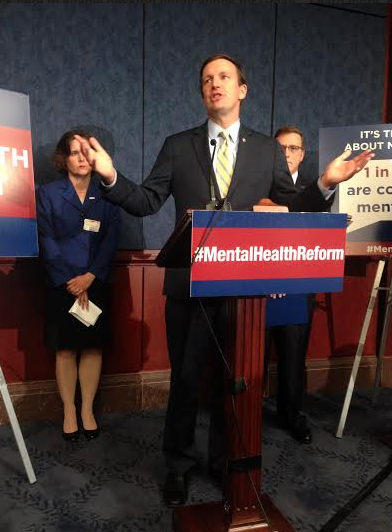 Senators Chris Murphy (D-CT) and Bill Cassidy (R-LA) said the Mental Health Reform Act of 2015 "identifies the weaknesses in our current mental health care delivery system and seeks to reform America’s mental health system so that it meets the needs of all patients." Senators Chris Murphy (D-CT) and Bill Cassidy (R-LA) said the Mental Health Reform Act of 2015 "identifies the weaknesses in our current mental health care delivery system and seeks to reform America’s mental health system so that it meets the needs of all patients."
“Many provisions in this bill are similar to those in the landmark bipartisan Helping Families in Mental Health Crisis Act recently reintroduced in Congress by Representatives Murphy and Johnson,” said John Snook, executive director of the Treatment Advocacy Center. “Together, the two bills demonstrate that members of our federal government are finally tackling the extreme inequities in our nation’s mental health system - a system that has ignored and discouraged treating our most vulnerable and ill."
Among other important provisions the bill would:
- Make it easier for states to implement assisted outpatient treatment (AOT) programs by extending a federal grant program for local jurisdictions until 2020. AOT has been found to reduce homelessness, repeat hospitalizations, incarceration and episodes of violence among people with severe mental illness, but only New York has fully implemented its AOT law.
- Increase insurance coverage for people with severe mental illness by easing the IMD exclusion to allow Medicaid reimbursement for acute stays for adult patients in psychiatric care facilities.
- Clarify HIPAA to ensure that families of people with severe mental illness have access to critical information concerning their loved ones.
“This legislation comes at a time when we can see the consequences of untreated severe mental illness in our jails and emergency rooms, among families desperate for help and in communities that have been shattered by violence,” Snook said. “If passed into law these provisions would expand access to treatment through proven outpatient treatment programs, increase insurance coverage and provide guidance to families and providers."
"We might finally see a better mental health system," the executive said.
To comment, visit our Facebook page.
Visit our blog archive to read all our recent posts.
How to Fix a Major Problem in the LAPD – guest commentary
(Aug. 4, 2015) With respect to the question of why police decided to confront 25-year-old Ezell Ford in South Los Angeles on Aug. 11, 2014, when we ask broader questions, the root cause of police involvement in incidents like this one becomes obvious.
 Why do four times the number of people with mental illness receive treatment in jail or prison than in proper treatment facilities? Why do four times the number of people with mental illness receive treatment in jail or prison than in proper treatment facilities?
Why can people with severe mental illness expect to live 25 fewer years than others? Why do up to two-thirds of people with mental illness have a co-morbid medical disorder?
With any other medical illness, a person is given treatment based on symptoms. In California, people with mental illness must become gravely disabled or a danger to themselves or others to be compelled to get treatment, assuring danger and that many deteriorate to the point they are on the street, end up in prison, are victimized or die.
California law needs to be changed. Waiting for danger is waiting too long.
BRIAN JACOBS
NAMI ORANGE COUNTY, CALIFORNIA
Read this column and the original article.
(Photo: Rick Loomis/Los Angeles Times)
To comment, visit our Facebook page.
Visit our blog archive to read all our recent posts.
Handcuffed by an Expensive, but Useless System
(August 3, 2015) A significant portion of the mentally ill population in California are either warehoused in jails and prisons – widely regarded as the country’s de facto mental institutions – or left homeless and untreated on the streets.
 But police and others worried about the number of mentally ill homeless in Sacramento are at a loss, as the shrinking number of public psychiatric beds and mental health funding creates a grim reality that is both literally and figuratively taxing for all involved (“People with mental illness left homeless, helpless,” KXTV, July 14). But police and others worried about the number of mentally ill homeless in Sacramento are at a loss, as the shrinking number of public psychiatric beds and mental health funding creates a grim reality that is both literally and figuratively taxing for all involved (“People with mental illness left homeless, helpless,” KXTV, July 14).
"I don't remember it ever being this bad,” said Sacramento Police officer Michelle Lazark.
US census data estimates that there are nearly 400 homeless people with severe mental illness in Sacramento alone, and 40,000 statewide.
Sacramento law enforcement are concerned by the number of mentally ill homeless but are handcuffed by funding cuts and policy changes, which continue to leave the most severely ill untreated, said Lazark.
"The [problem] is that we've lost 2,000 in-patient hospital beds for psychiatric patients in the last 15 years," explained Randall Hagar, Government Affairs Director of the California Psychiatric Association. "We have a 45-year-old treatment law that needs to be updated that is really not serving people well."
Hagar notes that a large percentage of severely mentally ill Californians are criminalized and end up in prison – a huge cost for taxpayers and an injustice to families and patients.
"Just to house somebody in a jail, I think costs $45,000 to $50,000 per year," Hagar said. "And then if you add treatment costs on top of that, you've got a very expensive situation for someone who's mentally ill."
Indeed, the Department of Corrections reports that it houses 30,000 mentally ill inmates – roughly a third of the entire prison population.
It would cost approximately $1.5 billion to treat all 30,000 inmates in the prison system with average counseling and housing expenses totaling $50,000.
In contrast, the estimated cost for psychiatric care in a community-based treatment system is estimated at about $30,000 – a $600 million a year savings in what most experts and families of patients believe is the best system for now.
Hopefully, Sacramento will follow the lead of other California counties, like Kern County, and authorize Laura’s Law when it comes up for vote later this year.
Read the Treatment Advocacy Center report “Considerations for Demonstrating the Cost Effectiveness of AOT Services” to learn more.
(Photo: Mindsay Mohan/Flickr)
To comment, visit our Facebook page.
The Treatment Advocacy Center Stands with the ACLU
(July 31, 2015) The American Civil Liberties Union (ACLU) filed suit yesterday against two California agencies for leaving people with mental illness and developmentally disabled defendants to languish in jail – and often deteriorate – when they are not competent to stand trial.
 In Stiavetti et al. v. Ahlin et al, ACLU of Northern California and the law firm Sullivan & Cromwell contend this practice is unconstitutional (ACLU sues state hospital system for failing mentally ill and developmentally disabled criminal defendants,” ACLU, July 29). In Stiavetti et al. v. Ahlin et al, ACLU of Northern California and the law firm Sullivan & Cromwell contend this practice is unconstitutional (ACLU sues state hospital system for failing mentally ill and developmentally disabled criminal defendants,” ACLU, July 29).
“While these vulnerable defendants wait for transfer to treatment facilities, they’re stuck in a tragic limbo,” said ACLU of Northern California Senior Staff Attorney Michael Risher. “They’re not receiving any treatment that would enable them to stand trial, and defendants often end up serving much more jail time than they would have under normal circumstances.”
The Treatment Advocacy Center stands with the ACLU to condemn the practice of warehousing mentally ill defendants in jail rather than transferring them in a timely manner to facilities with the resources to provide the treatment they so desperately need.
The following resources from the Treatment Advocacy Center provide data and other information about the treatment of California inmates with severe mental illness and treatment options in the state:
A copy of the lawsuit and the ACLU Northern California announcement are online at ACLUNC.
(Photo: Caitlin Regan/Flickr)
To comment, visit our Facebook page.
Visit our blog archive to read all our recent posts.
Kern County Authorizes Laura's Law
(July 30, 2015) The Kern County Board of Supervisors voted to implement Laura’s Law countywide this week, making it the latest California county to embrace assisted outpatient treatment as a tool for providing treatment to people with severe mental illness who are too ill to seek help for themselves ("County to mandate treatment for those with serious mental illness," Bakersfield Californian, July 28).
 “Passing Laura’s Law helps provide better services to everyone in their community. It saves money, it saves lives and it helps people get well,” said Carla Jacobs, a member of the Treatment Advocacy Center Board of Directors. “It’s time every county implement this vital program.” “Passing Laura’s Law helps provide better services to everyone in their community. It saves money, it saves lives and it helps people get well,” said Carla Jacobs, a member of the Treatment Advocacy Center Board of Directors. “It’s time every county implement this vital program.”
Others echoed support for the passage of Laura’s Law in Kern County.
“It is critically important that we manage the health care of [people with severe mental illness] as best we can,” said Kern County Supervisor Mick Gleason, whose family member with mental illness refuses treatment.
“Laura’s Law will keep people with severe mental illness out of the hospital,” said Brad Cloud, the deputy director of Kern’s mental health department.
Members of law enforcement also applauded the decision.
People who suffer with a severe mental illness get trapped in an unending loop of trouble when they refuse treatment, said Sheriff Donny Youngblood in support of the decision to implement Laura’s Law.
“Across this country our largest mental health facilities are our jails,” Youngblood said. “We have to change that. Jails are not the right people to treat people with mental illness.”
California was unique in the United States when it included in Laura’s Law a requirement that each county opt in with a vote by its Board of Supervisors. With this vote 11 California counties have fully implemented the law, but families in the state’s other 47 counties are still without access to this proven method of supporting recovery from the most severe mental illness and saving taxpayer dollars.
Nevada County, which implemented Laura’s Law in 2008, estimates it saves $1.81 for every $1 invested. A recent study in New York, where every county has implemented its version of Laura’s Law, found that mental health services could be expanded beyond AOT participants with the savings from these high utilizers of public systems staying in treatment.
Read more about assisted outpatient treatment in California.
To comment, visit our Facebook page.
Visit our blog archive to read all our recent posts.
Helping Those Trapped in the Hell of Their Own Minds – guest commentary
(July 29, 2015) My son is a paranoid schizophrenic. His mother, sister, and I slowly watched a popular, happy, academically successful and extroverted teen turn into an individual who’s completely separated from reality, utterly delusional, suffering auditory and visual hallucinations, and wracked by paralyzing fear and suicidal depression.
 When my son could no longer hide his delusions and had his first complete psychotic break, we took him to the Hillsborough County Mental Health Center. There, he was diagnosed with schizophrenia and given medication for anxiety. Yes, read that again: anxiety. When my son could no longer hide his delusions and had his first complete psychotic break, we took him to the Hillsborough County Mental Health Center. There, he was diagnosed with schizophrenia and given medication for anxiety. Yes, read that again: anxiety.
Three months later my beautiful son was nothing more than a calm schizophrenic trapped in a nightmarish hell within his own mind. He saw only one way out: suicide. When he spoke openly of this to a teacher at school, we decided to take him back to the hospital, but we knew the last one was unsatisfactory and of no use.
His mother discovered St. Joe’s in Tampa has a pediatric wing for mental health. He was admitted and given a sleep aid, a different anxiety medication, an antidepressant, and finally an antipsychotic. This cocktail of medication, along with counseling, slowly — very slowly — brought my son back to life.
But why did we have to go through this? Why couldn’t the first hospital help my son? HCMH works under rules governed by the federal government. St. Joe’s, a private hospital, does not. But what if I told you there is a bill in Congress to address the many failings of the current approach of the federal government to mental health?
The name of the bill is Helping Families in Mental Health Crisis. Congressman Tim Murphy of Pennsylvania is the author, and it is a comprehensive overhaul of current law. This landmark, society-changing piece of legislation will give much-needed help to individuals trapped in the hell of their own minds...
WAYNE HILTON
TAMPA, FLORIDA
Read the entire column.
(Photo: Adltya Doshl/Flickr)
To comment, visit our Facebook page.
Visit our blog archive to read all our recent posts.
|
|