Colorado Looks at Medicaid in Hopes of Reducing Recidivism for Mentally Ill Inmates
(July 9, 2015) Jails and prisons across the country have become de facto psychiatric hospitals. But in Colorado corrections officials are taking steps to address the issue by enrolling inmates in Medicaid in the hopes that coordinating continued mental health treatment upon release will lower the likelihood of them returning (“Breaking the Cycle,” Colorado Springs Independent, July 8).
 "We think there's a very, very significant mental health issue in the jail, we're working on alternatives to address that," said Sheriff Bill Elder. "We think there's a very, very significant mental health issue in the jail, we're working on alternatives to address that," said Sheriff Bill Elder.
Elder recognizes that when mentally ill inmates are released without any system in place to ensure that they continue treatment, they quickly decompensate, re-offend and are taken back to jail.
So next month his jail will partner with the Department of Human Services and hire three employees to assist exiting inmates with enrollment in government programs for which they qualify, from food stamps to GED classes, job placement services and Medicaid.
"Because of the way the state prison system works, [the Department of Corrections] knows when an inmate is coming up for parole and begins the Medicaid application process 90-180 days before parole to ensure that everything is in place the moment the inmate steps outside the DOC facility," explains Marc Williams, spokesperson for the Colorado Department of Health Care Policy and Financing,
Williams adds that his office has been reaching out to "county jails, sheriff's offices and county human service offices" to provide training and advice on how to partner if they offer the same services. His department considers it a "best practice" to connect exiting inmates with workers who can enroll them in Medicaid in jail.
The program has already seen success in other counties.
Mark Techmeyer, with the Jefferson County Sheriff's Office, said their county jail has offered Medicaid enrollment to inmates for the past four years.
"We believe that the program is very successful," Techmeyer said. "We believe also that it is reducing the recidivism rate."
To be sure, programs like this are a positive step forward. But the odds are still 4.1 to 1 that a person with mental illness living in Colorado will be placed behind bars rather than in a public psychiatric bed.
Colorado needs to make better use of its civil commitment laws to provide more timely treatment to individuals in need of treatment for symptoms of psychiatric crisis before they enter the corrections system in the first place.
Read the Treatment Advocacy Center report “The Treatment of Persons with Mental Illness in Prisons and Jails” to learn more.
To comment, visit our Facebook page.
Visit our blog archive to read all our recent posts.
The Incalculable Cost of Not Treating Severe Mental Illness
(July 8, 2015) Deaths at the hands of police have dominated the media spotlight for the past year, but less attention has been paid to the fact that nearly one-quarter of the victims have a mental illness (“Changes occur in police response to mental illness,” Immortal News, July 7).
 Keith Vidal was a victim with severe mental illness. Keith Vidal was a victim with severe mental illness.
In early January 2014, Vidal, an 18-year old diagnosed with schizoaffective disorder, was in the midst of a psychotic episode.
Vidal had armed himself with a screwdriver and threatened his mother, Mary Wilsey. Mary and her husband called 911 for help calming their son down.
But when North Carolina law enforcement arrived at the scene an altercation ensued and Vidal was shot and killed.
A month later, the officer responsible for Vidal’s death was indicted by a grand jury for voluntary manslaughter.
Stories like Keith’s are prompting police departments across the country to implement crisis intervention training (CIT) for police officers.
But that isn’t enough - Five states still remain without an AOT law, and the majority of states are in need of significant improvements to the laws they already have.
The cost of not treating severe mental illness – to the individuals suffering from it, their families, communities and taxpayers – is incalculable. The failure of most states to enact and or use common-sense laws that would reduce these impacts should be recognized as the national disgrace it is.
Read the Treatment Advocacy Center report “Considerations for Demonstrating the Cost Effectives of AOT Services” to learn more.
To comment, visit our Facebook page.
Visit our blog archive to read all our recent posts.
Mentally Ill Deserve Life Outside of Prison – guest commentary
(July 7, 2015) I have a mental illness diagnosis and I want to ask: Why do people want to punish the mentally ill?
 Don't remain in the dark ages. We built a new jail, we built a new homeless shelter. Is it progressive to lock mentally ill people in jail cells? If you would like to close mental health institutions as a residence for the mentally ill, Gov. Terry Branstad, please first build modern care facilities in place of the old institutions. Put as much energy into care for the people of Iowa as you put into economic growth. Don't remain in the dark ages. We built a new jail, we built a new homeless shelter. Is it progressive to lock mentally ill people in jail cells? If you would like to close mental health institutions as a residence for the mentally ill, Gov. Terry Branstad, please first build modern care facilities in place of the old institutions. Put as much energy into care for the people of Iowa as you put into economic growth.
Stop taking away our rights to treatment, our personal dignity as U.S. citizens, our homes, our families and our work. We have a right to be treated with dignity and respect.
I was jailed several years ago because I took coffee, doughnuts and pistachios from a local convenience store. I was manic, unmedicated and alone. Theft is certainly not something I would do when well. I thought that advancements had been made in the treatment of the mentally ill since that time. Sadly, we have miles to go before we sleep peacefully knowing our family members and friends with a diagnosis are safe and have proper treatment.
I tire of being identified as a nut, crazy, not all there. I didn't choose my mental illness any more than my brother chose to die from cancer.
Iowans, Legislators, Governor Branstad, give us life outside of jails and prisons, not death.
COLLEEN KNIGHT
DES MOINES, IOWA
Read this column and the original article. To comment, visit our Facebook page. Visit our blog archive to read all our recent posts.
Alabama Mental Health System Fails Man at Every Turn
(July 6, 2015) Shane Watkins, 39, was shot and killed by Alabama police last March while suffering a psychotic break after he stopped taking medication to treat his schizophrenia (“Mother seeks peace, answers in son’s shooting death,” Times Daily, July 1).
 Watkins’ mother, Darlene, said she tried to get her son committed in the days leading up to the fatal encounter. She convinced Watkins to go to the emergency room for treatment, but he was turned away. Watkins’ mother, Darlene, said she tried to get her son committed in the days leading up to the fatal encounter. She convinced Watkins to go to the emergency room for treatment, but he was turned away.
The pair located another hospital, but they were turned away again.
It’s no surprise that Watkins was turned away from the psychiatric hospital. In Alabama, a person must be a “real and present threat to self or others or aggressively suicidal or homicidal” in order to qualify for inpatient treatment.
What’s more, judges cannot commit someone to treatment in a facility if there are no beds. With just 23 public psychiatric beds per 100,000 people, Alabama fails to meet the 50 bed minimum standard considered necessary to provide adequate treatment for individuals with severe mental illness.
Just days after Watkins was turned away from the hospital, officers responded to a domestic disturbance at the home he shared with his mother.
According to witness reports, Watkins answered the door armed with a box cutter and dared police to shoot him. But Darlene insists her son did not attack the officer with the weapon. The encounter ended in tragedy.
“I just can’t believe that he died at 39 and that that’s the only way they know how to handle any situation,” Darlene said. “Instead of working that situation out, they shot him.”
Perhaps if the law enforcement officer had received crisis intervention training (CIT) - which consists of specially trained officers who respond to service calls involving mental illness - Watkins would be alive today. But Alabama does not use the evidence-based practice for reducing tragic outcomes between people with untreated severe mental illness and law enforcement.
Last week, the Lawrence County grand jury announced their decision not to indict the officer involved in fatally shooting Watkins. They concluded there was not probable cause to determine a crime had been committed and that the “actions of the deputy were justified” (“Mental health issues played part in deadly LawCo encounter,” Decatur Daily, July 5).
The Watkins family is heartbroken by the decision.
“I was praying that justice will finally be done and that my son can rest in peace,” Darlene said.
“There should have been a better way to handle that,” said Watkins’ sister, Yvonne Mote. “I was hoping that the jury would have compassion toward someone that had mental illness and what they were going through.”
To comment, visit our Facebook page.
Visit our blog archive to read all our recent posts.
Tennessee Must Couple Mental Health Court with AOT
(July 2, 2015) A new mental health court is set to launch later this month in Tennessee (“Launch of mental health court set for late July,” the Chattanoogan, Jun. 30).
 The court will target nonviolent defendants with serious mental illness and connect them to treatment services in the community. The court will target nonviolent defendants with serious mental illness and connect them to treatment services in the community.
“Mental health courts help the most vulnerable citizens of our community, many of whom have cycled in and out of the justice system, homelessness, emergency rooms, and mental health and substance treatment systems without ever getting the sustained treatment and support they need for recovery,” said Assistant Public Defender Anna Protano-Biggs who helped spur the program.
“The goal is to reduce the likelihood of continued crime by stabilizing these individuals, who cost more than seven times more to jail and who are subject to worsening mental conditions when incarcerated,” she continued. “Simply put, it’s a win for everyone in our community.”
This is certainly a great step for Tennessee, but there is another issue that must be addressed.
Tennessee is one of only five states that do not authorize involuntary treatment in the community.
The mental health court model is similar to a civil law mechanism long championed by the Treatment Advocacy Center, called assisted outpatient treatment (AOT).
As in AOT, mental health courts exert leverage over a mentally ill person to encourage compliance with prescribed treatment.
The key difference is that the mental health courts wait until after someone with severe mental illness commits a crime, whereas AOT commits the mental health system to patients before they enter crisis.
Some proponents of mental health courts mistakenly believe that the diversion tactics eliminate the need for court-ordered treatment, but this is wrong.
While mental health courts are critical for people with severe mental illness who commit criminal acts and face prosecution, criminal conduct should never be a prerequisite for receiving effective treatment.
Tennessee must take the dual approach of utilizing diversion practices, like mental health courts, and implementing assisted outpatient treatment laws across the state.
Read the Treatment Advocacy Center report “Prevalence of Mental Health Diversion Practices: A Survey of the States” to learn more.
To comment, visit our Facebook page.
Visit our blog archive to read all our recent posts.
A Forgone Conclusion
(July 1, 2015) “It was not yet 9 am and Gary Page was drunk. The disabled handyman had a long history of schizophrenia and depression and, since his wife died in February, he had been struggling to hold his life together,” writes the Washington Post in an investigative editorial on fatal shootings by police this year (“Distraught people, deadly results,” Washington Post, Jun. 30).
 Page called 911 and told the dispatcher “I want to shoot the cops” and “I want them to shoot me.” Page called 911 and told the dispatcher “I want to shoot the cops” and “I want them to shoot me.”
Shortly after, Indiana law enforcement arrived at Page’s home, found that he had taken a neighbor hostage, and shot him to death. It was later discovered that Page’s gun was a starter pistol, loaded only with blanks.
According to the Post, police have shot and killed 460 people so far this year; 123 – or 26% – of them showed “signs of mental illness.”
123 people who, like Page, were in the midst of a psychiatric crisis.
Moreover, in “45 cases, police were called to help someone get medical treatment, or after the person had tried and failed to get treatment on his own,” reports the Post.
“This [is] a national crisis,” said Chuck Wexler, executive director of the Police Executive Research Forum, an independent research organization devoted to improving policing. “We have to get American police to rethink how they handle encounters with the mentally ill. Training has to change.”
In a 2014 report, the Treatment Advocacy Center found that at least half of those shot and killed by law enforcement each year in the U.S. have a mental illness.
The report makes three recommendations for decreasing the number of justifiable homicides associated with severe mental illness.
- Return responsibility for mental health from law enforcement and the criminal justice system to the mental illness treatment system.
- Collect more complete and reliable data to improve the study of justifiable homicide trends.
- Use assisted outpatient treatment (AOT) to reduce officer-involved tragedies and enact AOT laws in the five states where the treatment option remains unavailable (Connecticut, Maryland, Massachusetts, New Mexico, Tennessee).
It is a sad and forgone conclusion that until law enforcement and lawmakers across the country heed these recommendations the list of people with mental illness shot dead by police will continue to grow.
Read the Treatment Advocacy Center study “Justifiable Homicides: What is the Role of Mental Illness?” to learn more.
To comment, visit our Facebook page.
Visit our blog archive to read all our recent posts.
Fixing America’s Mental–Health System – guest commentary
(June 30, 2015) Congress has been given another opportunity to fix the nation’s broken mental-health system, thanks to the bipartisan efforts of Representatives Tim Murphy (R., Pa.) and Eddie Bernice Johnson (D., Tex.). Murphy, the only psychologist in Congress, and Johnson, the only psychiatric nurse in Congress, understand the depths to which public psychiatric services have descended and are determined to do something about it. On June 4, they introduced the Helping Families in Mental Health Crisis Act, HR-2646.
 The legislation contains a broad range of solutions, including addressing the shortage of psychiatric beds in community hospitals and expanding the mental-health workforce. It also proposes improvements in federal privacy laws to make it easier for families and law-enforcement officials to get the information they need to help individuals with severe psychiatric disorders. Perhaps most important, the bill proposes the creation of an assistant secretary for mental health in the Department of Health and Human Services (HHS). To ensure that someone competent assumes this post, the secretary of HHS will appoint the new administrator with the advice and consent of the Senate. Only a psychiatrist or a psychologist with clinical and research experience in mental illness and substance-use disorders will be eligible to fill the position. These protections should ensure quality federal leadership, which, at this time, is woefully lacking. The legislation contains a broad range of solutions, including addressing the shortage of psychiatric beds in community hospitals and expanding the mental-health workforce. It also proposes improvements in federal privacy laws to make it easier for families and law-enforcement officials to get the information they need to help individuals with severe psychiatric disorders. Perhaps most important, the bill proposes the creation of an assistant secretary for mental health in the Department of Health and Human Services (HHS). To ensure that someone competent assumes this post, the secretary of HHS will appoint the new administrator with the advice and consent of the Senate. Only a psychiatrist or a psychologist with clinical and research experience in mental illness and substance-use disorders will be eligible to fill the position. These protections should ensure quality federal leadership, which, at this time, is woefully lacking.
A December 2014 review by the Government Accountability Office (GAO) commissioned by the Subcommittee on Health of the House Committee on Energy and Commerce unearthed dismal findings about the inefficiency of our mental-health system. During a June 16 hearing on HR-2646 before the subcommittee, Representative Murphy cited the report’s key findings. “We are spending $130 billion a year over some 112 government programs and agencies that don’t work together, have little accountability, and in many cases not very good results,” he noted. It’s a painful litany of bad outcomes: 40,000 suicides last year; 10 million individuals with serious mental illness; 200,000 mentally ill who are homeless; and 1.2 million with mental illness in jails and prisons. This is all evidence, Representative Murphy said, of a “badly broken” system.
E. Fuller Torrey
SALLY SATEL
Read the entire column.
To comment, visit our Facebook page.
Visit our blog archive to read all our recent posts.
HOUSE COMMITTEE APPROVES $15 MILLION TO EXPAND TREATMENT FOR SEVERE MENTAL ILLNESS
The House Appropriations Committee has approved $15 million in funding to help local mental health systems establish and implement assisted outpatient treatment (AOT) programs nationwide. This marks the first time Congress has approved funding for court-ordered treatment in the community for people with severe mental illness. “AOT is a critical lifeline for people with severe mental illness who are too ill to volunteer for treatment but who could live successfully in the community with it,” said John Snook, executive director of the Treatment Advocacy Center. “These programs connect people with services rather than abandoning them to jail or the streets.” Multiple independent studies have shown that AOT reduces violence, incarceration, homelessness and repeat hospitalization among people with severe mental illness such as schizophrenia and severe bipolar disorder. The program also vastly reduces overall costs of public services associated with severe mental illness. “Lawmakers are finally making fiscal decisions that will benefit the most severely ill and save taxpayers money,” Snook continued. “This funding will help ensure the mental health system is committed to patients who need help the most.” The $15 million will help communities in the 45 states that already have AOT laws on the books implement the program by providing seed money for up to 50 programs nationwide. The U.S. Department of Justice, Office of Justice Programs deemed the intervention to be an effective and evidence-based practice for reducing crime and violence in 2012. Both the National Sheriffs’ Association and the International Association of Chiefs of Police have passed resolutions in support of the use of AOT. The Substance Abuse and Mental Health Services Administration added AOT to its National Registry of Evidence-based Programs and Practices in 2015.
At Least 15 Taser Deaths in Connecticut in Past Decade
(June 29, 2015) The death of David Werblow - which occurred last March after he was Tasered during an altercation with a police officer in Branford, Connecticut - was officially ruled a homicide this month (“Medical examiner rules cause of death in Branford Taser incident a homicide: victim was in psychotic episode,” New Haven Register, June 17).
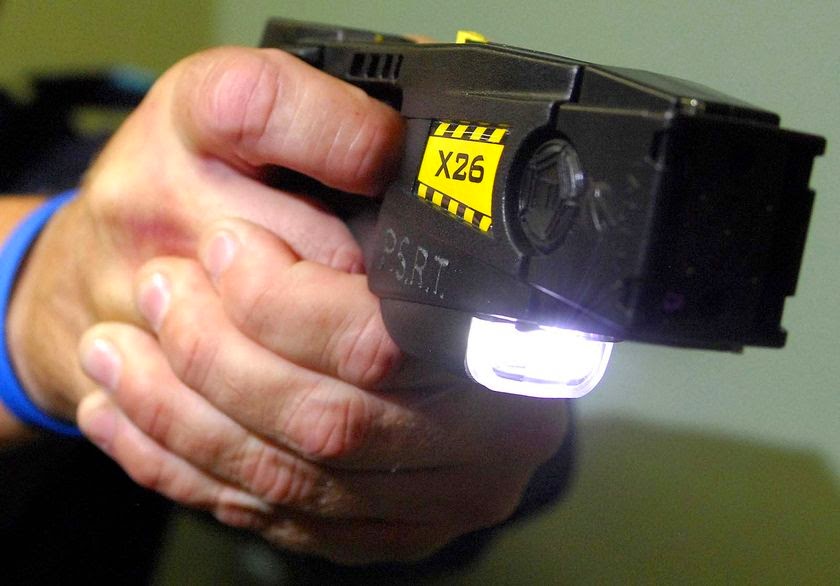 The office of the chief medical examiner said in a report that Werblow died a “sudden death following physical altercation, including electric shock and restraint during a psychotic episode due to schizophrenia.” The office of the chief medical examiner said in a report that Werblow died a “sudden death following physical altercation, including electric shock and restraint during a psychotic episode due to schizophrenia.”
“For the medical examiner, a homicide determination is made when the death occurs at the hand of another or due to the hostile or illegal acts of another,” said Chief Medical Examiner Dr. James Gill. “It does not require intent in most instances. If a physical altercation causes or contributes to death, homicide is typically invoked.”
But, Gill notes that the label “homicide” does not necessarily mean a criminal act took place, and it is the criminal justice system that decides whether incidents involving law enforcement actions are justified.
The State Police Central District Major Crime Squad is currently investigating Werblow’s death to determine whether or not it was justifiable.
Werblow’s death is added to at least 14 others who have died after being Tasered by police in Connecticut since 2005, prompting Senator Edward Kennedy Jr. and the American Civil Liberties Union of Connecticut to call for statewide regulations of how police use electronic weapons.
Tragedies like these are far too common.
The Treatment Advocacy Center in 2014 published an analysis of police shooting data and other information from a much larger sampling - nearly 40 years (1980-2008) - and concluded that “at least half of the people shot and killed by police each year in this country have mental health problems.”
Read the Treatment Advocacy Center and National Sheriffs’ Association’s joint report on justifiable homicides to learn more.
To comment, visit our Facebook page.
Visit our blog archive to read all our recent posts.
Holes in the Mental Health Safety Net
(June 25, 2015) Last year in Chicago, approximately 22,000 mental health-related 911 calls were made. But some of the police districts in Illinois where the most mental health calls come from are also the districts with the fewest mental health services (“Mental health 911: Areas with most calls have fewest services,” WBEZ, June 12).
 When someone is released from Cook County Jail, the largest single site jail in the country, they are given the phone number to a mental health hotline run by the jail and told to call anytime, according to WBEZ. When someone is released from Cook County Jail, the largest single site jail in the country, they are given the phone number to a mental health hotline run by the jail and told to call anytime, according to WBEZ.
The hope is to break the cycle of jail recidivism, said Dr. Dena Williams, director of behavioral health at Cook County Jail. The logic goes that if a former inmate with mental illness can call and get help accessing treatment, they will be less likely to reenter the corrections system.
But hotline staff cannot get callers into psychiatric services immediately. There are waiting lists, sometimes upwards of six months
“The length of time it takes someone to receive medication is sometimes so long that they are unable to wait and they will end up right back in our custody,” Williams said. “It keeps me up at night because jail is not a place to be receiving treatment.”
In addition to the issue of waiting lists, there is another big hole in the mental health safety net: the location of services.
Sergeant Lori Cooper, with the Chicago Police Department, notes that sometimes officers respond to calls in areas where there is high demand for mental health services, but little supply. As a result, they are stuck with fewer nearby services where they can send people and are forced to ask them to travel long distances for mental health care.
“[It] is kind of like putting them in a wheelchair with flat tires,” Cooper said.
Illinois received high grades for its mental health commitment laws in a recent Treatment Advocacy Center report. However, the state received a “D” for its use of the laws.
Moreover, with only 11.1 public psychiatric beds per 100,000 people, Illinois fails to meet the standard of 50 beds considered necessary to provide minimally adequate treatment for individuals with severe mental illness.
Illinois needs to do a better job ensuring that local officials use the laws when appropriate, and that mental health professionals are aware of who meets the standard. In areas where services are low, using outpatient laws becomes even more important.
Read the Treatment Advocacy Center report “Mental Health Commitment Laws: A Survey of the States” to learn more.
To comment, visit our Facebook page.
Visit our blog archive to read all our recent posts.
|
|