“My Son Thinks We’re the ‘Crazy Ones’” – personally speaking
(Jan. 22, 2016) My son, WG, was a happy, talkative, sweet, and focused boy. He was very outgoing and popular in school. His classmates would have described him as the class clown; a real leader. He showed so much promise.
 WG suffered his first obvious psychotic break during class in the seventh grade. He had rolled up in a ball under his desk. His teacher held him in her arms as he cried uncontrollably. He doesn’t remember the incident. WG suffered his first obvious psychotic break during class in the seventh grade. He had rolled up in a ball under his desk. His teacher held him in her arms as he cried uncontrollably. He doesn’t remember the incident.
Our family continues to seek help for WG. When he was in grammar school we went to weekly psychiatrist appointments, but they didn’t seem to help. The psychiatrist was reluctant to diagnosis him because he was under eighteen.
Over twenty years later, my son has still never been given a formal diagnosis. We suspect he is dual diagnostic: he suffers from schizophrenia and depression, as well as drugs and alcohol abuse. Everyone can see that my son is sick, except him.
Since WG does not believe he is sick, he refuses to take any prescribed medication. He says he doesn’t need treatment and that he will heal himself. He doesn’t have insight into his situation and doesn’t understand the cause and effect of his actions. He thinks he’s fine and everyone one else is crazy. I now know that there is a term for this – anosognosia – and that scientific evidence from brain scans show that the condition is not his fault.
The police have been called many, many times since WG was 15 years old as a result of his illness. He is seemingly unable to follow the rules, exhibits defiant behavior, and self-medicates with drugs and alcohol. Now, at age 32, my son sleeps most of the day and continues to struggle with substance abuse issues. He has few friends and is very sad and lonely. He says he hates his family and has hinted at suicide. Everything is getting worse by the day for my son. He needs help NOW before he dies.
On February 2, the Marin County Board of Supervisors will vote on whether or not to implement Laura’s Law. This legislation is the help my son needs; the help all of our loved ones with severe mental illness needs. Unfortunately, the people who should be helping my son have said they can’t help him unless he agrees to treatment. They are waiting until he decides to seek treatment voluntarily, but he can’t due to his anosognosia. After decades of watching him spiral out of control, I can tell you that day will never come.
Does that mean that my son should be shut out from treatment, left to suffer until he further hurts himself or someone else? That’s what the Marin County Mental Health Board said in its draft resolution about Laura’s Law. But they need to remember who they work for – the Board of Supervisors, and the people of Marin County. They are not doing their jobs if they refuse to treat the sickest of our community.
My son has a right to be protected and treated just like those in the community who aren’t as sick as he is, and I want the Marin County Mental Health Board to acknowledge that!
MARY APPLEGARTH
MARIN COUNTY, CALIFORNIA
To comment, visit our Facebook page.
Visit our blog archive to read all our recent posts.
RESEARCH WEEKLY: The 'National Bill' for Severe Mental Illness
(Jan. 21, 2016) The study of mental health is characterized by what is known as the "evidence-to-practice" or "science-to-treatment" gap. "Chasm" would be more fitting.
Around the world, thousands of scientists and academics are at work to explore and define the causes, mechanisms and treatments of psychiatric diseases and to examine the public health, policy, economic and other impacts of them. Yet few of these discoveries make their way into general public awareness and usefulness.
The gap has huge practical implications. Hypotheses are being tested, treatments are being tried, and evidence is being amassed that directly bears on the everyday lives and work of patients, families, clinicians and policymakers, who don't learn about it in a timely way - or at all. RESEARCH WEEKLY was launched by the Treatment Advocacy Center as one small step toward bridging the gap. When we publish and distribute a blog like "Fish oil may delay onset of schizophrenia," it is our contribution to getting treatment evidence into the hands of people who could benefit from it. When we calculate the risk mental illness adds to police incidents in a study like "Overlooked in the Undercounted: The Role of Mental Illness in Fatal Law Enforcement Encounters," it is because lawmakers cannot make evidence-based policy without evidence.
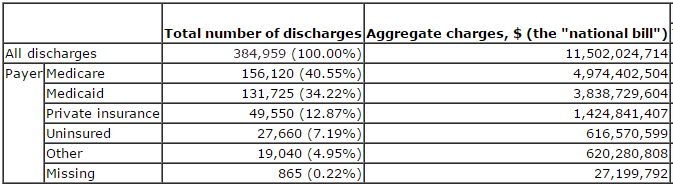
FIGURE 1: The National Bill for Schizophrenia Hospitalization, By Payer (2013)
The Cost Factor
One of the many factors that influence the transfer of evidence to policy or practice is money. From city halls to the halls of Congress, the savings or cost associated with treating or not treating people with severe mental illness is often decisive in whether treatment policies and practices fly or die. Fortuitously, when it comes to the single biggest driver of direct costs for severe mental illness - hospitalization - the federal government itself operates a robust and user-friendly resource.
The Healthcare Cost and Utilization Project (called HCUP) is "a family of health care databases and related software tools and products" operated by the Agency for Healthcare Research and Quality (AHRQ) within the Department of Health & Human Services. Among a multitude of data points, HCUP reports the cost of all hospital stays in the US - including mental health hospital stays - by year, region, state and many other variables. HCUP labels these aggregated costs "the national bill."
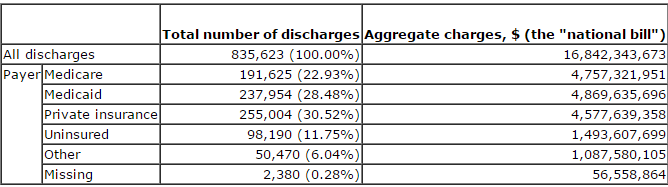
According to HCUP, there were 1.2 million hospital stays for treatment of mood disorders and schizophrenia in 2013 (the most recent year reported,) and the "national bill" for this inpatient treatment was $28,344,368,387 - $28 billion, in rounder numbers. Mood disorders (primarily bipolar disorder and depression) accounted for the lion's share of the absolute cost - $16.8 billion. With roughly half as many people diagnosed, schizophrenia was more costly per capita at $11.5 billion.
HCUP's data shows that the public invests heavily in hospitalizing these critically ill patients. Through Medicare and Medicaid, the public paid 75% of the national bill for hospitalization related to schizophrenia and 50% of the bill for mood disorders in 2013 (Figures 1 and 2). The combined cost to Medicaid for hospitalizations related to the two conditions was topped only by the costs of hospitalizations for live births and septicemia ("blood poisoning"). At almost $9.2 billion, inpatient care for the two psychiatric diseases cost Medicaid more than twice what either respiratory failure or heart attack did.
FIGURE 2: The National Bill for Mood Disorder Hospitalization, By Payer (2013)
In the winter 2016 edition of Issues in Science and Technology, researcher Judith Teich writes, "Making progress on helping people with (serious mental illness) will depend not just on new drugs but on good information on which effective policies and treatment regiments can be based."
Psychiatric hospitalization is the most expensive treatment modality that exists for severe mental illness. It takes place when psychiatric symptoms become so acute that inpatient care becomes a medical necessity, provided a bed is available. The national bill details the high cost that results when mood disorders and schizophrenia are not treated until psychiatric symptoms become so acute that inpatient care becomes necessary. It's a resource that can help address the "service-to-practice" gap by providing "good information" for discussing "effective policies and treatment regiments" of two of the most disabling - and costly - psychiatric diseases.

Doris A. Fuller
Chief of Research and Public Affairs
References:
Next Week: January Digest
Research Weekly is a summary published as a public service of the Treatment Advocacy Center and does not necessarily reflect the findings or positions of the organization or its staff. Full access to research summarized may require a fee or paid subscription to the publications.
To comment, visit our Facebook page.
Visit our blog archive to read all our recent posts.
Mental Health Reform Shows Promise of Success this Year, says Speaker Paul Ryan
(Jan. 20, 2016) Laying out his agenda for Congress this election year, Speaker Paul Ryan highlighted both mental health and criminal justice reform as areas where he expected to see legislation passed.
Reforms currently being discussed in both areas would have a profound impact on the way the country treats people with severe mental illness.
Ryan highlighted two bills that focus on reforming our broken system to better serve people with severe mental illness, noting that both already enjoy strong bipartisan agreement:
- The Helping Families in Mental Health Crisis Act, introduced by Representatives Tim Murphy (R-PA) and Eddie Bernice Johnson (D-TX), focuses on mental health reform for those with severe mental illness and their families who are struggling to get necessary care for their loved ones. The legislation advanced out of the House Energy and Commerce health subcommittee markup in November with all provisions intact to help people with severe psychiatric illnesses.
- The Comprehensive Justice and Mental Health Act of 2015, introduced by Representatives Doug Collins (R-GA) and Bobby Scott (D-VA) would increase CIT and other training for law enforcement on how to appropriately respond to incidents involving people with mental illness, provide support for mental health courts and expand data collection on the criminalization of mental illness. The legislation passed this week out of the House Judiciary Committee. The Senate companion bill of the same name passed out of the Senate by voice vote in December.
The combination of effective mental health and criminal justice reform holds the potential of finally addressing our nation’s longstanding mental health failures. For too long, our nation’s mental health system has failed those in need, leaving law enforcement to pick up the pieces. As a consequence, our jails have become de facto psychiatric facilities. It is inhumane, ineffective and too often ends in tragedy.
CONTACT YOUR LEGISLATORS. Tell them that you support comprehensive mental health reform and urge them to support the Helping Families in Mental Health Crisis Act (HR 2646) and the Comprehensive Justice and Mental Health Act of 2015 (HR 1854).
After Tasing Mentally Ill Man to Death, Officers Granted Immunity
(Jan. 19, 2016) Three North Carolina police officers who Tased a mentally ill man to death while attempting to take him into custody are immune from prosecution, a three-judge panel ruled last week (”Cops Tased a mentally ill non-criminal to death, and they can't be prosecuted,” Courthouse News, Jan. 14).
 In 2011, Ronald Armstrong, who had been diagnosed with bipolar disorder and paranoid schizophrenia, was off his medication and poking holes in his leg "to let the air out," his sister, Jinia Armstrong Lopez, said in a 2013 complaint. In 2011, Ronald Armstrong, who had been diagnosed with bipolar disorder and paranoid schizophrenia, was off his medication and poking holes in his leg "to let the air out," his sister, Jinia Armstrong Lopez, said in a 2013 complaint.
Lopez took her brother to the emergency room, but he became frightened as he was being evaluated by hospital staff and ran away.
Responding to his uneven behavior, the Pinehurst police department was called. The officers arrived to find Armstrong acting erratically, eating grass and dandelions and putting cigarettes out on his tongue.
According to reports, officers surrounded Armstrong. They tried to pry his arms and legs free from a post he had wrapped himself around, but he was holding on too tightly. Two police officers joined them, and Armstrong's sister was standing nearby.
According to the complaint, one of the officers proceeded to draw his Taser and warn Armstrong that if he didn't let go of the post, the device would be used on him. Armstrong refused, and the officer Tased him five separate times over a two-minute period.
The officers applied handcuffs and shackled his legs, the ruling said. He was no longer moving and was unresponsive. They administered CPR, and he was transported to the emergency room where he was pronounced dead shortly after.
Lopez sued the police officers for use of excessive force in violation of Armstrong's rights, but qualified immunity protects officers who commit constitutional violations but who, in light of clearly established law, could reasonably believe that their actions were lawful.
The court determined that Armstrong's constitutional rights were violated and that excessive force was not warranted.
The enduring takeaway ought to be the recognition that the criminal justice system is inevitably flawed. A 2015 Treatment Advocacy Center report on police involved homicides found that the risk of being killed during a police incident is 16 times greater for individuals with untreated mental illness than for other civilians approached or stopped by officers.
While the officers in this case were granted immunity, this country is certainly not immune to the many far-reaching consequences of not treating its most severely ill. It’s time to say “enough is enough” and do what is necessary to provide treatment before tragedy.
To comment, visit our Facebook page.
Visit our blog archive to read all our recent posts.
At the Intersection of Treatment and Housing
(Jan. 14, 2016) California legislators last week announced a funding proposal to the tune of $2 billion to build new, permanent housing for the state’s mentally ill homeless.
 While housing the homeless is certainly a step in the right direction, some argue that lawmakers are simply addressing the symptoms and not the root cause of a larger issue: the nation’s broken mental health system (“California legislators propose spending $2 billion to build housing for homeless,” Los Angeles Times, Jan. 4). While housing the homeless is certainly a step in the right direction, some argue that lawmakers are simply addressing the symptoms and not the root cause of a larger issue: the nation’s broken mental health system (“California legislators propose spending $2 billion to build housing for homeless,” Los Angeles Times, Jan. 4).
“This is a tipping-point moment for mental health, homelessness, and Proposition 63 in California,” said former Senate President Pro Tem Darrell Steinberg (D-Sacramento) among others at a press conference on Los Angeles’ Skid Row.
“Thanks to the leadership of this Senate, we have a historic opportunity to help local communities forge systemic long-term solutions, making a real difference in the lives of thousands of forgotten Californians,” he said.
But Los Angeles County Supervisor Mike Antonovich criticized the initiative for taking funding decisions out of local leaders’ control.
“Any directives by the state could undermine this expansion effort and delay progress being made in their own unique communities,” Antonovich said in a statement. Some of the $400 million in Proposition 63 money the county received this year goes towards housing, but it also funds a range of mental health services, including crisis intervention and transition programs for people coming out of locked psychiatric facilities.
We agree that securing housing for the homeless mentally ill should be a priority. But, in order to work towards a comprehensive solution, we need to go the extra mile in California.
Studies throughout the country overwhelmingly show assisted outpatient treatment (AOT) – when implemented – works to reduce homelessness among people with mental illness. Research on New York’s AOT law showed that among people receiving court-ordered treatment in the community, 74 percent fewer experienced homelessness.
Currently, fourteen California counties have implemented Laura’s Law, the state’s AOT program, but the law was originally set up so that it would need to be renewed every five years and is set to require renewal again in 2017.
Assemblywoman Marie Waldron (R- Oceanside) is sponsoring a bill, AB 59, which would extend the sunset date for Laura’s Law until January 1, 2022.
CONTACT YOUR LEGISLATORS today! Tell them that you support continuing Laura’s Law in California and urge them to vote in favor of AB 59.
To comment, visit our Facebook page.
Visit our blog archive to read all our recent posts.
"My Son is Sick, Not Evil" – personally speaking
(Jan. 13, 2016) My son, Myreon, started showing signs of mental illness at the age of 16. As it progressed, he would stay up all night saying he sold his soul to the devil and tearing his bedroom apart. One day he ran outside naked and was almost run over by a public transit bus.
 Myreon has been involuntarily committed to a mental health facility four times. It was during one of his stays that we learned that he suffers from schizophrenia and bipolar disorder, as well as a traumatic brain injury that causes memory loss. His illness has caused him to act erratically and get into trouble with the law. Myreon has been involuntarily committed to a mental health facility four times. It was during one of his stays that we learned that he suffers from schizophrenia and bipolar disorder, as well as a traumatic brain injury that causes memory loss. His illness has caused him to act erratically and get into trouble with the law.
Last August, Myreon was arrested by Flint Police on a weapons charge. As he was being arrested, the police officers beat him up as my daughter and I stood there, watching helplessly.
A couple weeks after my son arrived in jail, he was placed in solitary confinement. Officers gave me numerous reasons why he was placed in “the hole,” but I know they are all lies. The real reason he was put there is because he’s mentally ill and they don’t know what else to do with him.
The court eventually found Myreon incompetent to stand trial. He was sent to a Michigan prison and I haven’t spoken to him since, despite my many attempts. I worry about my son all day every day. Two years ago, Myreon was physically and sexually assaulted by someone while incarcerated. I fear for his safety. He has already suffered so much, and so have I. I have had two strokes and don’t know how much more I can take.
I want my son’s story to be told to raise awareness of how poorly the police handled this case and continue to handle other cases involving mental illness. Myreon has been imprisoned for mistakes he has made in the past, but he never shot or killed anyone. My son is not a killer; he is mentally ill. His mind is not able to handle all that he is going through, and he has already tried to commit suicide two times. I am scared for him. My son’s life should not be taken at only 24 years old because he is sick. I pray someone can help me get help for my Myreon before it is too late.
AUDREY TRIPPLETT
FLINT, MICHIGAN
To comment, visit our Facebook page.
Visit our blog archive to read all our recent posts.
RESEARCH WEEKLY: The Growing Focus on Inflammation in Psychiatric Research
 (Jan. 12, 2016) Two theories have for decades dominated research on the causes of schizophrenia: genetics and neurotransmitters. Over the past two years, a third theory – the infectious/inflammatory theory—has become the first major new addition to schizophrenia study in the last half-century and, with less evidence, to the study of bipolar disorder and depression. (Jan. 12, 2016) Two theories have for decades dominated research on the causes of schizophrenia: genetics and neurotransmitters. Over the past two years, a third theory – the infectious/inflammatory theory—has become the first major new addition to schizophrenia study in the last half-century and, with less evidence, to the study of bipolar disorder and depression.
This theory states that infections play an important role in causing schizophrenia, probably in conjunction with predisposing genes or the effects of infectious agents on neurotransmitters.*
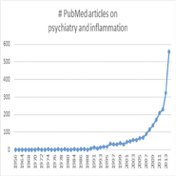
Evidence of the growing focus can be seen in the recent outpouring of professional papers proposing to use anti-infective and anti-inflammatory drugs to treat schizophrenia and bipolar disorder (see figure below). Also indicative is the emergence of infectious/inflammatory theory in mainstream scientific media and books, including Infectious Madness: The Surprising Science of How We “Catch” Mental Illness, by science writer Harriet Washington (Little, Brown, 2015).
Now In Treatment Trials
 The Stanley Medical Research Institute (SMRI), a supporting organization of the Treatment Advocacy Center, has been funding research into the role of infection and inflammation in the causes of and treatment for schizophrenia for more than 20 years. Half of SMRI’s current 52 treatment trials involve the use of anti-infective or anti-inflammatory agents/drugs to alter the immune system. Slightly more than half of its newly funded trials also will be testing anti-infective or anti-inflammatory agents in the treatment of schizophrenia. The Stanley Medical Research Institute (SMRI), a supporting organization of the Treatment Advocacy Center, has been funding research into the role of infection and inflammation in the causes of and treatment for schizophrenia for more than 20 years. Half of SMRI’s current 52 treatment trials involve the use of anti-infective or anti-inflammatory agents/drugs to alter the immune system. Slightly more than half of its newly funded trials also will be testing anti-infective or anti-inflammatory agents in the treatment of schizophrenia.
An example is Valacyclovir, an antiviral widely used against herpes family viruses. In 2014, a small SMRI trial reported improved cognitive functions of individuals with schizophrenia; a much larger replication trial is in progress using 12 American sites. Treatment trials also are underway utilizing anti-inflammatory drugs (e.g. aspirin) specifically on patients with schizophrenia who have elevated levels of inflammatory markers in their blood (e.g., high C-reactive protein). The aspirin study will be completed in mid-2016.
Meanwhile, the American Journal of Psychiatry in November 2015 published a review of 200 research papers on inflammation and depression that found a similar link. “Depression and inflammation are intertwined, fueling and feeding off each other,” Janice K. Kiecolt-Glaser et al. wrote in the provocatively titled “Inflammation: Depression fans the flames and feasts on the heat.” “This bidirectional loop, in which depression facilitates inflammatory responses and inflammation promotes depression, has clear health consequences.”
Practical Implications
As director of the NIMH in 2012, Dr. Thomas Insel described what he called the “crisis of medication development for mental disorders.”
“There is diminishing activity in research and development for new medications within either the biotech or pharmaceutical industries,” he wrote in “Experimental Medicine.”
“While the development of psychosocial interventions and devices, including the use of mobile technologies, is promising, the absence of a robust development pipeline for more effective medications would be worrisome in any area of medicine and should be a grave concern to the mental health community.” He reported that creating new medications, on average, is a 15-year endeavor that costs more than $2 billion and fails 95% of the time.
In such an environment, the growing focus in psychiatric research on the role of conditions that can be treated with an existing arsenal of proven drugs and medications is one with significant practical implications for individuals who live or work with the most severe mental illnesses.
* Infections as measured by antibodies in the blood; inflammation, as measured by markers such as C-reactive protein and various cytokines.
JOHN M. DAVIS, M.D.
Professor of Psychiatry and Research Professor of Medicine
Department of Psychiatry, University of Illinois at Chicago
Member, Psychiatric Advisory Board of the Treatment Advocacy Center
References:
Next Week: "The National Bill" for Severe Mental Illness
Research Weekly is a summary published as a public service of the Treatment Advocacy Center and does not necessarily reflect the findings or positions of the organization or its staff. Full access to research summarized may require a fee or paid subscription to the publications.
To comment, visit our Facebook page.
Visit our blog archive to read all our recent posts.
Man Killed by Police Had History of Mental Illness
(Jan. 11, 2016) The father of a 38-year-old mentally ill man killed in a police-involved shooting in Zion, Illinois said his son's death resulted from poor "judgment calls" by his son and police, both of which he wishes had gone differently (“Man killed by Zion cops was 'likable guy,' had history of mental illness, his dad says,” Lake County News-Sun, Jan. 7).
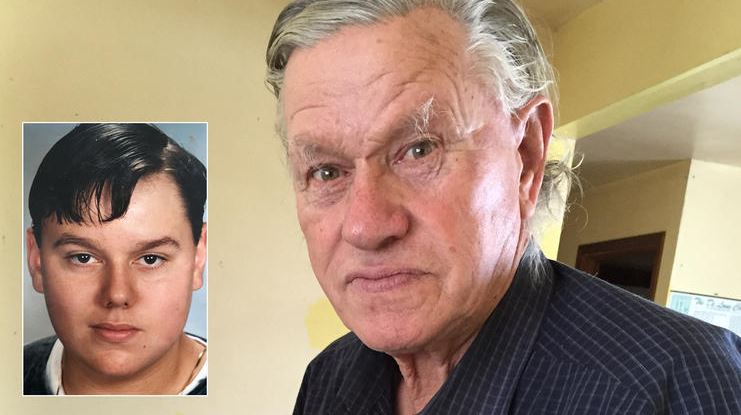 Charles “Charlie” Hollstein, who had been diagnosed with schizophrenia, was carrying a BB gun and wearing a homemade tactical-style vest while taking photos of an elementary school last Wednesday morning before he was fatally shot by Zion police after a foot chase that ended in a struggle, according to Lake County authorities. Charles “Charlie” Hollstein, who had been diagnosed with schizophrenia, was carrying a BB gun and wearing a homemade tactical-style vest while taking photos of an elementary school last Wednesday morning before he was fatally shot by Zion police after a foot chase that ended in a struggle, according to Lake County authorities.
"I'm blaming both of them a little bit," Hollstein’s father, Carl, said of his son and police. "But then again, it's a judgment call for the police. They've only got a split second to make a decision. They probably rushed to judgment. Charlie probably rushed to judgment."
"After the foot pursuit, a struggle with the offender and officers ensued, which resulted in the offender being shot," a statement from the Lake County Major Crime Task Force read.
Hollstein died of three gunshot wounds to his upper left back, according to the Lake County coroner.
His father didn't know why his son was at the school or carrying the BB gun, but said Hollstein liked taking photos with his cell phone camera and enjoyed crafting his own clothes. He added that his son was a "likable guy" who struck people as very polite, but struggled with mental illness and could be violent.
In 2005, Hollstein was committed to an inpatient facility after failing to comply with outpatient treatment. He was released in 2007 and went to live at a local nursing home for several years before moving out in 2013 to live independently.
"It probably would have been better if he'd been living at a nursing home, but who thinks something like this will happen?" his father said.
Unfortunately, tragedies like this are far too common. We have dismantled the mental illness treatment system and turned mental health crisis from a medical issue into a police matter. This is patently unfair, illogical and is proving harmful both to the individual in desperate need of care and the officer who is forced to respond.
A 2015 Treatment Advocacy Center report found “the risk of being killed during a police incident is 16 times greater for individuals with untreated mental illness than for other civilians approached or stopped by officers.” The report urges lawmakers to reduce loss of life and the many social costs associated with police shootings by enacting public policies that will:
- Restore the mental health system so that individuals with severe mental illness are not left to deteriorate until their actions provoke a police response;
- Fund reliable federal tracking and reporting of all incidents involving the use of deadly force by law enforcement, whether lethal or not; and
- Assure that the role of mental illness in fatal police shootings is identified and reported in government data collection.
Read our report, “Overlooked in the Undercounted: The Role of Mental Illness in Fatal Law Enforcement Encounters,” to learn more.
To comment, visit our Facebook page.
Visit our blog archive to read all our recent posts.
In Memoriam: Ted Stanley
(Jan. 8, 2016) The Treatment Advocacy Center marks the passing of Ted Stanley, an unequaled philanthropist, friend and champion for eliminating barriers to the treatment of severe mental illness. Inspired by the triumph of his son, Jonathan Stanley, over severe mental illness, Mr. Stanley for decades committed his considerable vision, energy and wealth to reshaping the landscapes of mental illness research and advocacy in America.
 Without the support and vision of Ted Stanley and his late wife, Vada, there would be no Treatment Advocacy Center. Dr. E. Fuller Torrey, founder of the Treatment Advocacy Center, tells the story, “In 1998, Vada called me after reading my book Out of the Shadows and asked, ‘Isn’t there something we can do NOW to help people who need treatment for serious mental illness?’ After discussing the problem at length, we agreed that advocacy to improve access to treatment for individuals with serious mental illness – especially those who were not aware of their illness – had the greatest potential. Vada and Ted then committed funds to get the Treatment Advocacy Center started.” Without the support and vision of Ted Stanley and his late wife, Vada, there would be no Treatment Advocacy Center. Dr. E. Fuller Torrey, founder of the Treatment Advocacy Center, tells the story, “In 1998, Vada called me after reading my book Out of the Shadows and asked, ‘Isn’t there something we can do NOW to help people who need treatment for serious mental illness?’ After discussing the problem at length, we agreed that advocacy to improve access to treatment for individuals with serious mental illness – especially those who were not aware of their illness – had the greatest potential. Vada and Ted then committed funds to get the Treatment Advocacy Center started.”
The generous and unwavering commitment of the Stanleys made possible the Treatment Advocacy Center’s emergence as a prominent national voice for mental illness policy reform. Since our founding in 1998, more than half the U.S. states have made important changes to their civil commitment standards and treatment laws as a result of this work. In late 2015, President Obama signed a bill into law that, for the first time, provides federal funding for assisted outpatient treatment programs, a signature success that harkens back to Vada’s initial plea for programs to help those who need treatment NOW.
In addition to supporting the Treatment Advocacy Center’s achievements, Mr. Stanley emerged as a philanthropist without rival in the support of mental illness research. Through the Stanley Family Foundation, he donated almost $600 million to the Stanley Medical Research Institute to support groundbreaking research on the causes and treatment of schizophrenia and bipolar disorder. He funded psychiatric research at the Cold Spring Harbor Laboratory in New York and at the Broad Institute in Cambridge, Massachusetts. And, in 2014, he donated $650 million to the Broad Institute to support genomic research of schizophrenia and bipolar disorder, bringing his total donations for mental illness research to more than 1.2 billion dollars.
The Treatment Advocacy Center celebrates the life and generosity of Ted Stanley. No one has done as much to advance the cause of mental illness treatment. We all stand in awe of his contributions that promise to benefit humanity for generations.
On behalf of the board and staff of the Treatment Advocacy Center.
Stephen Segal – President, Board of Directors
John Snook – Executive Director
To comment, visit our Facebook page.
Visit our blog archive to read all our recent posts.
ACT NOW: Don't Give Up Virginia's Psychiatric Hospital Beds
(Jan. 6, 2016) Virginia Gov. Terry McAuliffe (D) wants to close Catawba Hospital in Roanoke County, even though there are more than 85 prisoners with mental illness in VA jails waiting for a psychiatric bed to become available.
 Less than five months ago Jamycheal Mitchell died in a Virginia jail, waiting for a hospital bed to open up in a mental health facility. This came after four months of incarceration. He had been ordered to a state mental hospital by the courts, but there was no room at the inn, so he stagnated, refusing treatment while his mental illness remained untreated and he starved himself while in custody. Less than five months ago Jamycheal Mitchell died in a Virginia jail, waiting for a hospital bed to open up in a mental health facility. This came after four months of incarceration. He had been ordered to a state mental hospital by the courts, but there was no room at the inn, so he stagnated, refusing treatment while his mental illness remained untreated and he starved himself while in custody.
He was arrested in April for stealing less than $5 worth of junk food. There is a direct correlation between the lack of beds and Mitchell’s death.
Virginia currently has only 37 percent of the psychiatric beds needed to adequately meet the needs of its population with serious mental illness, according to our report, “No Room at the Inn: Trends and Consequences of Closing Public Psychiatric Hospitals.”
Had a bed been available when a court ordered that he be evaluated, Mitchell might have been able to receive life-saving treatment.
If Virginia is truly committed to improving its mental health services, we must acknowledge that we cannot afford to lose any of these beds. We must commit to either spending what is needed to renovate the hospitals, or redirecting those funds to the creation of new facilities with just as many beds as we will lose by closing Catawba.
Virginia residents: Voice your support now by taking the following actions:
- Contact your representatives and tell them Virginia cannot afford to lose any more public psychiatric beds.
- Write a letter to your local paper demanding a zero-net-loss policy for any closures moving forward.
To comment, visit our Facebook page.
Visit our blog archive to read all our recent posts.
|
|