Homeless Need a Better Solution
(Feb. 24, 2015) Staff at the Salvation Army homeless shelter in Chicago are worried after noticing a drop in the number of people seeking shelter from bitter cold temperatures this week (“Shelter concerned the cold hasn't brought needy, homeless,” Chicago Tribune, Feb. 23).
 "I don't know where they could be going," said Rose Mary Salazar, Corps coordinator. "I don't know where they could be going," said Rose Mary Salazar, Corps coordinator.
Between 75 and 100 people come in on any given day to take advantage of the free lunch the center offers, but there were only 57 on Monday, said Salazar.
Salazar said one Salvation Army client is fortunate enough to be in the hospital right now. The woman, who receives disability for bipolar disorder, went off her medication, and it was difficult to keep her in one place because she was unstable.
"Here is a woman who didn't have to be homeless at all, and yet she was too sick," she said. "Her caregiver didn't know how to keep her safe and at home, so she would just give her the money and hoped that she would get herself a room."
There are currently nearly 600,000 people in the United States who call the street their home. In many cities such as Chicago, homeless people with severe mental illnesses are now an accepted part of the urban landscape and make up a significant percentage of the homeless who ride subways all night, sleep on sidewalks, or hang out in the parks. Others live in the woods on the outskirts of cities, under bridges, and even in the tunnels that carry subway trains beneath cities.
People with untreated serious mental illness comprise approximately one-third of the total homeless population, and an even higher percentage among homeless women and among individuals who are chronically homeless. They will all be even more vulnerable this winter.
Read the Treatment Advocacy Center’s backgrounder on serious mental illness and homelessness.
To comment, visit our Facebook page.
Visit our blog archive to read all our recent posts.
Severe Mental Illness Brought My Son to His Knees – personally speaking
(Feb. 25, 2015) My son was a wrestler in high school. He loved to ride dirt bikes and horses, and was famous for standing up for the little guy. The men in my family have a long history of serving in the United States Navy. Joshua, followed in the footsteps of his grandfather, uncles, and cousins to serve our country.
 But after he entered the Navy, my son started battling depression which later included schizophrenia. The illness caused my son’s thoughts to become disordered so that he didn’t even understand he was sick. Joshua was no longer the happy-go-lucky boy I had raised, but a young man afraid to leave his bedroom. I tried to get Joshua help. I tried to explain the symptoms he was showing but no one would talk or listen to me. The HIPAA privacy rule prevented me from helping my son and forced me to stand helplessly by and watch him suffer. But after he entered the Navy, my son started battling depression which later included schizophrenia. The illness caused my son’s thoughts to become disordered so that he didn’t even understand he was sick. Joshua was no longer the happy-go-lucky boy I had raised, but a young man afraid to leave his bedroom. I tried to get Joshua help. I tried to explain the symptoms he was showing but no one would talk or listen to me. The HIPAA privacy rule prevented me from helping my son and forced me to stand helplessly by and watch him suffer.
One night while my husband and I were lying in bed, we heard a loud noise coming from our son’s bedroom. We ran to Joshua’s room and found him standing against the wall with his head tilted back at an odd angle. He was thin and unhealthy looking because he hadn’t been eating or drinking. His eyes were closed and he was making a loud, agonizing wail of pain. My husband called 911. When the emergency workers arrived they were compassionate and wanted to help us but they said there was nothing they could do because our son was not considered a danger to himself or others. We were not told what was wrong with him or anything else when the emergency workers were at our home.
After all the other emergency workers left the house, two kind police officers stayed behind. They told my husband and me that we should take Joshua to the hospital. They told us which hospital had a psychiatric unit. The two officers helped Barry and I walk our son to our mini-van. This took a great deal of time because Joshua still had his head tilted back at an odd angle, he was still making loud agonizing wails of pain, and he was walking in small, baby-steps.
When we arrived at the hospital, Josh was silent. The attending physician made us leave the room. She would not listen to us. We couldn’t even describe what had happened or what he was experiencing. Several minutes later, after talking privately with Joshua, the doctor said Joshua would not be admitted to the hospital. Barry and I tried to stress that Josh needed medical care. We weren’t allowed to know what was wrong with him or why he wasn’t being admitted to the hospital. But we had no voice!.
My son died by his own hand five weeks later.
The HIPAA privacy rules were never intended to block people from getting needed medical attention. The family must be included in care so we will know how to help our loved ones to make the situation better. Our sick loved ones visit a doctor for about 15 minutes a month but the family has him all the other minutes in a month but, still, we are kept in the dark and don’t know what to do or how to help and care for our loved one because HIPAA excludes us.
My son wrestled with a painful illness that held him in its grip – and he lost. Mental illness brought my strong, young son to his knees. He took his life at the tender age of 24 years. And I lost my world, my child.
Nothing will ever bring back my son, but I know that mental health treatment and the understanding care and support of families can save lives. Family members are a huge part of their sick loved one’s life but HIPAA blocks all communication rendering families helpless. Clarifying HIPAA rules and opening the doors to communication that includes family members and caregivers will help.
Today, I am forced to live without my son. It’s still difficult to talk about what happened to Joshua, but I’m speaking up to help others. Senator Murphy’s bill would clarify HIPAA and help hurting people like my son and my family. No one should have to suffer as we have. No one should have to die from a treatable mental illness.
KATHY HARKEY
VIRGINIA
To comment, visit our Facebook page.
Visit our blog archive to read all our recent posts.
More Mental Health Courts, More "Human Kindness"
(Feb. 23, 2015) Paton Blough, 38, spoke candidly to a Senate subcommittee last week about the criminal acts he committed while suffering from untreated bipolar disorder and urged support for a proposal that would establish more mental health courts in South Carolina (“ More mental health courts could open in S.C.,” Bluffton News, Feb. 19). 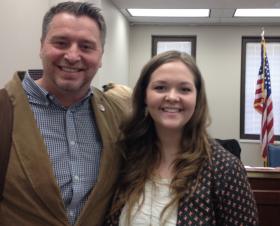 “It’s actually kind of a miracle that I’m here today,” Blough said. Blough attended mental health court after amassing nine criminal charges as a result of his mental illness, and credits it with helping him obtain treatment and live free of psychosis for five years. “In my paranoia, I’m thinking, ‘well, they’re going to kill me,’” said Blough, describing his psychotic break. “Eventually, without sleep for several days, it becomes almost warfare, where you think half the people are against you and following you. It gets very, very bizarre.” Blough is a clear example of the impact mental health courts could have on rehabilitating mentally ill offenders. He is now a state board member for the National Alliance on Mental Illness and teaches law enforcement how to interact with suspects with mental illness. “A lot of what we train is just human kindness,” he said. Those with a serious mental illness represent less than 4 percent of the general population but 17 percent of the South Carolina prison population. Sen. Vincent Sheheen introduced the legislation in an effort to change these startling statistics. “If you go into any hospital today, if you go into any jail today, you’ll see warehoused folks who are mentally ill who are in the revolving system,” Sheheen said. “It’s not good for them, and it costs taxpayers a lot of money.” South Carolina received an F grade in the Treatment Advocacy Center’s state survey of mental health diversion practices. Although not a substitute for assisted outpatient treatment (AOT), mental health courts can be a valuable intervention tool once an individual has entered the criminal justice system. Indeed, increasing the number of mental health courts in South Carolina is not only the smart thing to do; it is the kind thing to do. To comment, visit our Facebook page. Visit our blog archive to read all our recent posts.
It's Time to Stop Recycling the Mentally Ill
(Feb. 20, 2015) A new diversion program in Minnesota designed to keep mentally ill offenders in treatment and out of jail could save lives and money (“Proposed diversion program would keep mentally ill out of jail, in the fold,” Minneapolis Star Tribune, Feb. 17).
 “People are being recycled over and over again and it’s costing the state a lot of money through the courts, through the jails, through the emergency rooms,” said Goodwin. “And the service is just so disjointed that people with a mental illness are told ‘OK you’re done here, go look for housing or some other service, and it’s not going to happen.” “People are being recycled over and over again and it’s costing the state a lot of money through the courts, through the jails, through the emergency rooms,” said Goodwin. “And the service is just so disjointed that people with a mental illness are told ‘OK you’re done here, go look for housing or some other service, and it’s not going to happen.”
The new Mental Health Jail Diversion Grant Program would create four “jail diversion hubs” throughout the state that would serve as short-term treatment and resource centers for mentally ill adults arrested for minor crimes.
Sen. Barb Goodwin, DFL-Columbia Heights, author of the bipartisan bill, believes it will reduce unnecessary jail time and the burden on police resources, as well as save the state millions of dollars.
“We’re not just dealing with a onetime incident and returning that person back onto the street, but we’re getting that person back into the fold and getting them the services they need,” said co-author of the bill Rep. Nick Zerwas.
Minnesota is taking a major step in the right direction. Less than half of the U.S. population lives in communities where the most basic methods of diverting people with severe mental illness from the criminal justice system are being used.
Mental health courts divert qualifying criminal defendants from jail into community-based mental health treatment. Crisis intervention teams – often called CIT teams – consist of specially trained officers who respond to service calls involving mental illness. Both programs have consistently been found to reduce the arrest and incarceration of individuals with severe mental illness.
Read the Treatment Advocacy Center’s study Prevalence of Mental Health Diversion Practices: A Survey of the States to find out more.
To comment, visit our Facebook page.
Visit our blog archive to read all our recent posts.
"The Modern Asylum"
(Feb. 19, 2015) “We can’t continue to abandon our most vulnerable citizens in the name of autonomy,” argues Christine Montross, in an op-ed for the New York Times (“The modern asylum," New York Times, Feb. 18).
 Montross writes in response to an article published in the Journal of the American Medical Association that found that deinstitutionalization has been a failure. The authors argued that we are instead seeing “transinstitutionalization,” a process by which the mentally ill are alternately and repeatedly passed between the mental health and criminal justice systems. Montross writes in response to an article published in the Journal of the American Medical Association that found that deinstitutionalization has been a failure. The authors argued that we are instead seeing “transinstitutionalization,” a process by which the mentally ill are alternately and repeatedly passed between the mental health and criminal justice systems.
“As a hospital psychiatrist, I see this every day,” said Montross. “Patients with chronic, severe mental illnesses are still in facilities—only now they are in medical hospitals, nursing homes and, increasingly, jails and prisons, places that are less appropriate and more expensive than long-term psychiatric institutions.”
Montross is correct. The elimination of hospital beds for people who are psychotic or otherwise acutely or chronically disabled by severe mental illness endangers them and society at large.
The elimination of psychiatric beds is creating enormous strains on law enforcement, jails, prisons and hospital ERs, where acutely ill people are essentially ‘re-institutionalized’–or left to live on the streets. Wherever they are, they exist in an alternate reality that deprives them of the ability to participate in life as they could with treatment.
Nationwide, only 14.1 public hospital beds remained for each 100,000 people by 2010, the latest year for which data is available. The bed population has not been this low since 1850, when it was 14.0. A minimum of 50 beds per 100,000 is a consensus target for providing minimally adequate treatment to the public.
As Montross attests, our current mental health system is one in which people with the most serious mental illnesses “suffer in inappropriate facilities while we pat ourselves on the back for closing the asylums in favor of community care…institutionalization is already happening, but it is happening in a far less humane way than it could be.”
To comment, visit our Facebook page.
Visit our blog archive to read all our recent posts.
It's Personal for New Mexico Legislator
(Feb. 18, 2015) Untreated severe mental illness is personal for state Senator Mary Kay Papen. Her grandson has suffered with schizophrenia and bipolar disorder for years and she hopes her new assisted outpatient treatment (AOT) bill will help people like him in New Mexico (“NM senator: Assisted outpatient treatment saves money, lives,” Watchdog, Feb. 10).
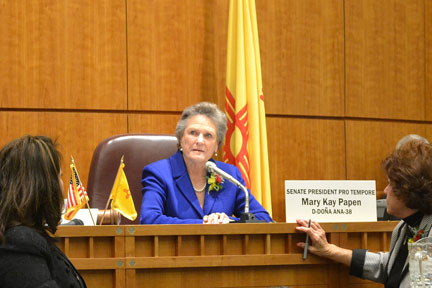 “He’s schizophrenic and bipolar and there have been times when he would have been eligible for this,” Papen said, describing her grandson’s history of mental illness at a recent hearing on the bill. “I don’t want him killed. I don’t want the police shooting him, and I don’t want him to shoot somebody else.” “He’s schizophrenic and bipolar and there have been times when he would have been eligible for this,” Papen said, describing her grandson’s history of mental illness at a recent hearing on the bill. “I don’t want him killed. I don’t want the police shooting him, and I don’t want him to shoot somebody else.”
Brian Stettin, policy director of the Treatment Advocacy Center, told the hearing committee that the court-ordered outpatient treatment program in New York has dramatically reduced both hospitalization and incarceration rates.
“It’s pretty simple,” said Stettin. “We know from the studies that AOT leads to reduction of hospitalization and criminal acts, and people wind up getting treated in jails or prison for mental illness. There is no more expensive form of treatment than hospital care or care in a correctional facility. By reducing those occurrences we’re saving a whole lot more than we’re spending up front.”
The state came under scrutiny last year when Albuquerque police officers shot and killed James Boyd, a mentally ill homeless man.
New Mexico is one of only five states that do not authorize involuntary treatment in the community.
Such laws often make it possible for people with mental illness to receive medical care before they are so ill they require hospitalization or experience other consequences of non-treatment.
Read the latest study on the benefits of assisted outpatient treatment, which found that the program saves more taxpayer money than it costs.
To comment, visit our Facebook page.
Visit our blog archive to read all our recent posts.
RESEARCH: AOT SAVES TAXPAYER DOLLARS
Court-ordered treatment in the community reduces taxpayer costs associated with untreated serious mental illness for individuals stuck in the “revolving door” of repeated hospitalization, incarceration and other consequences of non-treatment, according to a new study released Wednesday.
Conducted by a national health management consulting firm, the report commissioned by the Treatment Advocacy Center found that the costs of serving clients in assisted outpatient treatment (AOT) were more than offset by the reduced need for inpatient hospitalization and other high-cost services. A net public savings resulted, according to Health Management Associates.
“In all cases,” the review of data from seven counties in New York and Ohio reported, the taxpayer costs when individuals stayed in treatment – keeping medical appointments, filling prescriptions and otherwise using mental health services – “were more than offset by the reduction of other public investments such as hospitalization and incarceration.” Cost savings were consistent across the urban and suburban New York counties, where AOT receives dedicated state funding, and in Summit County, Ohio, where it is integrated into existing mental illness services.
“We already knew AOT was an effective treatment option that saves lives,” said Doris A. Fuller, executive director. “The report shows it saves money, too, even in geographically different settings where it is being put to work in dramatically different ways.”
The use of AOT resulted in net cost savings of 47% in New York City, 58% in five outlying New York counties and 50% in Summit County, Ohio, the study reported. In all counties, reduced psychiatric hospitalization produced the greatest cost savings – from 40% in New York City to 67% in Summit County. Medicaid-paid costs also declined because of reduced hospital costs.
Fuller said the Treatment Advocacy Center commissioned the report in response to concerns from public officials that they cannot afford to utilize AOT for their highest-risk citizens with a history of noncompliance with mental health treatment. She said these individuals “repeatedly suffer consequences from their lack of treatment that incur significant taxpayer costs.”
“If states and counties look at what they are spending in every budget area touched by untreated mental illness– crisis intervention, law enforcement, jails, homeless shelters and more – they will find they can’t afford not to use this treatment option,” she said.
In addition to reporting the cost impact of AOT in the seven counties, Health Management Associates analyzed how the counties identified and quantified cost centers and developed concrete recommendations for other states and counties to use in projecting or assessing their own cost of implementing court-ordered treatment in their communities.
Her Name Was Kylee Forrest
(Feb. 13, 2015) Justin Michael Chisum, 29, has been charged with murdering his 4-year-old daughter, Kylee Forrest, in what police described as a “violent attack” in Lubbock, Texas (“Guardian recalls joy from 4-year-old, would call 'Dad, my Dad!' before death,” Lubbock Avalanche Journal, Feb. 4).
 Kylee’s guardian, Courtney Forrest, said that Chisum had schizophrenia and took medicine for it, but was mostly normal. Chisum would often pick Kylee up from Forrest to take her to church and bring her back afterwards. But last week, when Kylee wasn’t dropped back off like usual, Forrest became concerned. Kylee’s guardian, Courtney Forrest, said that Chisum had schizophrenia and took medicine for it, but was mostly normal. Chisum would often pick Kylee up from Forrest to take her to church and bring her back afterwards. But last week, when Kylee wasn’t dropped back off like usual, Forrest became concerned.
Forrest said she called Chisum’s mother and was told that Chisum’s medication had recently been changed, and he wasn’t doing well. He had attempted to check himself into the hospital just days before and was initially turned away. Chisum was eventually admitted, but was discharged just 24 hours later.
Kylee was found dead in Chisum’s apartment from blunt force trauma on Sunday (Feb. 1) evening.
“What bothers me the most was that he changed medicine and needed help,” Forrest said. “Why didn’t they help him?”
Texas received one of the lowest rankings in the Treatment Advocacy Center’s hospital bed study. The shortage of public psychiatric beds contributes to a number of costly and sometimes dangerous social problems, including increased violence.
When individuals with severe mental illness receive appropriate and effective treatment, their risk of committing violent acts is no greater than that of the general population. When they do not receive treatment, multiple studies have found their risk of violent behavior, including homicides, to be significantly elevated.
To comment, visit our Facebook page.
Visit our blog archive to read all our recent posts.
Congressional Briefing Details Obstacles Created by the HIPAA Privacy Rule
(Feb. 12, 2015) The hurdles raised by the HIPAA Privacy Rule were detailed today by experts and family members at a Congressional briefing on the HIPAA privacy rule.
 The two-decade-old privacy law under the Health Insurance Portability and Accountability Act (HIPAA) was created in part to protect patients’ information, but it also can reduce the quality of care that individuals with untreated severe mental illness receive. The two-decade-old privacy law under the Health Insurance Portability and Accountability Act (HIPAA) was created in part to protect patients’ information, but it also can reduce the quality of care that individuals with untreated severe mental illness receive.
“Interpreting the privacy rule to keep family members and caregivers in the dark about loved ones in psychiatric crisis is a common misuse of HIPAA,” said Doris A. Fuller, executive director of the Treatment Advocacy Center. “We need to make it easier for families to be involved when individuals are too ill to provide critical health information or to make informed decisions about their treatment needs.
“The way that HIPAA has been interpreted has prevented communication with the very people who have a deep and often lifelong relationship with the patient and who will be responsible for managing or providing care in the community,” said Dr. Morse, MD, MPA.
"We must strive to make HIPAA clearer to providers, patients, and loved ones," said Congresswoman Eddie Bernice Johnson. "Second, we must work to remove the barriers that parents and caregivers of individuals with serious mental illness (SMI) face when seeking treatment for their loved ones.”
Panelists cited the Helping Families in Mental Health Crisis Act as one solution. The bill would make it absolutely clear that medical professionals are permitted to listen to information that family or friends have about an individual’s medical condition or prior treatment history. Too many providers cite HIPAA liability as to why they refuse to talk with family members or receive any medical information.
“Murphy’s bill would clarify HIPAA and help hurting people like my son and my family,” said Kathy Harkey, mother of a son who died after struggling with severe mental illness. “No one should have to suffer as we have. No one should have to die from a treatable mental illness.”
The briefing was hosted by the Treatment Advocacy Center at the invitation of Representatives Eddie Bernice Johnson (D-Texas) and Tim Murphy (R-PA).
To comment, visit our Facebook page.
Visit our blog archive to read all our recent posts.
Members of Congress Seek Answers for Agency's Failure
(Feb. 11, 2015) Following the release of a Government Accountability Office report that offered evidence the Substance Abuse and Mental Health Services Administration (SAMHSA) is failing people with severe mental illness, the Oversight and Investigations Committee convened a hearing today seeking answers for the agency’s failure.  Here is what participating members said: “This is an important opportunity to improve our nation’s mental health system,” said Rep. Diana DeGette. “If you have a program you need to be able to determine if that program works.” “Failure to provide mental health is costing lives,” said Rep. Joe Kennedy. “Lasting mental health reforms are long overdue.” “Why is SAMHSA funding groups that encourage people to go off needed medication?,” asked Rep. Bennett McKinley. “Does Congress need to pass a law for you to define severe mental illness?,” asked Rep. Marsha Blackburn. “We’re concerned about . . . indifference and spending money without seeking results.” Among the problems identified in the report:
- The GAO identified 112 programs spread across eight federal agencies with combined budgets of $5.7 billion in 2013 that might support individuals with serious mental illness but only 30 targeted specifically for this population.
- Of the 30 targeted programs, fewer than half had been evaluated or were scheduled to be evaluated. As an example, a multi-agency committee established to improve coordination for such programs has not met since 2009.
- Few agencies were found to be tracking their programs for serious mental illness, and many were unable to say how much money was actually being spent for the target population or if individuals were actually participating in such programs.
But when asked to grade SAMHSA on a scale of 1 to 10, Administrator Pam Hyde gave her agency a 10. If this is any indication that aid from the federal agency for people with severe mental illness and their families won’t be coming anytime soon, we don’t know what is.
To comment, visit our Facebook page.
Visit our blog archive to read all our recent posts.
|
|