
(May 8, 2019) Yesterday, the Treatment Advocacy Center released its most recent report, Road Runners: The Role and Impact of Law Enforcement in Transporting Individuals with Severe Mental Illness, which presents the results of a 2018 nationwide survey of police departments and sheriffs’ offices. The preliminary survey findings help illustrate how law enforcement agencies across the country are grappling with their responsibilities to individuals with serious mental illness.
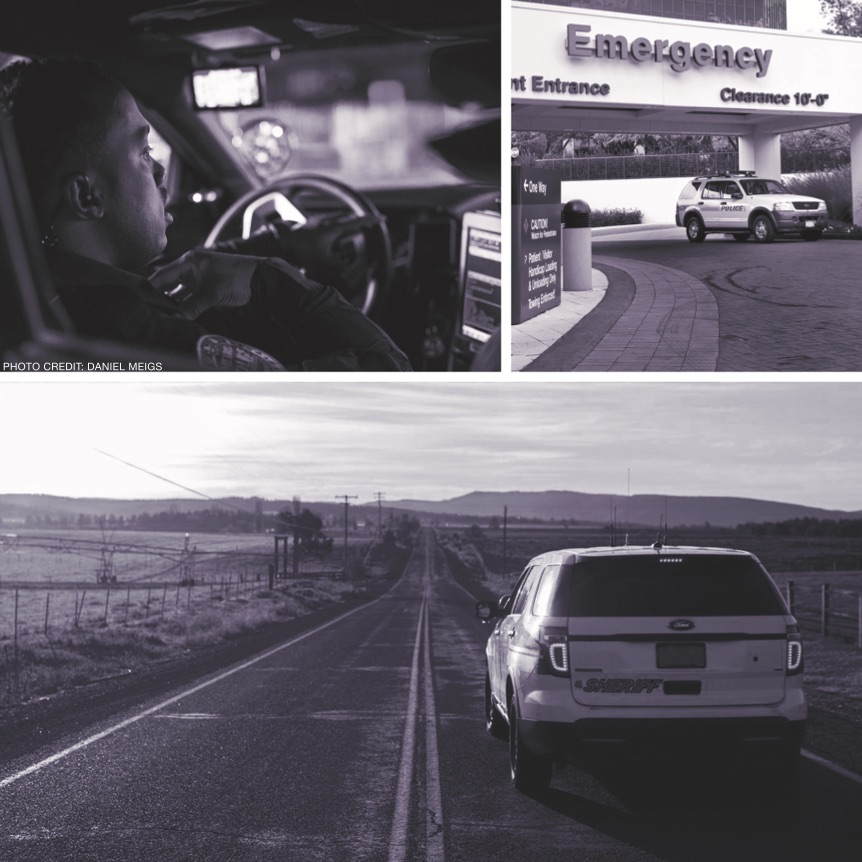
In many jurisdictions, police officers or sheriffs’ deputies are tasked with transporting people with mental illness between treatment facilities, commitment hearings, and sometimes even jail. Not only does this practice criminalize individuals with mental illness who simply need medical care, but it substantially burdens law enforcement. Agencies are forced to devote personnel time and fiscal resources to serve as psychiatric transportation providers, rather than attend to regular duties patrolling their communities.
However, the United States is not the only nation learning to address these challenges. In this special edition of Research Weekly, we explore what other countries are doing to facilitate treatment for individuals with mental illness—while limiting involvement of general law enforcement. We take a brief look at programs in Canada, Australia, the Netherlands, and Sweden.
Canada
Car 87 in Vancouver, Canada is the country’s oldest police mental health crisis response initiative, becoming an official public service in 1987. A partnership between the Vancouver Police Department and Vancouver Coastal Health, Car 87 is one of several specialized police vehicles used in the city. For a given crisis situation, one Vancouver Police constable and a psychiatric nurse will respond to conduct on-site assessments and make necessary treatment referrals. The Car 87 team also help locate and transport individuals at the request of community mental health services. Car 87 offers the benefits of a law enforcement-mental health response, providing expertise in both maintaining public safety and administering psychiatric care.
A similar program operates out of Toronto, where response units are referred to as Mobile Crisis Intervention Teams (MCITs). MCITs are the result of a partnership between the Toronto Police Service and local hospitals that began in 2000. Each team is composed of a specially-trained police officer and a mental health nurse. MCITs may travel to the scene of a crisis along with emergency police officers, or after emergency officers have arrived and determined the scene is safe for MCIT personnel. Similar to Vancouver’s Car 87, MCITs use special police vehicles designated for the mental health crisis intervention. Toronto Police respond to crisis calls that occur outside of MCIT operating hours.
Australia
Across Australia, territories follow a psychiatric crisis response structure known as the Crisis Assessment and Treatment Team (CATT). While units are referred to by different names in different regions (i.e., CATT in Tasmania, “acute care teams” in New South Wales, and the Acute Community Intervention Service in Victoria), they offer similar services to their respective populations. Their mental health-based response teams rely on psychiatric nurses, social workers, psychiatrists, and psychologists, among other mental health practitioners, for the bulk of response duties. The Australian model differs from the Canadian examples described above because no law enforcement officer is involved in the initial response. However, CATTs do work with police, ambulance, and other public services when needed.
Two Australian territories, New South Wales and Western Australia, employ police-based response teams in addition to their versions of CATTs. The Mental Health Intervention Team (MHIT) began as a two-year pilot program in New South Wales in 2007 and became permanent in 2009. The program is a collaborative effort between the police force, health and mental health commission, and other agencies. MHIT police officers undergo specific training and act as first responders to mental health-related calls. Western Australia replicated and implemented the model in 2015.
In an effort to reduce unnecessary police involvement in mental health care, the New South Wales MHIT adopted an updated memorandum of understanding with New South Wales Health in 2018, which requires that an individual detained under the country’s Mental Health Act be transported by ambulance, rather than a police vehicle, unless the individual or public safety is at risk. Police vehicles are considered a last resort.
Netherlands
In the Netherlands, the public mental health department, called Safetynet, relies on staff and resources from mental health agencies, shelters, and addiction and welfare services to provide case management and crisis response to individuals with complex mental health needs. Social psychiatric nurses work with police to provide assessment and initial treatment plans for the individual in crisis. Individuals may then be referred to a central crisis unit where they are assessed by a resident psychiatrist to determine the need for inpatient treatment.
Sweden
A final notable model is Stockholm, Sweden’s Psychiatric Emergency Response Team ambulance. Two mental health nurses and one paramedic operate an unmarked, mental health-specific ambulance that responds to crises spanning potential suicide to episodes of psychosis. The program was specifically implemented to combat the country’s growing suicide epidemic in 2015, and to replace police officers serving as psychiatric crisis responders with medical professionals whenever possible.
- Mitchell, C., & Dorian, E. (2017). Police psychology and its growing impact on modern law enforcement. Hershey, PA, USA: IGI Global.
- Hensen, M. J., et al. (2016, April). Pathways through care of severely mentally ill individuals experiencing multiple public crisis events: a qualitative description. BMC Psychiatry.
- Bouveng, O., et al. (2017, February). First-year follow-up of the Psychiatric Emergency Response Team (PAM) in Stockholm County, Sweden: A descriptive study. International Journal of Mental Health.
- Vancouver Police Department. (2016). Vancouver Police Mental Health Strategy.

Jessica Walthall
Research and Advocacy Associate
Treatment Advocacy Center