
 (Jan. 12, 2016) Two theories have for decades dominated research on the causes of schizophrenia: genetics and neurotransmitters. Over the past two years, a third theory – the infectious/inflammatory theory—has become the first major new addition to schizophrenia study in the last half-century and, with less evidence, to the study of bipolar disorder and depression.
This theory states that infections play an important role in causing schizophrenia, probably in conjunction with predisposing genes or the effects of infectious agents on neurotransmitters.*
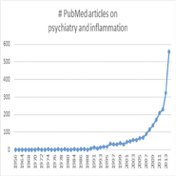
Evidence of the growing focus can be seen in the recent outpouring of professional papers proposing to use anti-infective and anti-inflammatory drugs to treat schizophrenia and bipolar disorder (see figure below). Also indicative is the emergence of infectious/inflammatory theory in mainstream scientific media and books, including Infectious Madness: The Surprising Science of How We “Catch” Mental Illness, by science writer Harriet Washington (Little, Brown, 2015).
Now In Treatment Trials
 The Stanley Medical Research Institute (SMRI), a supporting organization of the Treatment Advocacy Center, has been funding research into the role of infection and inflammation in the causes of and treatment for schizophrenia for more than 20 years. Half of SMRI’s current 52 treatment trials involve the use of anti-infective or anti-inflammatory agents/drugs to alter the immune system. Slightly more than half of its newly funded trials also will be testing anti-infective or anti-inflammatory agents in the treatment of schizophrenia.
An example is Valacyclovir, an antiviral widely used against herpes family viruses. In 2014, a small SMRI trial reported improved cognitive functions of individuals with schizophrenia; a much larger replication trial is in progress using 12 American sites. Treatment trials also are underway utilizing anti-inflammatory drugs (e.g. aspirin) specifically on patients with schizophrenia who have elevated levels of inflammatory markers in their blood (e.g., high C-reactive protein). The aspirin study will be completed in mid-2016.
Meanwhile, the American Journal of Psychiatry in November 2015 published a review of 200 research papers on inflammation and depression that found a similar link. “Depression and inflammation are intertwined, fueling and feeding off each other,” Janice K. Kiecolt-Glaser et al. wrote in the provocatively titled “Inflammation: Depression fans the flames and feasts on the heat.” “This bidirectional loop, in which depression facilitates inflammatory responses and inflammation promotes depression, has clear health consequences.”
Practical Implications
As director of the NIMH in 2012, Dr. Thomas Insel described what he called the “crisis of medication development for mental disorders.”
“There is diminishing activity in research and development for new medications within either the biotech or pharmaceutical industries,” he wrote in “Experimental Medicine.”
“While the development of psychosocial interventions and devices, including the use of mobile technologies, is promising, the absence of a robust development pipeline for more effective medications would be worrisome in any area of medicine and should be a grave concern to the mental health community.” He reported that creating new medications, on average, is a 15-year endeavor that costs more than $2 billion and fails 95% of the time.
In such an environment, the growing focus in psychiatric research on the role of conditions that can be treated with an existing arsenal of proven drugs and medications is one with significant practical implications for individuals who live or work with the most severe mental illnesses.
* Infections as measured by antibodies in the blood; inflammation, as measured by markers such as C-reactive protein and various cytokines.
JOHN M. DAVIS, M.D.
Professor of Psychiatry and Research Professor of Medicine
Department of Psychiatry, University of Illinois at Chicago
Member, Psychiatric Advisory Board of the Treatment Advocacy Center
References:
- Insel, T. (12 June 2012). Director’s Blog: Experimental Medicine. NIMH.
- Kiecolt-Glaser, J.K. et al. (1 November 2015). Inflammation: Depression fans the flames and feasts on the heat. American Journal of Psychiatry.
- Stanley Medical Research Institute Annual Report for 2015 (unpublished).
Next Week: "The National Bill" for Severe Mental Illness
Research Weekly is a summary published as a public service of the Treatment Advocacy Center and does not necessarily reflect the findings or positions of the organization or its staff. Full access to research summarized may require a fee or paid subscription to the publications.
To comment, visit our Facebook page.
Visit our blog archive to read all our recent posts.