

The Pugilist
At 82, Dr. E. Fuller Torrey is still ready to fight the righteous fights
By Emily Kubera
Dr. E Fuller Torrey was livid.
The National Institute of Mental Health (NIMH) had just released its five-year strategic plan in December of last year. In response, Dr. Torrey and the Treatment Advocacy Center wrote a thorough – and devastating -- analysis of how this plan would fail people with severe mental illness.
But Dr. Torrey didn’t stop there. Next, he mobilized the public to submit their own reactions to NIMH’s plan. “Given the fact that the last new psychiatric drug for psychosis was clozapine, which was approved 30 years ago, the time is long past due when the NIMH should undertake an aggressive search for better drugs,” he wrote in Treatment Advocacy Center’s May 2020 Research Roundup.
NIMH had expected only a few hundred responses to its strategic plan. Instead, the federal agency received over 6,000.
NIMH’s current leadership “has no interest in doing anything but basic science, basic research – no interest in clinical research at all,” Dr. Torrey said in an interview, adding that they “need to be reminded on an hourly basis.”
Today, at 82, Dr. Torrey is still up for a good fight, but he only fights the righteous ones.
These days, when he is not actively fighting NIMH, you’ll find Dr. Torrey and his wife Barbara, a former economist and a member of the Treatment Advocacy Center Board of Directors, in their historic home overlooking the Potomac river. Located in a quiet, tree-lined neighborhood in Bethesda, Maryland, the sunlit house and its lush garden offer a stark contrast to the intensity of Torrey’s work and a temporary respite from it.
Though Dr. Torrey’s long career, which includes publishing some 21 books, included many righteous fights, his first fight was perhaps his most personal.
He was studying religion at Princeton University in the 1950s when his younger sister, Rhoda, was diagnosed with schizophrenia. Back then, there was little research on severe mental illness, especially schizophrenia, he explained.
“The main obstacle was the belief that schizophrenia was caused by bad mothering, bad parenting, a lack of understanding of what caused it and generally a lack of interest in the disease,” said Dr. Torrey.
His sister’s illness led directly to Dr. Torrey’s interest in schizophrenia research, but he had always wanted to study the brain. “When I decided to study psychiatry, I decided to do it because the brain seemed like the most interesting part of the body. The rest of the body looked pretty dull, especially the heart and the liver. But the brain looked like Alaska – the frontier. It looked like that’s where things would happen in my lifetime.
“If you wanted to be a well-known psychiatrist, you certainly wouldn’t go into schizophrenia research at that time. It would be considered to be a dead end.”
Dr. Torrey never set out to be a well-known psychiatrist; he just wanted to improve treatment for people with severe mental illness. According to his friend and founding Treatment Advocacy Center board member DJ Jaffe, “Dr. Torrey could have spent his life making hundreds of thousands of dollars doing couch therapy on the Upper West Side for the rich and worried.”
Instead, Dr. Torrey wanted to help the underserved and forgotten population: the seriously mentally ill. That meant taking on the NIMH.
Dr. Torrey’s battle with NIMH began in September of 1970. He started work there as a special administrative assistant, and by his second week he was on the verge of being fired.
He espoused the unpopular belief that because psychiatrists were one of two medical specialties receiving federal funding, they should be obligated to pay back the communities who need the help most. “There was a shortage of psychiatrists in rural and underserved areas,” he explained. “Since psychiatrists were being trained with federal funds, they should have some type of payback obligation, to payback services in high need areas.”
A succession of department heads were in and out of the director’s office during Dr. Torrey’s first year trying to get him fired. Each of them failed, and Dr. Torrey continued his work at NIMH for another five years.
In 1997, he published “Out of the Shadows: Confronting America’s Mental Illness Crisis,” a book that highlighted the underserved communities with severe mental illness that had been failed by our country’s broken mental health care system.
After reaching his book, the late Vada Stanley approached Dr. Torrey, asking him what they could do for people who need treatment for severe mental illness. Together, they concluded that advocacy was necessary to improve access to treatment for people with severe mental illness.
A year later, the Treatment Advocacy Center was born.
Ever since 1998, Torrey and Treatment Advocacy Center’s most consistent adversary has been the NIMH.
The debut issue of Catalyst included an article titled “Refusing to Settle for Pigeon Research,” decrying how the agency funds as many research grants for the study of pigeons as it funds to study the clinical or treatment aspects of manic-depressive illness. It closes by encouraging readers to call their representatives in Congress and tell them “not to let NIMH go to the birds!” 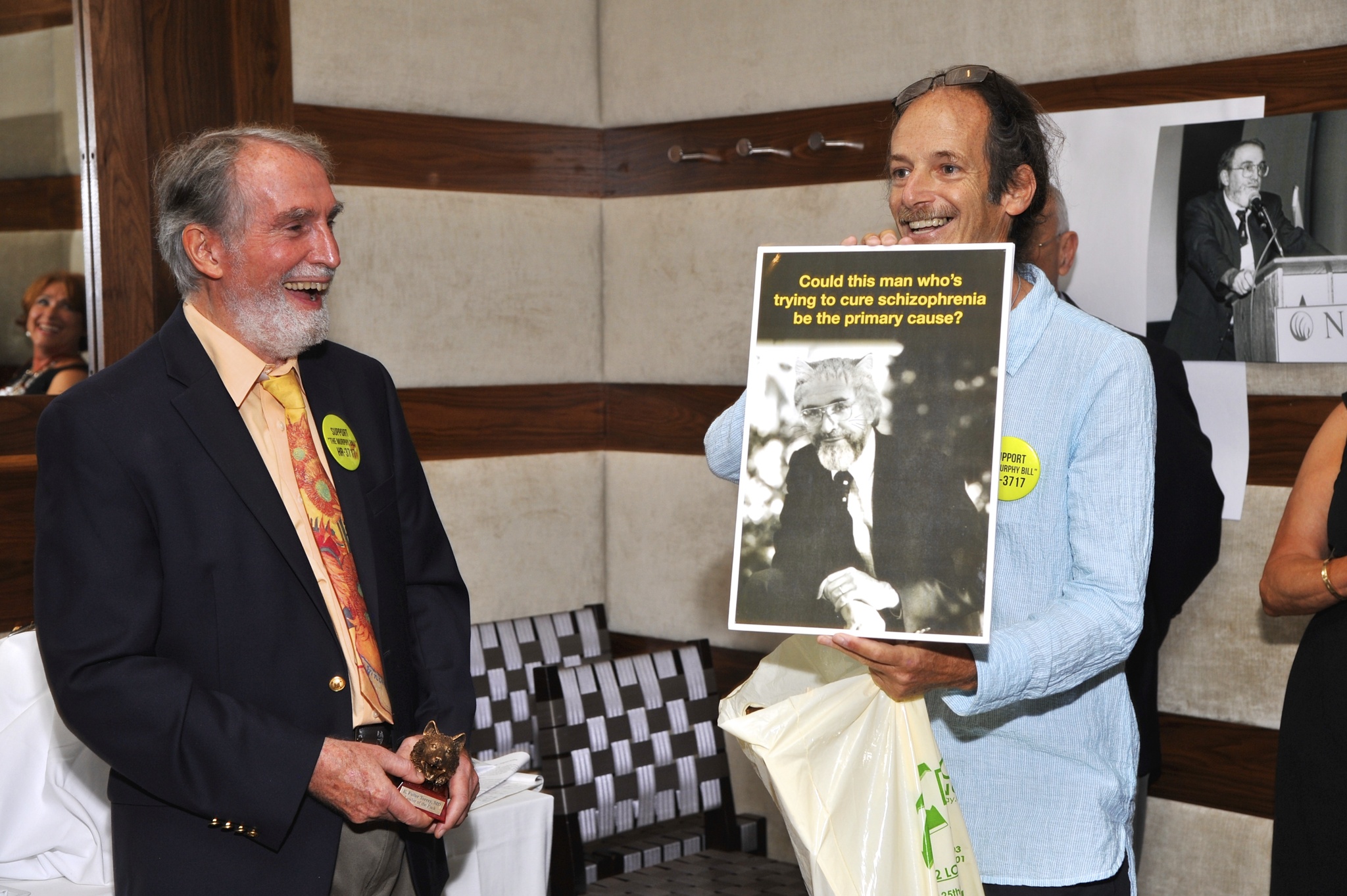
While not everyone has subscribed to Dr. Torrey’s brand of outspoken advocacy, many mental advocates regard him as a mentor and credit him with bringing up the next generation.
While Dr. Torrey was an adviser to the National Alliance on Mental Illness (NAMI), he would bestow a fellow outspoken advocate with an award of his own creation at the group’s annual conference.
Jaffe recalled that Dr. Torrey would take the stage wearing in a lifelike wolf mask. In front of 2,000 mental health advocates, Dr. Torrey would present the “Wolf Award” to an individual who had been shunned for their aggressive advocacy on behalf of those with severe mental illness.
Jaffe, a one-time recipient of the Wolf Award himself, said the award was one of many ways Dr. Torrey has encouraged and motivated outspoken advocates to keep fighting. “You feel happier, more enlightened and more vigilant in his presence,” said Jaffe.
Dr. Torrey may once have felt like a lone wolf in his career, but he is clearly no longer alone.
“It is rare in life to come across an individual who has had such a direct, positive effect on so many lives. He is a beacon of hope guiding us on this most difficult journey,” said fellow advocate Linda Harris Mimms.
“I don’t think I’ve done anything that unusual. I’ve tried to improve the profession; I’ve tried to improve the treatment of people not getting good treatment. When I became a doctor, this is just part of it. So, for me, it’s not a big deal,” said Dr. Torrey. Hearing this, Barbara Torrey interjects. “Not everyone writes over 20 books in their lifetime, Fuller.”
At 82, Dr. Torrey’s scholarly work and criticism of NIMH continue apace. Often the two are inextricably linked.
He recently submitted a paper to the peer-reviewed journal PLOS ONE, co-written with TAC Board President Michael Knable and psychiatrist Dr. A. John Rush, titled “Using the NIH Research, Condition and Disease Categorization Database for research advocacy: Schizophrenia research at NIMH.”
When asked about the prospect of retiring, Dr. Torrey demurs. “That’s nice for some people. What would I do, golf?” No, there’s too much fight left in him to retire.
Sure, his garden is a lovely place to relax. But if you’re Dr. Torrey, it’s also the perfect place to write about the failures of NIMH.
Emily Kubera is the communications and development manager at Treatment Advocacy Center