

(Jan. 24, 2018) Ten years after the passage of the Mental Health Parity and Addiction Equity Act of 2008, the promise of parity has not been realized, and large gaps still exist between mental health and general medical care, according to a pioneering report commissioned by the Bowman Family Foundation and published by Milliman Inc.
| Individuals are paying much higher out-of-pocket costs for mental health care than other medical conditions - Millman Inc. |
In particular, the report found that out-of-network service use is significantly higher for mental health care than general medical care, forcing individuals to pay much higher out-of-pocket costs for mental health care than other medical conditions. The survey also found that psychiatrists are paid considerably lower than medical and surgical physicians for the same or similar services, meaning no incentives exist for psychiatrists to participate in insurance networks. In fact, participation would result in large, likely unsustainable financial losses.
The Milliman report uses data from two large databases to evaluate commercial insurance claims covering more than 42 million individuals in all 50 states and the District of Columbia from 2013-2015. The report examines the proportion of mental health and physical health services received from out-of-network providers instead of those who agree to payments at a discounted rate within an individual’s insurance network. They also analyzed the amount of money paid to providers by insurance agencies for a particular treatment for a comparison of mental health and general medical physician reimbursement rates.
In particular, the report found that out-of-network service use is significantly higher for mental health care than general medical care, forcing individuals to pay much higher out-of-pocket costs for mental health care than other medical conditions. The survey also found that psychiatrists are paid considerably lower than medical and surgical physicians for the same or similar services, meaning no incentives exist for psychiatrists to participate in insurance networks. In fact, participation would result in large, likely unsustainable financial losses.
The Milliman report uses data from two large databases to evaluate commercial insurance claims covering more than 42 million individuals in all 50 states and the District of Columbia from 2013-2015. The report examines the proportion of mental health and physical health services received from out-of-network providers instead of those who agree to payments at a discounted rate within an individual's insurance network. They also analyzed the amount of money paid to providers by insurance agencies for a particular treatment for a comparison of mental health and general medical physician reimbursement rates.
Findings from the Study
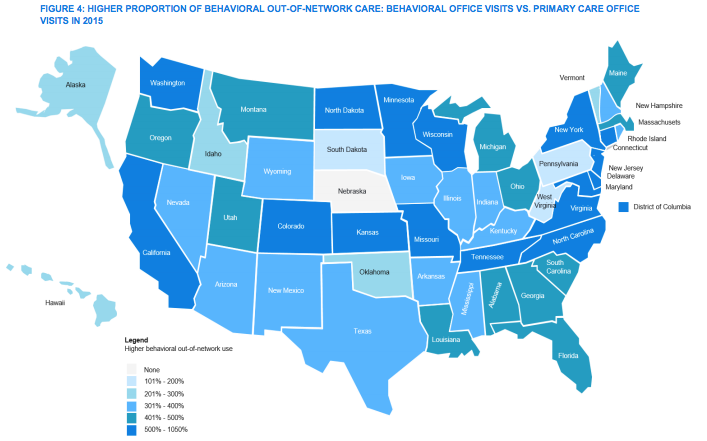 |
| Figure courtesy of Millman Inc. |
The survey found large differences between mental health and general medical care.
Inpatient services received out-of-network were 4.2 times higher in mental health care compared to general medical care. For example, an individual looking for inpatient psychiatric treatment is more than four times more likely to receive care from an out-of-network provider and thus incur anywhere from 40-100% of that treatment's costs.
Outpatient facility services received out-of-network were 5.8 times higher in mental health care than in general medicine. This means an individual in psychiatric crisis looking for crisis emergency services or partial-hospitalization is almost six times more likely to receive such care out-of-network and be charged accordingly.
As National Public Radio reported, "The high proportion of out-of-network behavioral care means patients with mental health or substance abuse problems were far more likely to face the high out-of-pocket costs that can make treatment unaffordable, even for those with insurance." This may mean patients delay seeking needed treatment, potentially never accessing mental health care at all because of the high costs.
The gap between reimbursement rates for providers was even more disparate. Primary care providers were paid 22% more for office visits than mental health care providers, while medical specialty care providers were paid 19% more.
"Together, the findings paint a stark picture of restricted access to affordable and much-needed treatment for mental illness and substance use disorders," writes Mark Moran for Psychiatric News.
Individual states varied widely in both metrics. Nine states, including Massachusetts, Minnesota and New Hampshire, had payments more than 50% higher for primary care providers compared to mental health physicians. Connecticut, Washington and Wisconsin had out-of-network service use almost 10 times higher for that of mental health care than general medical treatments.
The way forward
Henry Harbin, MD, previously the director of a large behavioral health care organization and now a consultant on parity issues, says these results should serve as a wake-up call for all involved.
"We are failing miserably to ensure access to behavioral health treatment," Harbin says. "Insurance companies are making it extremely difficult to get access to in-network care. Imagine an insurance plan offering insurance in a state and saying that 30% of your cancer treatment on average is going to be out-of-network and out of your own pocket. They wouldn't be allowed to write insurance policies like that."
Sadly, this remains the situation with mental health care.
Harbin urges stronger enforcement of existing laws, including a call for federal regulators to immediately audit some of the top insurers.
Ten years after the passage of the Mental Health Parity and Addiction Equity Act of 2008, it is about time.

Elizabeth Sinclair
Research Associate
References:
- Melek, S. P. et al. (December 2017). Addiction and mental health vs. physical health: Analyzing disparities in network use and provider reimbursement rates. Milliman Inc.