

(Oct. 10, 2017) Real-time psychiatric bed registries facilitate timely transfer and admission into an inpatient psychiatric bed, however, the majority of states in the United States do not utilize them, according to a new study.
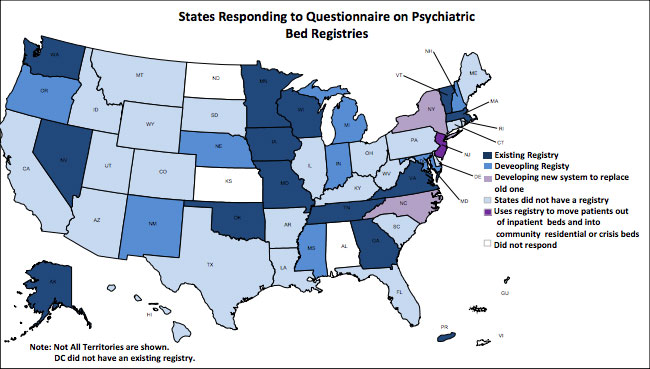
Inpatient psychiatric hospital beds are an important part of the continuum of care for individuals with serious mental illness, but these beds are often unavailable to those that need them. Psychiatric bed registries allow clinicians to locate available beds for individuals in a timely fashion, reducing bottlenecks in the system due to administrative tasks.
A survey of all 50 state behavioral health agencies found that only 16 states have operational bed registries. The survey was conducted by Amanda Wik with the National Association of State Mental Health Program Directors Research Institute, Inc (NRI).
Survey Results
The study found that very few of the states that utilize psychiatric bed registries do so in an effective way. Of the 16 states that have operational psychiatric bed registries,
- 9 states (56%) reported participation in bed registries was voluntary,
- 11 states (69%) reported only updating the registry on a daily or twice-daily basis,
- 4 states (25%) reported only tracking beds in one type of facility.
- 1 state(13%) reported requiring participation in the registry to be mandatory,
- 2 states (25%) reported requiring real-time updates.
Appropriate placement into a psychiatric bed depends on a multitude of factors, including diagnosis, acuity of the patient, age, gender, and symptom severity. This may require clinicians to spend hours making telephone calls to hospitals to identify suitable placements, according to the NRI report.
Inpatient psychiatric care also can be found in a variety of settings, each with different admission and insurance requirements, complicating placement decisions. These include public state hospitals, private psychiatric hospitals and general community hospitals with psychiatric units. In addition, only a small proportion of individuals with serious mental illness require such intensive services and often only require crisis, rehabilitation or respite level of care.
"Community beds such as crisis beds are important to include in registries because they may be able to address the needs of individuals at a lower intensity level of service than placements to inpatient care in general hospitals or private or public psychiatric hospitals," according to Wik.
The 21st Century Cures Act, passed in December of 2016, authorized grants to states to develop psychiatric bed registries with the understanding that these will improve timely access to mental health treatment.
"Registries that can match patient need with the types of available beds have the potential to lead to more efficient use of psychiatric inpatient capacity in states," according to the study.
For more information on types of psychiatric beds, stay tuned for a new Treatment Advocacy Center report that will be released later this month.

Elizabeth Sinclair
Research Associate
References:
- Wik, A. (September 2017). Psychiatric bed registries. National Association of State Mental Health Program Directors Research Institute, Inc.
Follow ORPA on Twitter at @TACResearch.
Research Weekly is a summary published as a public service of the Treatment Advocacy Center and does not necessarily reflect the findings or positions of the organization or its staff. Full access to research summarized may require a fee or paid subscription to the publications.
To comment, please visit our Facebook page.