

(Aug. 22, 2017) Most individuals with serious mental illness want to work, but most of them are not employed. The bridge between employment desire and fulfillment is supported employment, which focuses on matching individuals with significant impairments from psychiatric disease to the best employment fit and providing continuous support during employment.
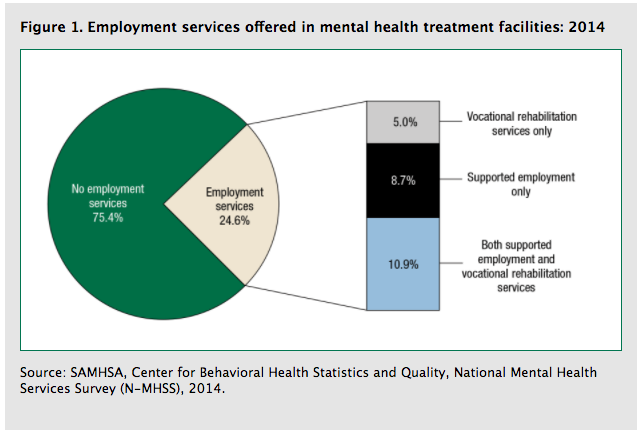 Strong evidence indicates that supported employment benefits participants and their communities, yet programs are scarce, according to a new government report. In 2014, only 2% of adults with serious mental illness had access to supported employment.
Access by Facility Type
The report by Laura J. Sherman and colleagues examined 2014 National Survey on Drug Use and Health data to assess the availability of supported employment at different types of mental health treatment facilities.
The analysis found the majority of mental health treatment facilities in the United States offered neither supported employment nor vocational rehabilitation services. Overall, fewer than 1 in 5 facilities offered either program in 2014.
Access varied significantly by mental health facility type. Supported employment was found at:
- 29.1% of outpatient treatment facilities operated by public agencies or departments
- 19.4% of outpatient treatment facilities operated by non-profits
- 10.3% of outpatient treatment facilities operated for profit
The highest prevalence of supported employment programs was found at federal Veterans Affairs department facilities, where 47.5% offered the services. The lowest rate - 10.0% - was found among religious organizations.
Access was significantly more limited at 24-hour hospital facilities, where 12.4% offered supported employment, than in non-medical residential settings, where the prevalence rate was 23.1%. The authors attributed this to differences in the populations and purpose of hospitals versus residential and outpatient settings.
State Results
The prevalence of supported employment varied significantly by state, from a low of 7.2% in Arkansas to a high of 44.6% in New Hampshire.
In five states besides Arkansas, the program was available from fewer than 1 in 10 of all mental health facilities: Iowa, Louisiana, Nebraska, Oklahoma and Tennessee.
In seven states besides New Hampshire, supported employment was offered by at least one in three mental health facilities: Kentucky, North Dakota, Oregon, Rhode Island, Texas, Vermont and Wyoming.
Nationwide, there were 13,176 mental health facilities in 2014, and 2,586 offered supported employment.
In the three years since the data were collected, grants have been awarded to expand supported employment programs in seven states: Alabama, Connecticut, Illinois, Ohio, Kansas, Utah and Washington. While this may improve access to individuals there, the authors said funding remains a challenge to supported employment development.
The Case for Supported Employment
Previous research reports that two-thirds of individuals with serious mental illness want to work and say that finding work is a top priority. Employment is recognized as a pathway to higher self-esteem, social integration and participation in the community.
Yet unemployment rates are stubbornly high among individuals with serious mental illness and getting higher. Sherman and colleagues reported that employment of people with a diagnosable mental illness with substantial impairment fell from 56% in 2008 to 48.5% in 2013. This came during a period when employment rates in the general population were rising.
Employment rates among individuals receiving public mental health services, the population with the greatest impairments, was lower yet: 17.9% to 39% depending on how the populations were defined.
The authors concluded "there is a clear gap in the availability of an evidence-based practice that can increase and sustain employment among adults with serious mental illness and that can aid in their recovery."

Doris A. Fuller
Chief of Research and Public Affairs
References:
- Sherman, L.J. et al. (June 2017). Availability of supported employment in specialty mental health treatment facilities and facility characteristics: 2014. The CBHSQ Report.
Follow ORPA on Twitter at @TACResearch.
Research Weekly is a summary published as a public service of the Treatment Advocacy Center and does not necessarily reflect the findings or positions of the organization or its staff. Full access to research summarized may require a fee or paid subscription to the publications.
To comment, please visit our Facebook page.