

 (Feb 1, 2017) If the US psychiatric bed supply were a hospital patient, it would be on a critical care unit, possibly even on life support. The Treatment Advocacy Center's newest study proposes a course of treatment to improve the health in at least one aspect.
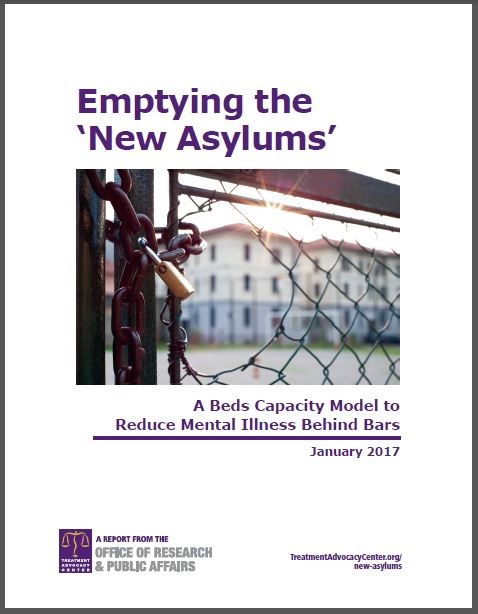
Emptying the 'New Asylums': A Beds Capacity Model for Reducing Mental Illness Behind Bars takes a mathematical approach to the critical shortage of treatment beds for mentally ill inmates who cannot come to trial because they do not meet legal standards of mental competence.
An estimated 90,000 inmates reach jail annually with psychiatric symptoms that render them incompetent to stand trial (IST) without treatment. Many states provide competency evaluation and treatment services in the jails or the community, but state hospitals remain the default option for IST inmates. With fewer than 12 beds per 100,000 people in the United States, there is a shortage of beds to serve all these inmates in a timely fashion. As a result, inmate bed waits are common, and some of those waits are months long. More than a dozen states are already being sued or threatened with legal action over the constitutionality of such waits, during which inmates often receive no treatment and only become more ill.
Small Changes Have Big Impacts
In a search for practical alternatives, the Treatment Advocacy Center contracted with computer modelers at two North Carolina universities to develop a mathematical model for reducing forensic bed waits. What the model found was that, especially where shortages are the most severe, even small changes in a single key variable can dramatically reduce their waits.
Psychiatric beds data from five states was used to project the impact of changing any one of three variables: the number of state hospital beds available for forensic patients, how long state beds are occupied on average, and how many new IST candidates are added to bed wait lists daily. The goal in all cases was to reduce bed waits to either three days or 14 days.
Here are sample findings that illustrate the model's projections.
- Diverting two mentally ill offenders per month from the criminal justice system in Florida reduced the average forensic bed wait in the state by 75%. From an average wait of 12 days in early 2016, the average wait fell to three days.
- Reducing the average length of stay for competency services by less than 2% in Texas - from 189 to 186 days - increased forensic bed capacity sufficiently to reduce bed waits from 61 to 14 days.
- Increasing the number of forensic beds by 11% in Wisconsin - from 70 beds to 78 beds - reduced IST bed waits from 57 days to 14 days.
A Fast Food Analogy
To understand how such small changes could produce such big results, think of arriving at a fast food restaurant with only one cash register open. As each new customer arrives, the line for service gets longer, and the wait for the newest arrivals gets longer. The model developed for Emptying the 'New Asylums' is based on queueing theory that studies waits like these.
Then another register opens. What happens? The line falls by half, and waits are dramatically reduced. The effect is largest when resources - in this case, cash registers - are most limited. If four registers are already open and a fifth one is added, the wait time for the same number of people would be reduced by much less. This is how adding relatively few beds can significantly decrease bed waits.
To examine the effect of another variable, go back to the line and the single register. If it takes the cashier two minutes for each transaction, and there are five people in line, the fifth person will wait 10 minutes to be served. Even shaving 15 seconds off each order, reduces the wait time for the fifth person by about 10%. This is analogous to shortening administrative and other factors that extend hospital stays beyond clinical need.
Finally, imagine that another fast food restaurant opens across the street. As new diners are diverted to it, the lines and waits in the first restaurant drop dramatically, even with only one register open. This illustrates the effect pre-arrest jail diversion can have, even without increasing bed numbers or reducing length of stay.
The model cannot account for human factors, such as unusually fast or slow cashiers, or the customer who arrives with an order for all 18 co-workers in her office.
Emptying the 'New Asylums' closes with eight recommendations and examples of how they could be implemented based on what the model found. To read the full report, visit TreatmentAdvocacyCenter.org/new-asylums.

Doris A. Fuller
Chief of Research and Public Affairs
The American Enterprise Institute will live-stream a program about Emptying the 'New Asylums' on Monday, February 6, from 10 am to 11:45 am Eastern time. Collaborators from the Treatment Advocacy Center and University of North Carolina will describe the study, and 11th District Judicial Court Judge Steve Leifman, Boston Globe Spotlight reporter Mike Rezendes and author Pete Earley will participate. Click here for details or to RSVP.
References:
- Fuller, DA et al. (January 2017). Emptying the 'New Asylums': Beds Capacity Modeling to Reduce Mental Illness Behind Bars. Treatment Advocacy Center.
Follow ORPA on Twitter at @TACResearch.
Next Week: Calculating Individual Risk for Schizophrenia
Research Weekly is a summary published as a public service of the Treatment Advocacy Center and does not necessarily reflect the findings or positions of the organization or its staff. Full access to research summarized may require a fee or paid subscription to the publications.
To comment, please visit our Facebook page.