

(Feb. 23, 2016) We who are patients, caregivers and professionals live on the front lines of mental health progress - or lack of it. We are impacted daily by advances in diagnosis, treatment, services and all the other aspects of living or working with chronic psychiatric diseases. Yet we are more often than not the proverbial "last to know" about new studies and findings about these conditions.
 This gap between evidence and practice too often leaves us woefully underequipped for the life-and-death battles we fight. As a member of the Treatment Advocacy Center team, I am blessed with routine access to brain and behavior research. Nevertheless, I continue to come across information I'd never seen when I was supporting my own daughter's losing war with terminal mental illness.
Researchers are on the front lines, too. At the National Institute of Mental Health (NIMH), in laboratories and at regulatory agencies, researchers theoretically are positioned to be the first to know what reaches end users so many years - sometimes decades - later. Yet they, too, face hurdles to research access - and their challenges make the challenges on our front lines even greater.
Transparency on the Scientific Front Lines
The International Society for CNS Clinical Trials and Methodology (ISCTM) is made up of more than 300 members who focus on diseases of the central nervous system such as schizophrenia, bipolar and other mood disorders, Alzheimer's and Huntington's Disease. At their annual scientific meeting February 16-17 in Washington, D.C., the group devoted an afternoon to issues in data transparency on both their front lines and ours.
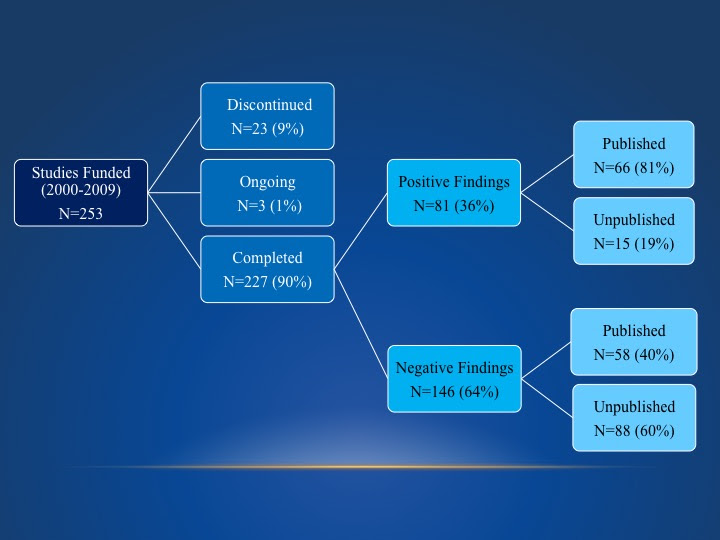
Mark Weiser, chair of the department of psychiatry at Tel Aviv University and associate director for treatment trials for the Stanley Medical Research Institute (SMRI), has been analyzing the publication rates for clinical trials conducted with funding from SMRI, the largest private funder of research into the causes and treatment of schizophrenia and bipolar disorder in the U.S.* Clinical trials test how proposed new treatments work in patients.
Of 253 clinical trials funded by SMRI from 2000 to 2009 and completed, Weiser found, publication rates barely topped 50% per year on average (54.6%). The greatest likelihood of publication was for "positive" studies - those that validated the theory under investigation. Yet most of the completed studies (64%) had "negative" results - meaning the findings did not support the theory being tested - and less than half of those (40%) found publishers (see chart).
"Bad for Everyone"
"This is bad for everyone," Weiser told the audience. "We get up in the morning scratching our heads about how we are going to help patients, and it's very bad if something already has been found not to work, but that information is not available." Unnecessary exposure of patients to study procedures or placebo and wasted funds that might be used for more effective treatments are among the results, he said. The fact that non-publication and positive-finding publication bias are issues in non-psychiatric specialties doesn't make them any less problematic, he said.
Moreover, the results of a majority of even the positive studies (53%) were not reproduced in a subsequent study, a critical benchmark for validity. The average time from the completion of a study to its publication was approximately two years, which meant that even if a treatment had positive findings and a journal accepted it for publication, other scientists - and the public - went on without the benefit of them for an extended time.
Some measures and market developments in recent years have improved access to both positive and negative data for scientists and the rest of us. Those will be the subjects of Transparency on the Public Front Lines - Part 2 on March 8.

Doris A. Fuller
Chief of Research and Public Affairs
* Stanley Medical Research Institute is a supporting organization of the Treatment Advocacy Center.
References:
- Weiser, M. "Improving transparency of clinical trial data." ISCTM 12th Annual Scientific Meeting. The Fairmont, Washington, DC. 16 February 2016. Conference presentation.
Next Week: February Roundup
Research Weekly is a summary published as a public service of the Treatment Advocacy Center and does not necessarily reflect the findings or positions of the organization or its staff. Full access to research summarized may require a fee or paid subscription to the publications.
To comment, visit our Facebook page.
Visit our blog archive to read all our recent posts.