

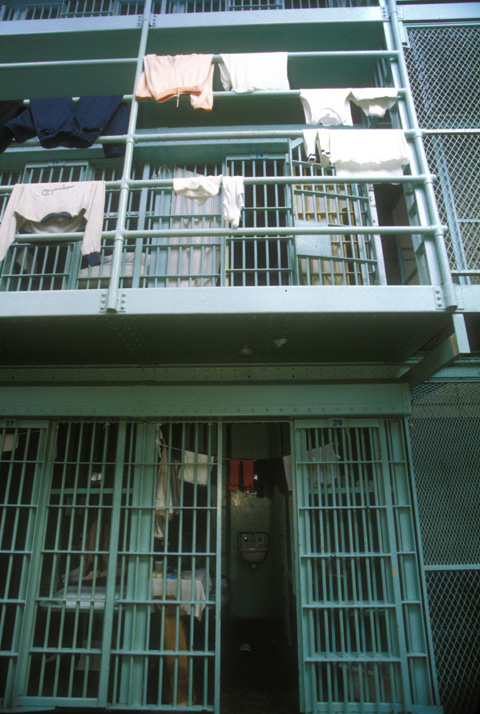
(Nov. 17, 2014) The story of Gregory Seifert represents everything wrong with New York’s mental health system. Last year, while touring the Erie County Holding Center—better known as the Buffalo Jail—I observed him quietly hallucinating in his cell, probably communicating with his superiors at the CIA, where he claimed to work.
 Police had arrested him 14 months earlier for cutting down three wooden power poles with a chainsaw, terminating power to 6,800 homes in suburban Buffalo in the dead of winter. Like most individuals with chronic paranoid schizophrenia, he doubtless had a logical (in his mind) reason for his actions: perhaps his voices told him that cutting off power would prevent a tsunami from Lake Erie from sweeping over Buffalo. When the police questioned him, though, Seifert denied everything. “I know this sounds weird,” he said, “but my cloned twin did it.”
Seifert hadn’t always heard voices. He had graduated from college with a degree in finance, got married, had four children, and held down a good job. But during his thirties, he suffered the onset of paranoid schizophrenia, and, worse, he had no awareness of his illness—a condition called anosognosia, which results from the disease’s effects on the parts of the brain we use to think about ourselves. From there, it was all downhill. As described vividly by Matthew Spina in the Buffalo News, Seifert lost his job and family, became homeless, set fire to his car (he thought it contained devices to spy on him), and was psychiatrically hospitalized for brief periods in community hospitals seven times, including just two weeks before chainsawing the poles. He mostly refused medication. After all, he thought he was fine.
Seifert’s stay in the Buffalo Jail was a difficult experience for him and everyone else there. Because of his illness, he broke jail rules, trashed his cell, and set fire to pillow stuffing that he had jammed into an air vent, which brought additional felony charges of second-degree arson. Yet he would not have been in jail at all if his schizophrenia had received appropriate treatment.
Tragically, his family’s efforts to get him medical help ran up against New York’s laws, which make the involuntary commitment of adults exceedingly difficult. And even if the laws encouraged commitment, finding a place to treat him would have been hard, too. These days, the Buffalo Psychiatric Center, a state hospital originally built to care for more than 3,500 people like Seifert, only has 190 beds, and they’re invariably full. Buffalo Psychiatric is architecturally a National Historic Landmark, its sandstone Gothic towers once standing as a symbol of the state’s enlightened protection of the sickest patients; they’re now a symbol of the state’s terrible neglect of such patients. Over the last several decades, New York State has downsized not just the Buffalo center but all of its state mental hospitals, which went from having 96,664 beds in 1955 to just 3,300 today—and the number keeps dropping. When the mentally ill do manage to get care, it’s often in the psychiatric units of community hospitals, where federal Medicaid and Medicare cover most of the costs, saving the state money—an incentive to further reductions. Claims that the seriously mentally ill get better care in community hospitals are nonsensical. Most such hospitals aren’t set up to look after the most difficult patients and tend to discharge them as quickly as they can.
The state’s abandonment of Seifert and similarly sick individuals leads to immeasurable human tragedies and very measurable social costs. Once a leader in public psychiatric services, New York State now shows how not to treat the mentally ill.
Dr. E. Fuller Torrey
Dr. Torrey is a founder of the Treatment Advocacy Center and executive director of the Stanley Medical Research Institute
Read the entire piece in the New York City Journal
To comment, visit our Facebook page.
Visit our blog archive to read all our recent posts.