
(May 31, 2016) In 1939, a psychiatrist and mathematician named Lionel Penrose looked at the relationship between prison and mental health populations in 18 European nations. He arrived at a startling and controversial observation about "mental disease and crime": if mental hospital populations are reduced, prison populations grow.
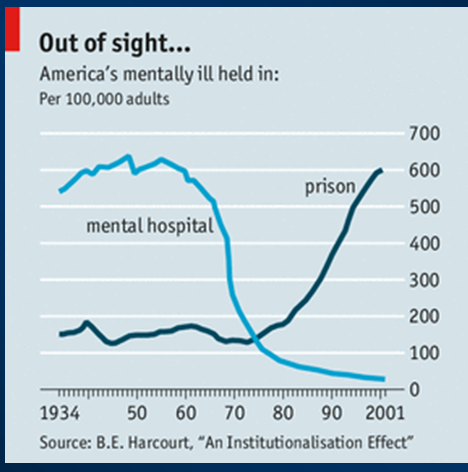 In 2016, we view the "Penrose hypothesis" across the 50-year social experiment known as "deinstitutionalization." Of the nearly 560,000 state hospital beds that existed at their peak in 1955, fewer than 40,000 remain today. At the same time, about 1.8 million jail bookings per year involve individuals with mental illness, and an estimated 350,000 adults with serious mental illness are currently living behind bars, at least 30,000 of them in solitary confinement.
The United States manages to incarcerate more mentally ill adults per 100,000 people than other high-income countries incarcerate, period. Presumably, Lionel Penrose would feel vindicated, albeit without any satisfaction.
A New Look at Trends and Consequences of Closing State Hospital Beds
The criminalization of mental illness is widely regarded as among the most widespread and devastating impacts of the half-century effort to eliminate state hospital beds, yet the Penrose hypothesis remains controversial and under study.
Into this crossfire, the Treatment Advocacy Center tomorrow releases its latest and arguably most dire report on the status of last-resort hospital beds in the United States. Combining original data collection with statistics developed for the federal government, the study will document, state by state, how America's state psychiatric hospitals are being repurposed as the clinical wings of the nation's jails and prisons, and the price this is exacting on the prisoners, corrections systems and communities.
The study, entitled Going, Going, Gone: Trends and Consequences of Closing State Hospital Beds, 2016, does not take up the debate over the Penrose hypothesis. Instead, it comes from the perspective that, for the men and women living with serious mental illness behind bars - typically without treatment - and for the family members and others who advocate on their behalves, the Penrose hypothesis is academic.
What matters in 2016 is that those in need are many, the beds for them are few and the consequences of trading hospital beds for jail beds can be deadly.
Visit our website tomorrow to read Going, Going, Gone.

Doris A. Fuller
Chief of Research and Public Affairs
References:
- Mind M, AP, et al. (3 December, 2014, online). Psychiatric hospital beds and prison populations in South American since 1990: Does the Penrose hypothesis apply? JAMA Psychiatry.
- Lamb, HR. (3 December, 2014). Does deinstitutionalization cause criminalization: The Penrose hypothesis. JAMA Psychiatry.
Next week: Behind Going, Going, Gone
Research Weekly is a summary published as a public service of the Treatment Advocacy Center and does not necessarily reflect the findings or positions of the organization or its staff. Full access to research summarized may require a fee or paid subscription to the publications.
To comment, visit our Facebook page.
Visit our blog archive to read all our recent posts.